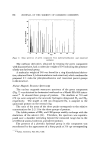
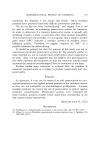
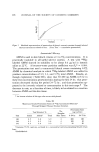
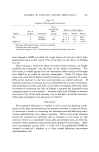
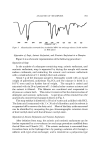
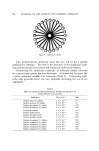
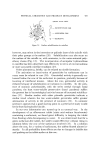
892 JOURNAL OF THE SOCIETY OF COSMETIC CHEMISTS omission of some steps. The well-known cationic-anionic two-phase titra- tion, also known as the Epton-Barr titration (23, 24) method, is one way to do this. Separation of Cellulosic Materials Many shampoos contain cellulosic materials as thickening agents. Newburger (19) suggested using ethanol to precipitate water-soluble gums and then preparing a dried film on which the ir spectrum is run with the aid of water-repellent glass plates. The present authors found that in many cases some water must be re- moved from the sample in order to precipitate the cellulosic materials with ethanol. The coagulated cellulosic material can be removed by filtering through glass wool and purified by washing with fresh ethanol. To pre- pare the cellulosic material for recording its ir spectrum, it is preferable to make a viscous solution of it with water, deposit a thin film on a silver chloride optical window, and dry in a 105 øC oven. Separation of Alkanolamide from a Shampoo Containing lPropylene Glycol, Soap, and a Sulfated Detergent It was found that an alkanolamide can be isolated from a shampoo containing propylene glycol, soap, and a sulfated detergent by passing a solution of it through a cationic-anionic mixed bed ion exchange column such as Amberlite* MB-I. Propylene glycol is retained along with the ionic materials. Alkanolamide is recovered by passing ethanol through the column. In practice, a 2.4-cm i.d. glass column is packed with 50 ml of Amber- lite MB-I resin, 20-50 mesh, and is back-flushed with distilled water to obtain a good packing. A 2-g sample (preferably containing less than 2 meq of total anionic surfactant and soap) is dissolved in about 20 ml of water and passed through the column at 2 ml/min. After the column is rinsed with water (it was noted that very little alkanolamide was eluted with water alone), 200 ml of ethanol is passed through the column at about 4 ml/min, collecting all the effluent. After back-flushing of the resin in the column with just enough ethanol to get rid of the bubbles (without overflowing the ethanol), another 200 ml of ethanol is passed through the column, collected, and combined with the first effluent. To recover the alkanolamide, solvent is evaporated off. Figure 3 is the ir spectrum of an alkanolamide recovered by this procedure. * Rohm and Haas Go., Philadelphia, Pa.

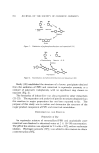
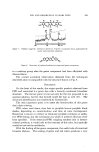
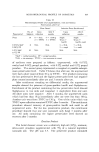
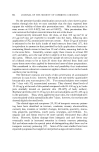
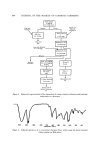
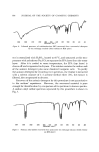
ANALYSIS OF SHAMPOOS 893 3500 3000 2500 2000 1800 1600 1400 1200 1000 80C 600 FREQUENCY (CM 4) Figure 3. Alkanolamide recovered from Amberlite MB-1 ion exchange column (dried residue on KBr plate) Separation of Soap, Artionic Surfactant, and Nonionic Surfactant in a Shampoo Figure 4 is a schematic representation of the following procedure: Separation of Soap In the analysis of a shampoo containing soap, artionic surfactant, and nonionic surfactant, soap is separated by drying the sample with excess sodium carbonate, and extracting the artionic and nonionic surfactants with a mixed solvent of 1: 1 diethyl ether and acetone. About 5 g of the shampoo sample is thoroughly mixed with an equal weight of pulverized, anhydrous Na2COa and the mixture is dried in a 105 øC oven until no further loss of weight. The sample is cooled and extracted with six 20-ml portions of 1: 1 diethyl ether-acetone mixture and the extract is filtered. The flitrates are combined and evaporated to dryness on a steam bath. This extract is reserved for the determination of detergent and nonionic surfactants. A spectrum of this residue from the analysis of a commercial shampoo is shown in Fig. 5. The soap residue is dissolved in 50 ml of water and acidified with HC1. The fatty acid is extracted with 3 X 30 ml of chloroform and the solvent is evaporated off to recover the fatty acid. Most of the fatty acids recovered can be identified by comparing the gas chromatographic retention times of their methyl esters with that of known methyl esters. Separation of Artionic Surf actants and Nonionic Surf actants After isolation from soap, the artionic and nonionic surfactants can be further separated by a two-column ion exchange procedure modified from that of Ginn and Church (33). The artionic surfactant is converted from its sodium form to the hydrogen form by passing a solution of it through a sulfonic acid-type of ion exchanger, and is retained on a polyamine-type
Purchased for the exclusive use of nofirst nolast (unknown)
From: SCC Media Library & Resource Center (library.scconline.org)