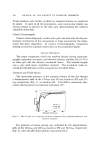
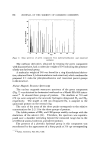
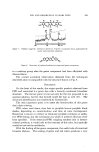
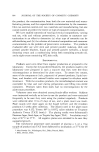
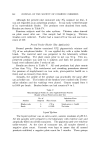
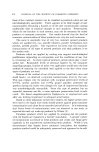
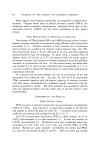
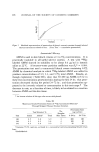
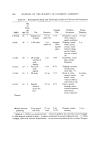
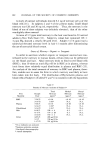
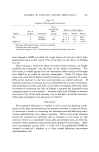
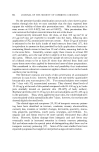
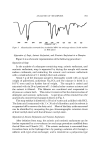
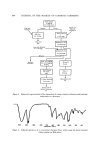
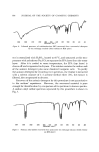
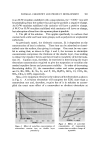
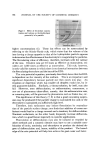
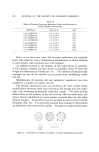
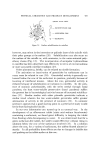
896 JOURNAL OF THE SOCIETY OF COSMETIC CHEMISTS 3500 3000 2500 2000 1800 1600 ]4oo 7200 1000 80o GO 4oo FREQUENCY (CM -•) Figure 6. Infrared spectrum of triethanolamine. HC1 recovered from commercial shampoo by ion exchange method (dried residue on KBr plate) ent is neutralized with H2SO4, heated to 60 øC, and saturated at this tem- perature with anhydrous Na2COa to separate the IPA layer from the water layer. After it is cooled to room temperature, the IPA (top layer) is drawn off and evaporated to dryness. The residue contains the sodium salt of the anionic detergent plus some dissolved inorganic salts. To purify the anionic detergent for recording its ir spectrum, the residue is extracted with a solvent mixture of 1:1 acetone-diethyl ether (34), the extract is filtered, then evaporated to dryness. Recovery of the anionic detergent by this procedure is not quantitative in the authors' experience. However, the recovered material is pure enough for identification by comparison of its spectrum to known spectra. A sodium alkyl sulfate spectrum separated by this procedure is shown in Fig. 7. 3500 3000 2500 2000 1800 1600 1400 1200 1 0oO 800 600 400 FREQUENCY (CM -I) Figure 7. Sodium alkyl sulfate recovered from polyamine ion exchange column (dried residue on KBr plate)

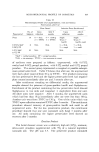
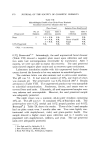
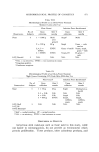
ANALYSIS OF SHAMPOOS 897 SUMMARY A comprehensive literature survey of methods for the analysis of sham- poos has been presented. A proposed scheme of analysis for complex modern shampoos using a combination of solvent extraction, ion exchange separation, and infrared spectroscopy is presented. (Received February 2, 1972) REFERENCES (1) Schwartz, A.M., and Perry, J. W., Surface Active Agents: Their Chemistry and Technology, Vol. I, Interscience Publishers, Inc., New York, 1949, p. 444. (2) Schwartz, A.M., Perry, J. W., and Berch, Julian, Surface Active Agents and Detergents, Vol. II, Interscience Publishers, Inc., New York, 1958, p. 621. (3) Behrman, H. T., The Scalp in Health and Disease, The C. V. Mosby Co., St. Louis, Mo., 1952, pp. 125-9. (4) Schwartz, A.M., Perry, J. W., and Berch, Julian, Ibid., pp. 323, 334 if. (5) Rosen, M. J., and Goldsmith, H. A., Systematic Analysis of Surface Active Agents, Interscience Publishers, Inc., New York, 1960, p. 238 if. (6) Smith, W. B., The analysis of synthetic detergents, d. Soc. Cosmet. Chem., 14• 513-27 (1963). (7) van der Hoeve, J. A., Analysis of textile auxiliary products, J. Soc. Dyers Colour., 70• 145- 54 (1954). (8) Drewry, J., Quantitative examination of detergents by paper chromatography, Analyst, 88, 225-31 (1963). (9) Rosenberger, G. A., The rapid analysis of shampoo powders containing soap, Seifensieder- Ztg., 65, 118-20 (1938) Chem. Abstr., 32, 3649 (3), (1938). (10) Ram, S., Analysis of washing powders containing sulfates and sulfonates, Analyst, 67• 162 (1942) Chem. Abstr., 36, 5581 (2), (1942). (11) Parisot, Andre, Rapid industrial analysis of soap and soap-like products, Olearia, 3• 13-20 (1949) Chem. Abstr., 44, 2263 (c) (1949). (12) Newburger, S. H., The analysis of shampoos, J. Ass. Oj•Sc. Agr. Chem., 41,664-8 (1958). (13) Bush, S. J., Chemical analysis in the cosmetic industry, J. Soc. Cosmet. Chem., 10• 258-71 (1959). (14) Neu, G. E., Techniques of foam measurement, Ibid., 11,390-414 (1960). (15) Mapstone, G. E., The determination of water in shampoos by distillation, Ibid., 12• 397- 400 (1961). (16) Sallee, E. M., Ed., Oj•Scial and Tentative Methods of the American Oil Chemists' Society, AOCS, Chicago, Ill., 1970, Method Fla-44. (17) Oriol Pascual, D. J., Problems encountered in determining the viscosity of shampoos• Parrum. Cosmet. Sayohs, 9, 171-8 (1966) Chem. Abstr., 65, 8662 (h), (1966). (18) Benk, E., and Treiber, H., Identifying phosphoric acid emulsifiers in shampoos containing egg products, Riechst., Aromen, Koerperpflegem., 16• 306-8, 310 (1966) Chem. Abstr., 66• 13997 (t), (1967). (19) Newburger, S. H., A Manual of Cosmetic Analysis, Association of Official Agricultural Chemists, Washington, D.C., 1962, pp. 36-43 (20) Puttnam, N. A., Lee, S., and Baxter, B. H., Application of attenuated total reflectance infrared spectroscopy to toilet articles and household products. I. Qualitative analysis, J. Soc. Cosmet. Chem., 16, 607-15 (1965).
Purchased for the exclusive use of nofirst nolast (unknown)
From: SCC Media Library & Resource Center (library.scconline.org)