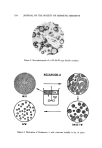
J. Soc. Cosmet. Chem., 26, 121-139 (March 1975) Effects of Phase Inversion and $urfactant Location on the Formation of OIW Emulsions T. J. LIN, Ph.D.,* HARUKI KURIHARA, B. S.,* and HIDEAKI OHTA, B.S.* Presented August 26-30, 1974, 8th IFSCC Congress, London Synopsis-Placing of the SURFACTANT in the oil phase prior to emulsification general]y produces a finer O/W EMULSION than the emulsion, with the same composition, pre- pared by initially placing the surfactant in the aqueous phase. To investigate the basic mechanisms responsible for the difference, a series of emulsions stabilized with various nonionic surfactants and oils were studied by using various preparative methods. Micro- scopic examination of the emulsion DROPLETS and surfactant MIGRATION STUDIES support a theory that when a hydrophilic surfactant is initially placed in the oil phase, a portion of the aqueous phase added during the emulsification process is solubilized or emulsified into the oil phase to form a W/O primary emulsion. This primary emulsion eventually inverts to form an O/W final emulsion as the surfactant migrates to the aqueous phase. A short-lived double emulsion of (W/O)/W type may be formed in the process of the PHASE INVERSION. INTRODUCTION One of the maior problems constantly faced by cosmetic chemists who are in charge of manufacturing emulsion products is the maintenance of batch-to- batch consistency. Often, without apparent reasons, a batch or two may turn too thick, too thin, or unstable. Checking of the weighing errors and raw material qualities may yield no clue as to the real cause. Frequently, the source of the problem lies in the unintentionally introduced process variables which are often very difficult to pinpoint. Although it has been known that variables such as mixing speed, tempera- ture, method of adding one phase to the other, etc., can cause marked effects on the physical characteristics of the finished emulsions, the precise manners by which these variables influence the emulsions are not well understood. *Consultant, 628 Enchanted Way, Pacific Palisades, Calif. 90272. ?Takasago Perfumery Co., Ltd., Tokyo Central P.O. Box 1033, Tokyo, Japan.

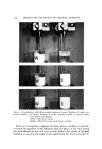
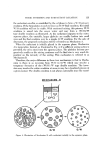
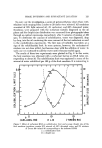
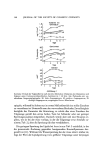
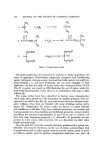
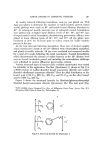
122 JOUBNAL OF THE SOCIETY OF COSMETIC CHEMISTS Figure 1. Emulsification with different initial surfactant location. Emulsion O (right), sur- factant initially in oil phase Emulsion W (left), surfactant initially in aqueous phase Top. Before emulsification Center. After 60-sec mixing Bottom. After 2-hour mixing and ¾z-hour standing From our investigation, it appears that many process variables can promote or retard the migration of the surfactant from one phase to the other during the emulsification process and consequently influence the quality of the final emulsion. In our previous works, it was reported that the initial surfactant lo.
Purchased for the exclusive use of nofirst nolast (unknown)
From: SCC Media Library & Resource Center (library.scconline.org)