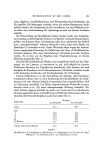
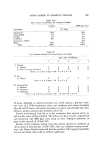
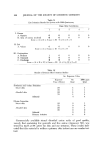
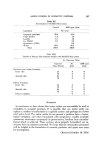
MICROORGANISMS IN THE ORBITAL AREA 171 DISCUSSION We have reported two case histories in which large numbers of potential pathogens were recovered from the face and orbital area with no detectable ocular infection. Kuehne et al. (3) report an instance where the mascara of a women with a eorneal ulcer caused by Fusarium solani contained the same fungus. The implication was that the mascara was the source of the fungus. Neither the time elapsed between consumer use and mierobiaI testing of the mascara, nor the number of fungi per gram of product was reported. Immediately after subject 20 used her eye shadow, S. aureus was recovered from the product. Forty-eight hours later the organisms oould not be recov- ered by plate count or enrichment which indicated the preservative system was bactericidal. If this subieet had ocular infection, and her eye cosmetics were sampled [mmediately after use, it might be interpreted that her eye make-up was the cause of the infection. Actually, the subjeet's ear infection was the source of the Staphtfiococcus population of her orbital area. Subsequent addition of these organisms to the orbital area from her cosmetics may not have been more sign:fieant and possibly less hazardous than rubbing her eyes with a finger. Pseudomonads have been implieated in corneal infections (4, 5). The eye area of subject 22 eonta•,ned thousands of these organisms per in s. A eorneaI abrasion could have occurred from a tweezer, a cosmetic applicator, or a fin- gernail, possibly resulting in an infection. If subject 22 scratched her eye with a cosmetic apvlieator allowing entry of P. aeruginosa already present on the orb•_tal area, the cosmetic manufacturer may have been implicated, particu- larly if the organism was found in the cosmetic, even in low numbers. Eve cosmetics should have adequate preservative systems to prevent prolif- era*ion of m eroorganisms which are transferred from the eye area to the cos- metic during use. The microbial content of used eye cosmetics has been re- ported (2, 5-10). We have shown (7, 9) that eve cosmetics collected from users in Los Angeles were of good microbial quality. However, low numbers of microorganisms in an eye cosmetic may not be significant because of the small amount applied. The CTFA recommended microbiological limits (11) for eye cosmetics is 500 microorganisms per gram of product. Microorganisms should not proliferate in an adequately preserved product beyond this mi- erob:al limit density (8, 9). An eye liner with the microbial load of 500 per gram, would transfer 2 microorganisms per applicator to the eyelid (9). The natural flora of the eyelid far exceeds this number. From 1952 to 196S, Loeateher-Khorazo and Gutierrez (12) determined the bacterial flora of noninfected eyes of 10,271 individuals I to 90 years of age. Staphylococcus aureus was found on the eyelid margins and eonjunetivas of triore than 30% of the subjects. Other pathogens recovered included Esche- richia coli and several species of Klebsiella and Proteus.

172 JOURNAL OF THE SOCIETY OF COSMETIC CHEMISTS On the basis of the findings reported here, we suggest that in future cases of ocular infections the source of the pathogens be fully investigated. In con- junction with testing the subject's cosmetics, the investigator should consider swabbing areas of the face, hands, forehead, cheeks, and particularly the ex- ternal auditory canal. CONCLUSION We have shown that the presence of pathogens around the orbital eye area may be related to chronic ear infections. We have also shown (9) that if an eye product is adequately preserved, these organisms will not proliferate. (Received September 16, 1974) REFERENCES (1) J. F. McConville and D. W. Anderson, Jr., Aerobic microflora of the human outer eye area of women of Los Angeles, California, J. Soc. Cosmet. Chern, 26, 83-91 (1975). (2) L. A. Wilson, J. W. Kuehne, S.W. Hall, and D. G. Ahearn, Microbial contamination in ocular cosmetics, Arner. J. Ophthalmol., 17, 1298-1302 (1971). (3) J. W. Kuehne, D. G. Ahearn, and L. A. Wilson, Incidence and characterization of fungi in eye cosmetics, Develop. Ind. Microbiol., 12, 173-7 (1971). (4) F. L. Gi]ardi, Infrequently encountered pseudomonas species causing infection in humans, Ann. lntern. Med., 77, 211-5 (1972). (5) F. N. Marzulli, J. Evans, and P. Yoder, Induced pseudomonas keratitis as related to cosmetics, J. Soc. Cosmet. Chern., 23, 89-97 (1972). (6) G. E. Myers and F. M. Pasutto, Microbial contamination of cosmetics and toiletries, Can. J. Pharrn. Sci., 8, 19-23 (1973). (7) D. W. Anderson, Jr., and M. Ayers, Microbiological profile of selected cosmetics with and without preservatives after use, J. Soc. Cosmet. Chern., 23, 863-73 (1972). (8) D. W. Anderson, Jr., J. F. McConville, and C. B. Anger, Microbiological profile of used eye cosmetics by examination of product only, Cosmet. Per[urn., 88, 25-7 (August 1973). (9) D. W. Anderson, Jr., J. F. McConville, and C. B. Anger, Some comments on the microbiological profile of used automatic eye cosmetics by examination of both applicator and product, Ibid., 88, 29-30 (1973). (10) D. G. Ahearn, et al., Microbial growth in eye cosmetics during use, Develop. Ind. Microbiol., 15, 211-6 (August 1974). (11) S. Tenenbaum, Microbiological limit guide lines for cosmetics and toiletries, CTFA Cosmet. J., 4, 25-31 (1972). (12) D. Locatcher-Khorazo, and E. Gutierrez, The bacterial flora of the healthy eye, in D. Locatcher-Khorazo and B. Seegal, Microbiology o[ the eye, The C. V. Mosley Company, Saint Louis, Mo., 1973, pp. 13-23.
Purchased for the exclusive use of nofirst nolast (unknown)
From: SCC Media Library & Resource Center (library.scconline.org)