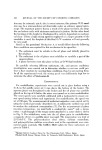
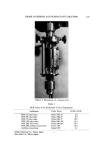
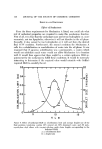
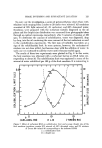
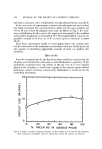
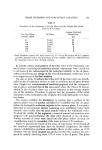
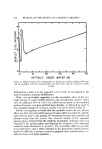
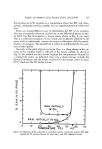
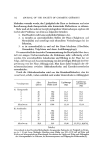
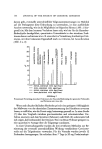
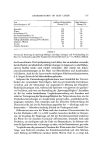
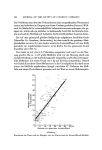
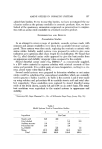
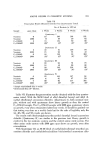
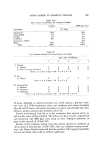
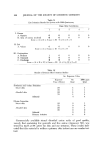
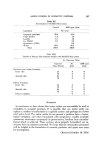
PHASE INVERSION AND SURFACTANT LOCATION Table II Dissolution of the Surfactant in the Oil Phase and the Droplet Size of the Final O/W Emulsion 133 Average Emulsiona Per Cent Water Oil Phase Droplet Size Initially Added 0 Turbid 50 0.4 Turbid 50 0.6 Turbid 50 0.8 Clear 2 0.9 Clear 2 1.0 Clear 2 Final emulsions contain 30% light mineral oil, 5% Tween 80-Arlacel 80 (4:1) mixture, and 65% aleionized water. The percentage of water initially added was substrated from the remaining water to form the final emulsion. By initially adding small portions of the total water in the formulation into the oil phase containing the surfactant mixture, experiments were carried out to determine if the enhancement of the surfactant solubility in the oil phase, without introducing any change in the over-all formulation, would also resuit in an improvement of the final emulsion. The data in Table II indicate that when 0.8% of the total water was initially added to the oil-surfactant mixture to make an emulsion, the oil phase became clear. Droplet size measurements of emulsions prepared with the correspond- ing oil phases indicated that at the same point where the Tween 80 became soluble in the oil phase, there was a great reduction in the average droplet size of the emulsion. Therefore, it appears that the promotion of the initial dissolution of the surfactant in the oil phase does help Mechanism A to func- tion better. The second condition for Mechanism A requires that a portion of the aqueous phase must be quickly solubilized or emulsified into the oil phase before the hydrophilic surfactant migrates to the aqueous phase. It was postu- lated that an oil-surfactant mixture containing some solubilized water might emulsify more readily than the same mixture without the solubilized' water. To check the validity of this argument, a series of mineral oil emulsiops were prepared with polyoxyethylene (6) oleyl ether dissolved in the oil phase. Various amounts of water were mixed into this phase before carrying out emulsification using the remainder of the water to form O/W emulsions. Figure 11 presents the results of this series of experiments. Even though all the emulsions represented here have an identical composition, the, initial aqueous solubilization produces remarkable effects. In this system, an O/W emulsion with the finest droplets was produced when the emulsiou was pre- pared by initially dissolving about 1.5% of water in the oil phase. This point,

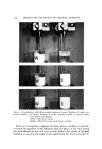
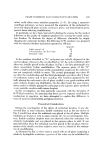
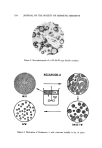
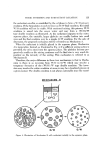
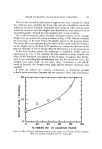
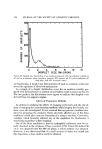
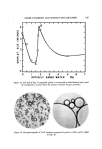
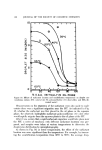
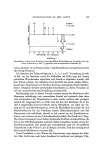
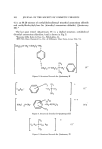
134 JOURNAL OF THE SOCIETY OF COSMETIC CHEMISTS 4 z o n,- •3 ILl [ [ I I I I I I I 0 I I I I I •,1 ..,! I I . 0 I0 20 $0 40 50 INITIALLY ADDED WATER (%) Figure 11. Effect of initial water solubilization on droplet size of final emulsion (30% min- eral oil emulsified with 5% polyoxyethylene (6) oleyl ether with the surfactant initially in oil) • indicated by a letter A in the expanded curve in Fig. 12 corresponds to the point of maximum aqueous solubilization. What was particularly surprising was the remarkable effect of the very small amount of water initially placed in the oil-surfactant mixture. When only an additional 0.3% of water was added beyond point A, the emulsion produced became very poor and had large droplets, as indicated by point B. The microphotographs of emulsions at point A and B are shown in Fig. 13. Further investigation revealed that the probable reason for the adverse effect was that when the initial amount of water added exceeded the solubili- zation limit at point A, the primary W/O emulsion became quite unstable and released water from the system. The chemical analysis of the separated aqueous phase indicated that the relatively hydrophilic surfactant used soon migrated to the aqueous phase and deprived the oil phase of the surfactant needed to make Mechanism A operative. The remarkable effect on an emul- sion produced by such a minor variation in the preparative method demon- strates the difficulty in trying to control or pinpoint some manufacturing var!- ables in a large-scale plant operation.
Purchased for the exclusive use of nofirst nolast (unknown)
From: SCC Media Library & Resource Center (library.scconline.org)