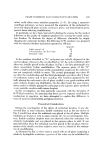
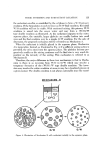
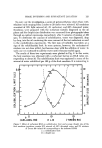
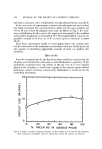
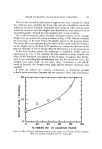
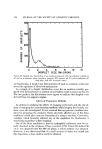
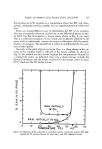
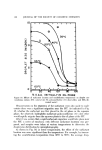
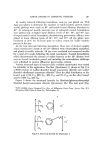
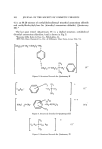
J. Soc. Cosmet. Chem., 26, 155-168 (March 1975) Utility of Amine Oxides in OilIWater Cosmetic Systems BURT LIKE, B.A., RALPH SORRENTINO, B.S., and ALFONSO PETROCCI, M.S.* Presented May 9, 1974, Seminar, Chicago, Illinois SYNOPSIS--The use of AMINE OXIDES as EMULSIFIERS for OIL-IN-WATER COS- METIC SYSTEMS is investigated. Various typical cosmetic systems are described in which amine oxides are used in place of conventional nonionic and anionic emulsifiers. The amine oxide emulsified systems were successfully PRESERVED from microbiological contamination by using readily available, inexpensive quaternary ammonium compounds. These preserved systems were then tested for SKIN and EYE IRRITATION and found to be nonirritating. INTRODUCTION The cosmetic industry today uses many emulsifiers in the production of creams, lotions, and specialty products. These emulsifiers cover just about every class of surfactant. There are nonionics, examples of which would be glycerol or glycol fatty acid esters, and ethylene oxide condensates of alcohols or fatty acids anionics such as amine soaps of fatty acids or fatty alcohol sul- fates and, to a lesser extent, cationics of the quaternary ammonium halide type, and the amphoterics. It is the object of this paper to show that another class of surfactants, amine oxides, have utility and inherent advantages in their use. Amine oxides are prepared generally by the reaction of a tertiary amine with hydrogen peroxide under controlled conditions. Figure 1 shows the gen- eral reaction with three typically used tertiary amines. Here alkyl dimethyl amine, alkyl amido propyl dimethyl amine, and alkyl his hydroexthyl amine are illustrated as examples of amines reacted with hydrogen peroxide to give the oxide. Other amines (alkyl morpholine, for example) are also converted to the oxide and sold commercially. *Onyx Chemical Co., Div. of Millmaster Onyx Corp., 190 Warren St., Jersey City, N.J. 07302. 155

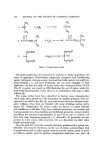
156 JOURNAL OF THE SOCIETY OF COSMETIC CHEMISTS •3 •H3 R•N + H202 • R-N-• 0 CH 3 CH 3 o H •H 3 2. R-C-N-(CH 2) + H202 • 0 H. •H 3 R-C-N- (CH2) 3-•'* 0 CH 3 CH2CH20H 3. R-N +'•iH202 CH2CH20H H2CH20H ) R-N -• •) CH2CH20H Figure I. Typical amine oxides The amine oxides have been found to be useful in a variety of products and areas of application. Dishwashing compounds, shampoos, hair conditioning agents, detergents, shaving creams, electroplating baths, paints, fuel additives, polymerization (1), and laser technology (2) are some examples of their application. In fact, the utility of amine oxides was recognized before World War II. A patent was issued in 1939 disclosing the use of amine oxides for their surfactant properties, either alone or in combination with soap or alkyl sulfates (3). The amine oxides have been described as having many characteristics which make them attractive to the formulatot of cosmetic products. They are reported to be mild to the skin (4), and some recent references disclose syner- gistic mildness when they are blended with more irritating surface active agents (5). Additionally, the amines oxides are known to impart lubricity and emolliency to the skin. They have antistatic properties, are wetting and foaming agents, have foam-building and stabilizing properties, viscosity-build- ing effects, are resistant to precipitation by hard water salts in solution, and have lime soap dispersing properties (1). Naturally, all properties are not present in every amine oxide structure, but are dependent on alkyl chain length and amine type. Over the past few years the cosmetic chemist's problems have grown con- siderably. Government restrictions on the use of certain antimicrobials both as preservatives and as active agents, rigorous toxicity testing, proof of prod- uct efficacy claims, need for product composition disclosure, etc., have all
Purchased for the exclusive use of nofirst nolast (unknown)
From: SCC Media Library & Resource Center (library.scconline.org)