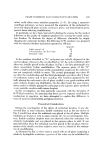
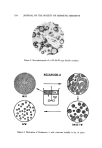
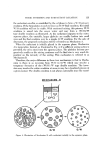
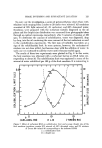
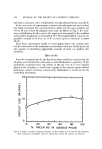
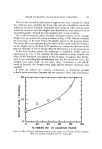
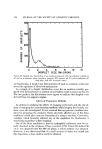
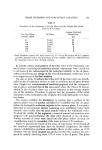
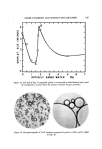
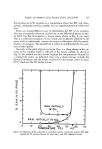
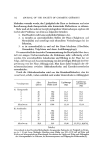
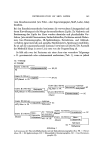
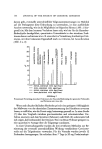
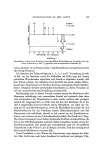
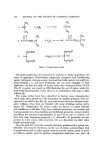
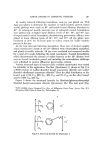
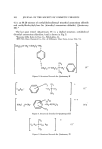
PHASE INVERSION AND SURFACTANT LOCATION 125 the surfactant •nicelles or emulsified by the oil phase to form a W/O primary emulsion. If the formulation is such to favor an O/W final emulsion, the initial W/O emulsion will not be stable. With continued mixing, this primary W/O emulsion is mixed into the excess water and may form a (W/O)/W type double emulsion as illustrated. As the surfactant migrates to the outer, aqueous phase, the unstable, larger globules are readily broken into small ones and the final emulsion may be a simple O/W emulsion. For the sake of discussion, the proposed mechanism will be referred to as Mechanism A. When the surfactant is initially placed in the aqueous phase, Mechanism A is inoperative. Instead, as illustrated in Fig. 4, if a sufficient mixing action is provided, the oil is mixed into the aqueous phase. The globules become pro- gressively smaller as the mixing continues and the final size is very much de- pendent on the intensity of the mixing. This mechanism is referred to as Mechanism B. Therefore, the' major difference in these two mechanisms is that in Mecha- nism A, there is an inversion from W/O to O/W which may involve a temporary formation of the (W/O)/W type double emulsion. The inver- sion may involve the entire emulsion at once or may be a localized process at a given instant. The double emulsion is not always noticeable since the transi- MECHANISM B I o/w o/w Figure 4. Illustration of Mechanism B with surfactant initial13• in the aqueous phase

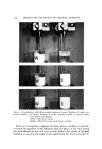
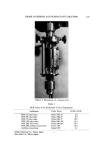
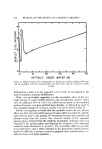
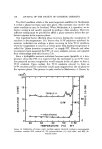
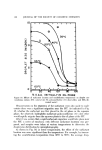
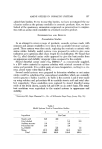
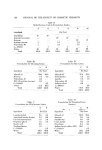
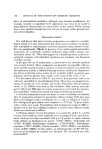
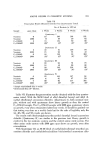
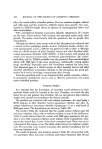
126 JOURNAL OF THE SOCIETY OF COSMETIC CHEMISTS tion may be extremely quivk also, in some instances, this primary W/O emul- sion may be a microemulsion not observable under an ordinary optical micro- scope. The important point is that as a result of the phase inversion, the drop- lets are broken easily with minimum mechanical agitation. On the other hand, the breaking of the droplet in Mechanism B is entirely dependent on mechani- cal shear. Unless a high mixing speed is employed or a larger quantity of the emulsifier is used, the droplets of this final O/W emulsion will not generally be very small. Based on the postulated Mechanism A, it would follow that the following three conditions are required for this mechanism to be operative: 1. The surfactant must be soluble in the oil phase and initially placed in the oil phase. 2. The surfactant in the oil phase must solubilize or emulsify a part of the aqueous phase. 3. A phase inversion must take place to form an O/W final emulsion. By carefully selecting different surfactants, oils, and process conditions, investigations were carried out to determine whether or not one could pro- duce a finer emulsion by meeting these conditions, than by not meeting them. In all the experimental work, the mixing speed was deliberately kept low to minimize the effect of Mechanism B. EXPERIMENTAL For emulsification, experiments were carried out in glass beakers using a 2 x 6-cm flat paddle mixer set 1 mm above the bottom of the beaker. The aqueous phase was first placed in the beaker and the oil phase was carefully placed on the top of it before the mixer was turned on to start emulsification. The mixer speeds were carefully calibrated with a tachometer to ensure cor- rect speed setting before each experiment. For emulsification, the speed was set at 150 rpm. The measurements of surfactant migration were carried out by using the method previously described (3). A colorimetric method was used to analyze the surfactant concentration (5). For the measurement of phase inversion temperature, we used both a conductivity meter •' and a torque meter.* A photograph of the torque meter attached to a mixer shaft is shown in Fig. 5. For solubilizing water into the oil phase prior to emulsiflcati9n, a magnetic stirrer or a paddle mixer was used. The temperature was kept at 21øC---0.5øC. The polyoxyethylenc oleyl ethers, sorbitan monoolcate, and polyoxyethylenc sorbitan monooleate used in the experiments were com- mercial grade materials. The Griflln's HLB values for these surfactants are given in Table I. *M•del CM-2A Conduct Meter by Toa Electronics Ltd., Tokyo, Japan. '•Model SS-IR Rotary Torque Meter by Yamasake Seiki Kenkyuzyo, Kyoto, Japan.
Purchased for the exclusive use of nofirst nolast (unknown)
From: SCC Media Library & Resource Center (library.scconline.org)