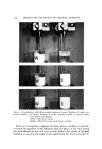
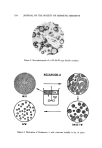
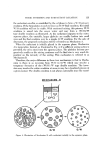
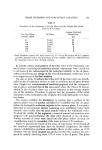
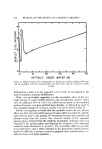
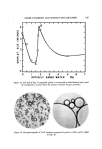
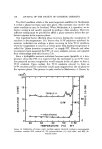
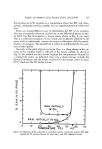
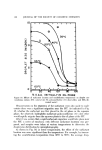
PHASE INVERSION AND SURFACTANT LOCATION 139 let size was reduced to %. However, even at 30øC, the droplet size could be reduced to about 1A0 by placing the entire surfactant in the oil instead of the aqueous phase. However, above the PIT (57'C), the situation was quite different as all emulsions prepared at 60øC produced extremely fine droplets regardless of the initial surfactant location. Therefore, as pointed out by Shi- noda, a good way to make emulsions stabilized by nonionic surfactants is to heat the emulsion to a temperature above the PIT and then rapidly cool it to a lower temperature (11, 12). CONC•VmONS In summary, it has been demonstrated that by directly or indirectly varying the sur[actant location, remarkable effects can be produced on the physical characteristics o[ O/W emulsions. It is believed that this is caused by the basic difference between the emulsi- fication mechanisms involved. By investigating the effects o[ varying sur[ac- rants, oils, and manufacturing conditions, it has been shown that the effects produced were consistent with the postulated mechanisms. (Received October 1, 1974) (1) T. J. Lin, Effect of initial surfaetant location on the viscosity of emulsions, J. Soc. Cosmet. Chern., 19, 683-97 (1968). (2) T. J. Lin and J. C. Labrechts, Effect of initial surfactant location on emulsion phase inversion, Ibid., 20, 1'85-98 (1969). (3) T. J. Lin, H. Kurihara, and H. Ohta, Effect of surfactant migration on the stability of emulsion, Ibid., 24, 797-814 (1973). (4) P. Sherman, Emusion Science, Academic Press, New York, 1968, p. 206. (5) R. A. Greif, E. A. Eetzkorn, and W. D. Leslie, A colorimetric method for the deter- mination of parts/million of nonionic surfacants, J. Arner. Oil Chern. Soc., 42, 180-5 (1965). (6) P. Beeher, Emulsions: Theory and Practice, 2nd ed., Reinhold Publishing Corp., New York, 1965, p. 249. (7) K. Shinoda and H. Arai, The correlation between phase inversion temperature in emulsion and cloud point in sohltion of nonionic emulsifier, J. Phys. Chern., 68, 3489-90 (1964). (8) K. Shinoda, The correlation between the dissolution state of nonionic surfaetant and the type of dispersion stabilized with the surfaetants, J. Colloid Inter[ace Sci., 24, 4-9 (1967). (9) M. Aoki, A. Kamada, and T. Matsuzaki, Application of surface active agents to pharmaceutical preparation. XII. Studies on the temperture of phase inversion and the system emulsified with nonionic surfaetants (1). The electric resistance-tempera- ture curve and HLB of surfactants, Yakugaku Zasshi, 83, 1132-6 (1963). (10) S. Matsumoto and P. Sherman, DTA technique for identifying the phase inversion temperature of O/W emulsions, J. Colloid Interface Sci., 33, 294-8 (1970). (11) K. Shinoda and H. Saito, The stability of O/W type emulsion as functions of tem- perature and the HLB of emulsifiers: The emulsification by PIT-method, Ibid., 30, 258-63 (1969). (12) T. Mitsui, Y. Machida, and F. Harusauki, Application of the phase-inversion-tem- verature method to the emulsification of cosmetics, Amer. Cosmet. Per[urn., 87, 33-6 (1972).

1. Soc. Cosmet, Chem., 26, 141-153 (March 1975) Methodisches zum Nachweis des Hauttalges unter besonderer Berticksichtigung der Akne HAGEN TRONNIER ::' Vortrag anl•i•licb der Vortrags- und Diskussionstagung der Gesellscbafi Deutscber Kosmetik-Cbemiker e. V., Baden-Baden, Bundesrepublik Deutschland, 14.--16. M•irz 1974 Synopsis-Methods for the determination of sebaceous matter of the skin in regard to acne.-Problems in the DETERMINATION OF SKIN LIPIDS are caused by its non- uniform composition, the different locale used for collection, and the questionable com- pleteness of lipid collection. Advantages and disadvantages of the different methods-in part based on the author's experiments-are described. The three disorders of the skin lipid systems which are of concern for SEBORRHOEA and related diseases include the amount, the composition, and the physical behavior of the LIPID FILM ON THE SKIN'S SURFACE. Of these, the last appears to be most important. This is based on numerous investigations of ACNE and of seborrhoea cases. The importance of the ratio of quantity of lipid to its SPREADING CHARACTERISTICS in the formation of ACNE COME- DONES is pointed out and is illustrated with investigations of skin lipids by different methods during GLUCOCORTICOID THERAPY. The disturbance of this ratio in acne is further illustrated with the aid of additional experimental results. Der Lipidgehalt der Haut und ihrer Oberfliiche hat bekanndich wichtige Funktionen innerhalb der. verschiedenen Schutz- und Abwehrmechanismen der Haut. Er beeinfluft positiv und negativ die Penetration chemischer Substanzen und spielt eine wichtige Rolle ftir das Funktionieren der Hornschicht, z. 13. ihres Wasser-Lipid-Mantels [Schneider (1)]. Ebenso wie fehlende oder zu geringe Lipidproduktion in der Haut zu Krankheitsbildern fiihren kann (z. 13. dem l•tat eraquell), gehSrt die vermehrte Talgsekretion als Seborrhoe zu den hiiu- figsten kosmetischen StSrungen und stellt als solche eine Mitursache auch der- matologischer Krankheitsbilder dar (z. B. der Acne vulgaris). Im Rahmen all- gemeiner Anpassung an die sie umgebende Umwelt unterliegt naturgemiif auch der Lipidgehalt der Haut Schwankungen und wird zudem dutch externe Matl- nahmen beeinfiuft. So ist es verstiindlich, daft seit langem mir unterschiedlichen * Prof. Dr. Hagen Tronnier, Hautklinik der Stiidtischen Kliniken Dortmund, D- 46 Dortmund, Bcurhausstr. 40. 141
Purchased for the exclusive use of nofirst nolast (unknown)
From: SCC Media Library & Resource Center (library.scconline.org)