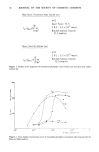
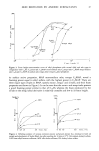
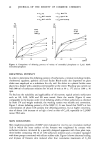
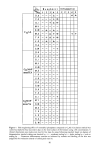
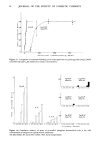
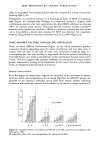
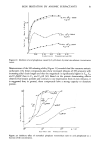
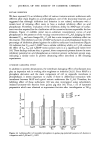
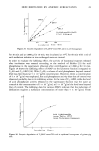
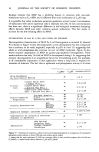
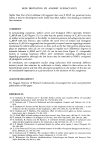
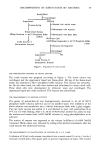
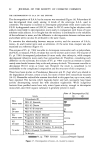
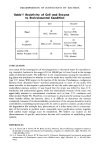
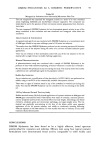
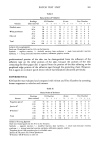
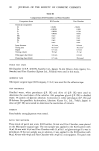
SKIN IRRITATION BY ANIONIC SURFACTANTS 65 higher than that of aryl sulfatase (16) suggests that even if MAP can penetrate horny layers, it may be decomposed more easily than alkyl sulfate, thus leading to relatively low irritation. COMMENT In summarizing cutaneous, surface active and biological effect especially between C•2MAP and C•2AS (Figure 27), it is clear that the potent irritancy of C•2AS is not due to surface active properties or the ability to denature proteins including enzymes since C•:MAP with less irritancy also exhibits the same level of surface and biological activity as C•2AS. It is suggested that the generally accepted notions regarding irritation mechanism by which surfactants act on skin, such as the fact that protein denaturation plays an important role (22), are not enough to explain such differential degrees of irritation between C•MAP and C12AS. As can be seen from Figure 27, comparable factors in causing cutaneous effects were membrane rupturing, adsorbing and degrading properties, although the last factor may be restricted to MAP's composed of phosphoric acid ester. In conclusion, our comparative studies using surfactants with extremely different irritancy reveal that irritation by surfactants is closely related to their action on the biomembrane system and that their adsorptive properties on the surface of the skin are of considerable importance as a primary factor in the initiation of skin roughness. ACKNOWLEDGMENTS Dr. Nagase, Director of Research Laboratories, encouraged this work and permitted publication of this paper. REFERENCES (1) G. Imokawa, H. Tsutsumi and Y. Kurosaki, Surface activity and cutaneous effects of monoalkyl phosphate surfactants,J. Amer. Oil Chem. Soc., 55,839-843, 1978. (2) G. Imokawa and T. Takeuchi, Surfactants and skin-roughenss, Cosmetics and Toiletties, 91, 32-46, 1976. (3) G. Imokawa, K. Sumura and M. Katsumi, Study on skin roughness caused by surfactants: 1 A new method in vivo for evaluation of skin roughness,J. Amer. Oil. Chem. Soc., 52,479-483, 1975. (4) G. Imokawa and Y. Mishima, The cumulative effect of surface active agents on human cutaneous horny layers,Jap. J. Dermatol., 473-481, 1976. (5) J. F. Kirk, Effect of hand washing on skin lipid removal, Acta. Derm- vener., 46, Sup. 57, 24-68, 1966. (6) G. Smeenk, The influence of detergents on the skin, Arch. Klin. Exp. Derm., 235, 180-191, 1966. (7) G. Imokawa, K. Sumura and M. Katsumi, A correlation between adsorption of surfactants onto callus and skin roughness caused by the surfactants,J. Jap. Oil Chem. Soc., 23, 17-23, 1974. (8) S. P. Harrold, Denaturation of epidermal keratin by surface active agents, J. Invest. Dermatol., 32, 581-588, 1959. (9) E.J. Van Scott and J. B. Lyon, A chemical measure of the effect of soap and detergents on the skin,J. Invest. Dermatol., 21,199-203, 1959. (10) G. Imokawa and Y. Mishima, The cumulative effect of surface active agents on cutaneous horny layers lysosome labilizing action, Contact Dermatitis, 5, 151-162, 1979. (11) H. Wilmsmann, Zur Reaction oberflachenaltiver Verbindungen mit Keratin and Enzymen, Fette Sei•n Anstrichm., 61,965-973, 1959.

66 JOURNAL OF THE SOCIETY OF COSMETIC CHEMISTS (12) F. W. Putnan, The interaction of proteins and synthetic detergents, Advan. Protein Chem., 4, 79-122, 1948. (13) G. Imokawa, K. Sumura and M. Katsumi, Study on skin roughness caused by surfactants. II Correlation between protein denaturation and skin roughness, J. Amer. Oil ½hem. Soc., 52, 490-493, 1975. (14) G. Imokawa and Y. Mishima, Cumulative effect of surfactants on cutaneous horny layers: adsorption into human keratin layers in vivo, Contact Dermatitis, in press. (15) G. Imokawa and M. Katsumi, Denaturing action of typical anionic surfactants on several proteins,J. Jap. Oil Chem. Soc., 25, 24-30, 1976. (16) G. Imokawa, Study on cutaneous and biological properties of monoalkyl phosphate anionic surfactants,J. Amer. Oil Chem. Soc., 56, 604-609, 1979. (17) J. Scala, D. E. Mcosker and H. H. Reller, The percutaneous absorption of ionic surfactants,J. Invest. Dermatol., 50, 371-379, 1968. (18) I. H. Blank and E.J. Gould, Penetration of anionic surfactants (surface active agents) into skin, ibid., 33, 327-336, 1959. (19) P. Flesch and E. Kun, A colorimetric method for determination of sulfhydryl groups in tissue homogenate by 1-(4-chloromercuri-phenylazo-naphthol-2), Pro. Soc. Exper. Biol. and Med., 74, 249-251, 1950. (20) M. Mezei, Effect of polysorbate 85 on human skin,J. Invest. Dermatol., 64, 165-168, 1975. (21) S. Shibko and A. L. Tappel, Rat-kidney lysosomes: isolation and properties, Biochem. J., 95,731-741, 1965. (22) A. B. G. Landsdown, Physicochemical factors influencing epidermal damage by surface active agents, Br.J. Dermatol., 86, 361-373, 1972. (23) G. Imokawa and Y. Mishima, Cumulative effect of surfactants on the acid phosphatase activity of human keratin layers in vivo, Contact Dermatitis, in press.
Purchased for the exclusive use of nofirst nolast (unknown)
From: SCC Media Library & Resource Center (library.scconline.org)