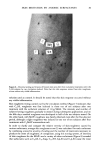
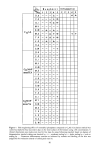
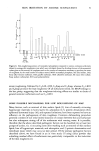
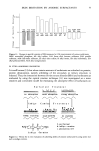
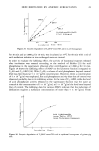
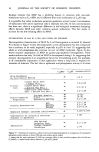
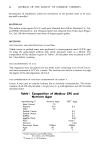
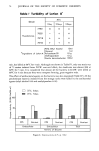
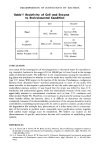
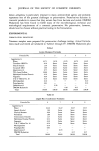
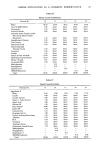
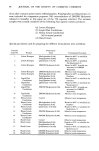
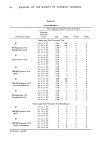
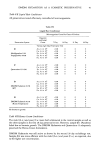
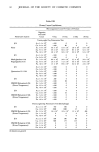
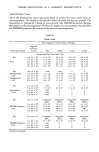
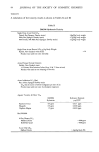
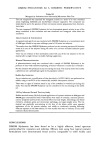
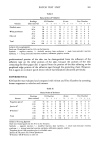
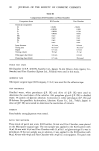
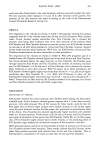
PATCH TEST UNIT 103 units were then firmly fixed to the volar forearms, and they were left in place for 24 hr. The test reactions were evaluated 1 hr and 24 hr after removal of the patches. The intensity of the skin reaction was rated according to the scale of the International Contact Dermatitis Research Group (13). RESULT The responses to the vehicles are shown in Table I. KI-Chamber showed less intense responses with all of the vehicles tested than Al-test and Finn Chamber. With distilled water, Al-test showed weaker reactivities than Finn Chamber but it showed the reaction, thus being faint erythema even 24 hr after removal of the patches while KI-Chamber and Finn Chamber showed no reaction at that time. KI-Chamber showed no reaction at all with white petrolatum. Al-test and Finn Chamber, however, showed similar weak reactions (faint erythema). With olive oil, KI-Chamber, Al-test and Finn Chamber showed almost the same reactivities as white petrolatum. The responses to the irritants are shown in Table II. With 20% propylene glycol in distilled water, KI-Chamber showed higher reactivities than Alotest and Finn Chamber, but Al-test showed almost the same reactivity as Finn Chamber. KI-Chamber gave stronger reactions than Al-test and Finn Chamber the number of erythema reactions was 9 in KI-Chamber, 5 in Al-test and 4 in Finn Chamber, and it showed the reaction (faint erythema) at 24 hr after removal. With 5% jasmin oil in white petrolatum, the KI-Chamber showed slightly higher reactivities than Al-test (P 0.1), and much higher reactivities than Finn Chamber (P 0.1). With 50% IP-Solvent in olive oil, the KI-Chamber showed higher reactivities than Al-test (P 0.01) and Finn Chamber (P 0.005). Twenty-four hr after removal, KI-Chamber showed 18.3% response, but Al-test and Finn Chamber showed 15.0% and 10.0%, respectively. DISCUSSION REACTIVITIES OF VEHICLES KI-Chamber showed the lowest response with distilled water among the three patch methods used. Al-test, however, showed greater response with it 1 hour after removal, and even 24 hr after removal. One of the reasons for these results could be that the filter paper disc of Al-test might contain water soluble irritants, or that Al-test might cause the press irritation because the filter paper disc protruded on polyethylene sheet of the Al-test. Finn Chamber also showed significantly higher reactivity with distilled water at 1 hr post exposure. These results could be due to the fact that Finn Chamber was made of aluminum of less purity than KI-Chamber (Table III), or the filter paper disc of Finn Chamber might contain water soluble irritants, or the protecting sheet of KI-Chamber might weaken the mechanical irritation of the chamber to the skin. With white petrolatum and olive oil, KI-Chamber showed no reaction, but Al-test and Finn Chamber showed weak reactions. These results indicate that KI-Chamber shows fewer false positive reactions with vehicles than Al-test and Finn Chamber. That is, KI-Chamber is considered to be more accurate than Al-test and Finn Chamber.

104 JOURNAL OF THE SOCIETY OF COSMETIC CHEMISTS REACTIVITIES OF IRRITANTS In spite of the tendency of the Al-test and Finn Chamber to show false positive reactions with distilled water, it is interesting that KI-Chamber showed higher incidences of reaction and severity with 20% propylene glycol in distilled water than Al-test and Finn Chamber. KI-Chamber is thus considered to be superior to Al-test and Finn Chamber in detecting the water soluble irritants. With 5% jasmin oil in white petrolatum and 50% IP-Solvent in olive oil, KI-Chamber again showed higher incidences and severity than Al-test and Finn Chamber. These results suggest that KI-Chamber may also be superior to Al-test and Finn Chamber in detecting the oily test samples. ACKNOWLEDGMENT The authors would like to express thanks to Albert M. Kligman, M.D., Ph.D., Professor of Dermatology, University of Pennsylvania Hirotake Futagoishi, Executive Director, Kanebo Ltd. Minoru Yamagishi, Manager of Cosmetic Laboratory, Kanebo Ltd. and Takashi Abe, Ph.D., Chief Scientist of Cosmetic Laboratory, Kanebo Ltd. for consultation advice in preparing this paper. REFERENCE (1) A.M. Kligman, The identification of contact allergens by human assay, I. A critique of standard methods,J. Invest. Dermatol., 47, 369-374 (1966). (2) A.M. Kligman, The identification of contact allergens by human assay, II. Factors influencing the induction and measurement of allergic contact dermatitis,J. Invest. Dermatol., 47, 375-392 (1966). (3) A.M. Kligman, The identification of contact allergens by human assay, III. The maximization test,J. Invest. Dermatol., 47, 393-409 (1966). (4) B. M. Lanman, W. B. Elvers and C. S. Howard, The role of human patch testing in a product development program, in The Toilet Goods Association, Proceedings, Joint Conference on Cosmetic Sciences, The Toilet Goods Association, Inc., Washington, D.C., 1968, pp 135-145. (5) B. Magnusson, Patch testing, in T. B. Fitzpatrick, M. A. Pathak, L. C. Harber, M. Seiji and A. Kukita, "Sunlight and Man," University of Tokyo Press: Tokyo, 1974, pp. 799-813. (6) J. Jadassohn, Verhandlungen der Deutschen Dermatologischen Gesellschaft, Archiv fur Dermatologie und Syphilis (Berlin), 34, 103-129 (1896). (7) B. Magnusson and K. Hersle, Patch test methods, I. A comparative study of six different types of patch tests, Acta Dermatovenereologica, 45,123-128 (1965). (8) Mid-Japan Contact Dermatitis Research Group, Standardization of patch tests in Japan, Contact Dermatitis, 2, 205-211 (1976). (9) A. A. Fisher, Contact Dermatitis, 2nd ed., Lea & Febiger Press: Philadelphia, Pa., 1973, pp. 26, 66. (10) R. Hayakawa, M. Kobayashi, H. Ueda and F. Morikawa, Clinical evaluation of Al-test patch test, The Journal of Dermatology, 2, 111-114 (1975). (11) A. A. Fisher, Contact Dermatitis, 2nd ed., Lea & Febiger Press, Philadelphia, Pa., 1973, pp. 123. (12) V. Pilira, Chamber test versus patch test for epicutaneous testing, Contact Dermatitis, 1, 48-52 (1975). (13) D. S. Wilkinson, S. Freget, B. Magnusson, H.J. Bandman, C. D. Cainan, E. Cronin, N. Hjorth, H.J. Maibach, K. E. Malten, C. L. Meneghini and V. Pilira, Terminology of contact dermatitis, Acta Dermatovenereologica, 50, 287-292 (1970).
Purchased for the exclusive use of nofirst nolast (unknown)
From: SCC Media Library & Resource Center (library.scconline.org)