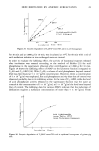
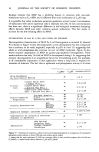
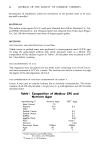
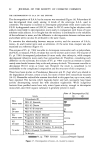
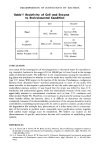
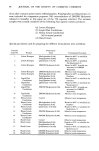
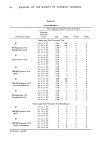
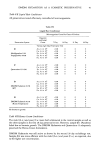
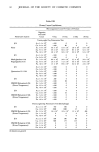
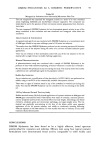
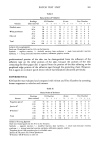
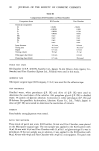
DMDM HYDANTOIN AS A COSMETIC PRESERVATIVE 95 Table XI Mutagenicity Evaluation-Ames Salmonella/Microsome Hate Test The test compound was examined for mutagenic activity in a series of in vitro microbial assays employing Salmonella and Saccharomyces indicator organisms. The compound was tested directly and in the presence of liver microsomal enzyme preparations from Aroclorin- duced rats. The test compound, DMDM Hydantoin did not demonstrate genetic activity in any of the assays conducted in this evaluation and was considered not mutagenic under these test conditions. Skin Irritation & Sensitization A repeated insult patch test was conducted with DMDM Hydantoin at a concentration level of 4,000 ppm diluted in tap water utilizing a panel of 50 human test subjects. The results show that DMDM Hydantoin produced no skin irritating reactions (all irritation scores 0) in any of the subjects during the series of 9, 24-hour occluded induction patch applications. There was no evidence of skin sensitization noted with any of the test subjects to the test material after a single 24-hour occluded challenge application. Human Photosensitization A photosensitization study was conducted with a sample of DMDM Hydantoin in the presence of ultra-violet radiation employing 25 human vo[unteers (12 males and 13 females). No skin irritation was produced at any time during the study. The material tested was neither a phototoxic nor a photoallergic agent in the population utilized. Rabbit Eye Irritation An eye irritation test, a modification of that described in 16 CFR 1500.42, was performed on rabbits, using a 1.0% W/V of the commercially avai[able 55% aqueous solution. There were no signs of irritation noted in any of the unwashed or washed eyes during this study. Test material DMDM Hydantoin can be considered to be non-irritating to the rabbit eye. 28-Day Subacute Dermal Toxicity Study Rabbits received twenty (20) daily dermal applications of aqueous solutions at 4000 ppm and 400,000 ppm concentration levels. Observations were made of mortality, reactions (pharma- cotoxic symptoms and local skin reactions) effects on body weight, hemotology and blood chemistry, urinalyses, gross and microscopic pathology, and organ weight ratios. The test material was practically non-irritating to the skin of the albino rabbit upon repeated application of the 0.4 percent solution, and mildly to moderately irritating following subacute exposure to the 40% solution. In these studies there was no evidence of any other treatment related abnormalities. CONCLUSIONS DMDM Hydantoin has been found to be a highly effective, broad spectrum antimicrobial for cosmetics and toiletries. Efficacy tests using four typical cosmetic formulations have demonstrated broad activity comparable to other widely used

96 JOURNAL OF THE SOCIETY OF COSMETIC CHEMISTS cosmetic preservatives. DMDM Hydantoin was compatible with the formulations tested and can be added at any stage of the formulation process. The DMDM Hydantoin was found to be active and stable over a wide range of pH and temperature conditions. The efficacy tests reported here show that DMDM Hydantoin offers excellent activity against the growth of bacteria (both Gram-negative and Gram-positive), fungi and yeast. It provides effective antimicrobial activity at low concentrations--generally at 0.15%-0.30% (by weight) in formulations and is not inactivated by relatively high concentrations of protein. Preservative activity was also demonstrated by a twenty- eight day rechallenge test. DMDM Hydantoin offers excellent toxicological and ecological profiles as shown by extensive safety and toxicity studies. A 55% aqueous solution of DMDM Hydantoin is not irritating to the skin, not toxic dermally, not toxic by inhalation exposure, non-sensitizing to human skin and is not a phototoxic or a photoallergic agent. A 1.0% solution of the commercial product was also shown to be non-irritating to the eye. REFERENCES (1) U.S. Pharmacopeia, XIX, Revo 1975, pp. 587-8.
Purchased for the exclusive use of nofirst nolast (unknown)
From: SCC Media Library & Resource Center (library.scconline.org)