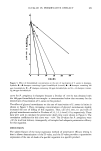
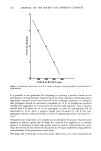
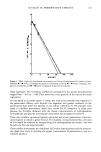
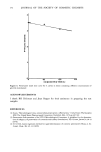
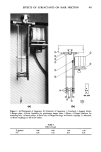
180 JOURNAL OF THE SOCIETY OF COSMETIC CHEMISTS relatively simple to construct. Violin bow methods (5, 13-15) which slide fiber loops down an inclined fiber seemed less attractive. Other workers (16-18) have measured forces to draw single fibers from bundles of parallel fibers. A category of methods which appeared valuable for fundamental investigations uses the capstan principle for measurement of forces to slide a weighted fiber on the curved surface of a reference material. The capstan approach, adopted for this paper is employed in several original articles (19-23) including one by Schwartz and Knowles (24) for measurements on human hair. A double capstan method using an Instron © has been developed, examined for effects of test variables and applied to a frictional study of surfactant systems. Method development and characterization are confined to the first section of this manuscript and surfactant behavior is described in the remaining sections. EXPERIMENTAL MATERIALS AND METHODS MATERIALS Hair fibers used were from a 12-year old Caucasian female (LAL), never waved or bleached, and from De Meo (DM) "blue string" hair. Fibers were bleached for 30 minutes with hydrogen peroxide containing ammonia to pH 10, unless otherwise specified. Mounts were prepared by fastening root and tip ends onto celluloid tabs with Scotch electrical tape, allowing 8 in of fiber between tabs. Hard rubber mandrels were prepared from polished rod supplied by Ace Comb Co., Butler, N.J., and wool mandrels by a single wrap of a wool challis fabric on a steel rod. EQUIPMENT Instron © Tensile Tester, Model TM with Automatic Integrator, Load Cell "A" and Friction Apparatus (See Section I). Usual conditions for wet friction are: chart 1 in/min., crosshead 5 in/min., extension cycle 4 in, chart sensitivity 4 g full scale, hard rubber mandrels at 10.7 RPM, total wrap angle 97 ø. METHODS Tress combing tests are conducted with three or more persons, each arranging four to six tresses according to combing ease, half treated with test material, half with reference. Tress position scores are taken, averaged and converted to a 0-4 scale with a 4 score indicating that all test tresses were ranked by all combers as easier to comb than reference tresses (0 score). Friction is measured as follows. The Instron © chart and integrator are zeroed and calibrated (4-g wt.) in the usual way but with the fiber mount on the load cell chain and the lower tab supported separately. The mandrels are immersed in test solution at 110øF, letting the fiber mount hang vertically with lower tab immersed with 1-g weight attached. The Instron crosshead is cycled and the integrator value (X•) for the down stroke is recorded. The fiber is wrapped on the immersed mandrels, rotation is started and the crosshead is cycled four times. Integrator readings are recorded for the last three downstrokes. Four additional fibers are measured similarly. An average integrator

EFFECTS OF SURFACTANTS ON HAIR FRICTION 181 value (X2) is calculated for the fiber set and the frictional coefficient (F.C.) is found from the equation: F.C. = • In -- X• where • is the angle of wrap in radians of the fiber about the mandrels and X• and X 2 are the integrator values. Unless otherwise specified, bleached fibers are rubbed root to tip against hard rubber using a 97 ø wrap angle and 1-g weight on the fiber. I. METHOD DEVELOPMENT AND STUDY DEVELOPMENT OF METHOD Static and dynamic (kinetic) friction are considered important to the behavior of hair. For example, in the textile literature (22, 25), hand or feel of samples has been related to these two friction parameters with a large difference giving a harsh hand. For the present study, however, only kinetic friction is investigated. The capstan approach makes use of a simple equation for calculating frictional coefficients (F.C.), 1 (1) F.C. = • In •-• where (• is the angle of wrap (radians) of the fiber about the mandrel, T• is the tension (g) applied to the lower end of the fiber and T2 is the tension developed at the upper end. Friction is assumed independent of load in accordance with Amonton's Law (8), although for fibers over wide load ranges exceptions have been found and compensat- ing equations presented (14, 26-28). Selection of an Instron Tensile Tester © as a control and measuring instrument led to several advantages but also complications. Due mainly to slip-stick action during rubbing of a fiber against a mandrel surface, T 2 varies rapidly between maximum and minimum limits, making force measurements difficult and uncertain. The Integrator resolves this problem by integrating T 2 values over a time span to give X2 and T•, the applied steady force, over the same time span to give X•. The ratio X2/X1 replaces TJT• in Equation 1. The chart recorder provides useful traces showing the variation of T• during rubbing intervals. Automatic down-up cycling of the cross-head moves the mandrel along a length of fiber, thereby producing a better average friction value and lessening fiber wear. Fortunately the load weighing system has adequate sensitivity and stability for single fiber measurements. In usual capstan methods, a fiber is hung over a mandrel (180 ø wrap) with both ends extending downward. With an Instron©, one end must be connected to the load cell, letting the fiber hang downward toward the mandrel.
Purchased for the exclusive use of nofirst nolast (unknown)
From: SCC Media Library & Resource Center (library.scconline.org)