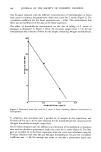
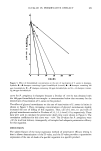
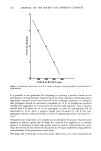
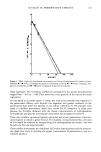
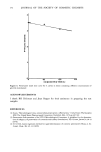
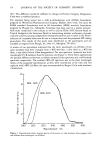
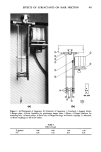
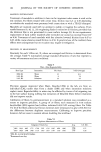
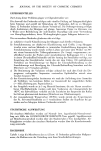
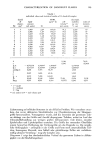
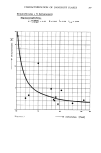
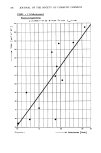
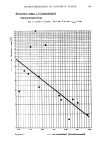
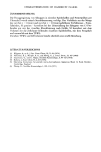
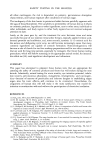
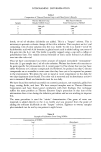
182 JOURNAL OF THE SOCIETY OF COSMETIC CHEMISTS A 360 ø wrap of fiber about the mandrel was tried with interesting results. Reasonable T2 forces appear until suddenly they increase and the recording pen rapidly moves offscale. This runaway is caused by increasing pressure of the fiber against itself at the crossover point which in effect adds force to the attached T• weight. A two mandrel system was adopted in preference to other possibilities (e.g. pulleys). The fiber hangs on a chain from the load cell, passes in front of the first mandrel, partially around it and over the rear mandrel, to hang vertically. The mandrels are held parallel to each other in a framework fastened to and below the crosshead. For repeat measurements, it is desirable to cycle the crosshead through several downstrokes. Geared pulleys were placed on each mandrel and driven with a flexible belt passing over a pulley on a constant speed motor. With mandrel rub speed greater than the cross-head's, root to tip rubbing is attained for entire crosshead cycles. A large total wrap angle of fiber on the two mandrels was suitable for dry friction measurements, since frictional coefficients seldom exceeded 0.2, a T2/T• ratio of 3.4:1. With wet damaged hair on hard rubber, the ratio became excessive, as high as 20:1, and friction increased significantly during successive measurements, presumably due to fiber surface deformation. The framework was modified to permit repositioning the rear mandrel for any one of three wrap angles, approximately 97 ø, 210 ø, or 348 ø. Test equipment in its current form, shown in Figure 1, performs satisfactorily and has been examined for effects of numerous test variables. RUB SPEED Varying rub speed indicated a tapering effect on friction as speed increased. For example, change from 1 to 9 to 22 in/rain increased friction from 0.18 to 0.24 to 0.26. A speed of 13.4 in/rain, chosen as standard, is the sum of peripheral speed (8.4 in/rain) and descent speed (5 in/rain) of the mandrels. Schwartz and Knowles (24) in measurements on hair found little frictional change with speed over an unspecified range. Textile literature (8, 14, 21, 27) indicates that friction becomes nearly constant at higher speeds. Transient forces, recorded on the chart during down-up movements of the crosshead provide a visual comparison of rub speed effects. On the upstroke, rub speed is the peripheral speed minus the linear speed of the mandrels. Generally the down-up traces do not differ sufficiently to warrant specific study. APPLIED LOAD (Tx) Load, applied as a weight on a fiber's distal end, must not generate rub forces above fiber yield values. Although Equation 1 theoretically compensates for load changes, the data in Table I indicates a small load effect. Applied loads evidently affect T2 in such a way that the ratio T2/T• of Equation 1 only decreases slightly as load increases. Other workers (12, 14, 15, 21, 22, 24, 26) report frictional decrease with load which has been attributed (14, 16) to deformation at the interfaces.

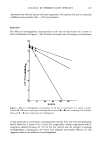
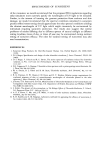
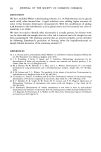
EFFECTS OF SURFACTANTS ON HAIR FRICTION 183 SIDE VIEW SCALEi (a) (b) Figure 1. '(a) Photograph of Apparatus. (b) Schematic of Apparatus. 1-Crosshead, 2-Support blocks, 3-Hanger plate, 4-Screw Assembly for positioning hanger plate, 5-Motor, 6-Hinged platform for tensioning belt, 7-Geared pulleys, 8-Drive belt, 9-Flanged bearings, 10-Geared couplings, 11-Mandrels, 12-Sleeve couplings, 13-Set-screw collars. Table I Effect of Load T• (grams) 0.46 0.85 1.40 2.20 F.C. 0.26 0.25 0.23 0.23
Purchased for the exclusive use of nofirst nolast (unknown)
From: SCC Media Library & Resource Center (library.scconline.org)