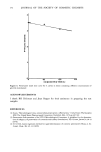
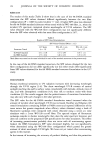
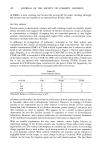
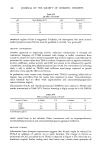
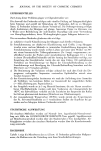
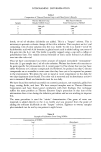
184 JOURNAL OF THE SOCIETY OF COSMETIC CHEMISTS WRAP ANGLE The test equipment allows choice among three angles, depending on frictional forces anticipated. A large angle (348 ø) is generally suitable for dry friction of hair on any type of mandrel and the smaller angles (97 ø, 210 ø) for wet friction. The effect of wrap angle for hair fibers in dilute cationic solution is shown in Table II. Table II Effect of Wrap Angle Wrap Angle 97 ø 210 ø 348 ø T2/T • 1.37 1.74 2.47 F.C. 0.19 0.15 0.15 Higher friction at 97 ø may be caused by wet fiber compression on the mandrels which increases the wrap angle over that geometrically calculated. This effect should be less important at larger angles. In any case frictional effects should be compared on a common substrate using the same wrap angle. RUB SUBSTRATE Mandrels of • in diameter are used routinely since other sizes affect wrap angle and peripheral speed. Mandrels of several compositions are compared in Table III using bleached fibers and commercial products diluted to 0.1% active ingredient (AI). Table III Mandrel Composition Frictional Coefficients 0.1% AI Dilutions Teflon Wool Fabric Hard Rubber Lucite Comm. TEALS Shampoo 0.07 0.34 0.43 0.44 Comm. Creme Rinse 0.06 0.19 0.29 0.31 Hard rubber, a common comb material, is principally used as substrate because high friction values tend to exaggerate treatment differences. Schwartz and Knowles (24) compared seven substrates and found that lucite and hard rubber give high wet friction exceeded only by glass. FIBER DIAMETER In several experiments, fiber diameter showed no relation to friction. Ten fine and 10 coarse fibers gave almost identical average results for wet friction. Since area of contact is a function of total surface area and hence diameter, friction of fibers appears independent of contact area as Amonton's law predicts. Frishman, et al., (29) also found no relation between the frictional coefficient and fiber diameter among 49 fibers. Others (30) however report correlation. Evidence, such as frictional increase by fiber swelling (22) and decrease by roughening the mandrels (22, 25) has led to general acceptance that contact area does influence friction and that Amonton's equation

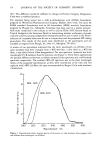
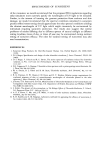
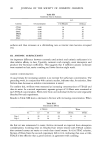
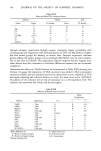
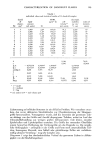
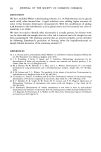
EFFECTS OF SURFACTANTS ON HAIR FRICTION 185 must be modified (26). However under our recommended test conditions, friction appears independent of fiber diameter. HAIR CONDITION Damaging hair fibers by bleaching leads to combing problems in practice and experimentally is a useful means to increase friction values and treatment differences. Results, such as shown in Table IV for measurements on wool in diluted commerical products, led to the use of bleached fibers for most experiments. Table IV Effect of Bleaching Bleaches 0.1% AI Dilutions 0 1X 3X Comm. TEALS Shampoo, F.C. 0.25 0.34 0.43 Comm. Creme Rinse, F.C. 0.22 0.19 0.19 In the cationic solution, friction is not increased by bleaching while in the anionic solutions friction increases markedly. To an extent this behavior may be attributed to formation of additional acidic sites (31, 32) by bleaching which enhances cationic pickup, offsetting frictional increase. A tendency for friction to increase during successive measurements of single fibers was greater with bleached than with undamaged fibers. Attempts to relate this behavior to wet tensile properties produced a qualitative relationship in that the bleached fibers yielded at lower forces. King (22) has suggested that fiber plasticity and frictional behavior are related. Easier yielding probably induces more intimate contact with mandrel surfaces as the fiber deforms (or conforms) during successive rubs. SOLUTION TEMPERATURE Some early tests with room temperature oolutions were repeated after adopting 110øF as standard. This 30 ø change had no significant effect. Lindberg (28) found that wool friction decreases very slightly as temperature is raised in this range. It is expected however that some test solutions, sensitive to temperature changes, may produce larger frictional changes. SOLUTION PH Many surfactant solutions have been tested at two or more pH levels with different mandrels during the course of experiments. A general trend is towards lower friction as pH is increased in the near-neutral range, although different buffers, surfactants, or concentrations occasionally reverse this. A specific effort to isolate pH effect is described in Section III. Friction of wool on wool is reported (12, 28, 30) as only slightly dependent on pH.
Purchased for the exclusive use of nofirst nolast (unknown)
From: SCC Media Library & Resource Center (library.scconline.org)