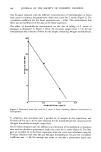
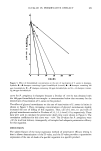
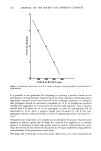
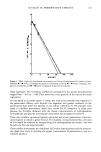
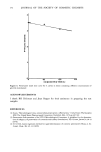
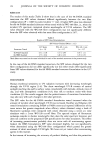
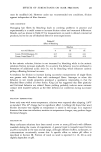
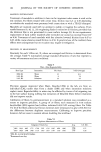
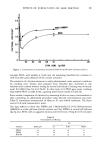
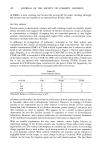
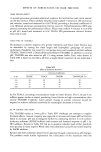
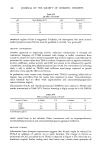
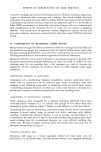
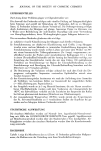
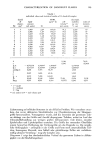
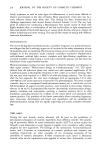
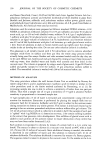
186 JOURNAL OF THE SOCIETY OF COSMETIC CHEMISTS MANDREL PRETREATMENT Treatment of mandrels in addition to hair can be important when water is used as the test medium. For fibers treated with creme rinse, friction was 0.21 or 0.38 depending on whether the mandrels were pretreated with creme rinse or with a TEALS shampoo. Mandrels are routinely used with no attempt to polish or roughen the surfaces. From textile literature (8, 10, 22, 25) roughening leads to reduction in friction provided that the lubricant film is not penetrated to cause surface damage (8). In our experiments, replacement of hard rubber mandrels after extended use caused an increase from 0.47 to 0.50. Treatment of used mandrels with fine abrasive lowered friction from 0.47 to 0.45, while coarse abrasive raised friction to 0.50. In practical use of the method, these effects seem unimportant but on occasion may require investigation. PRECISION OF MEASUREMENTS Routinely for each 5-fiber set, X2 values are averaged and friction is determined from the average. Table V summarizes average standard deviations of sets that represent a variety of treatments and test conditions. Table V Fiber--Fiber Reproducibility Hair Type Immersion No. Runs % SD (Average) DM, BL Water I0 10.3 LAL, BL Water 8 7.0 LAL, BL Solutions 39 2.6 Precision appears improved when fibers, bleached (BL) in the lab, are from an individual (LAL) rather than from a dealer (DM) and when immersion solutions replace water. Reproducibility in water may be affected by traces of oil migrating out to the hair surface during rubbing but extraction of bleached fibers before treatments did not improve results. Calibration of fibers by premeasurement in a standard solution was considered as a means to improve precision. A group of 25 fibers, each measured in 0.1% sodium laurylsulfate (SLS) against hard rubber, indicated 6.63% S.D. among fibers. For Table VI, 10 of the fibers selected at friction extremes were remeasured to give 2.82% S.D. for the differences between duplicate measurements. Calibrating to improve precision however did not seem to warrant almost doubling the workload. Table VI Duplicate Measurements of Fibers Integrator Values (g2) Avg. % S. Dev. t2082 1839 1807 1777 1768 1747 1715 1697 1681 1666 1778 6.77 22027 1820 1748 1708 1714 1710 1677 1707 1725 1636 1747 6.24 tDM, BL, in 0.1% SLS/H. Rubber. 2Remeasured next day.

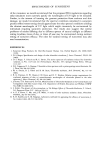
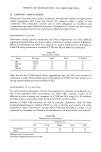
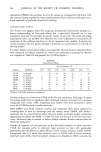
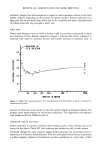
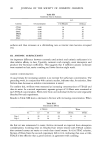
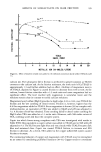
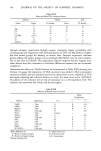
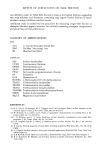
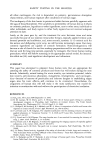
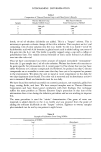
EFFECTS OF SURFACTANTS ON HAIR FRICTION 187 II. CATIONIC SURFACTANTS Distinction of cationic from anionic surfactants was relatively simple throughout most earlier experiments with lower wet friction for cationics under a variety of test conditions. This distinction narrows and at times disappears as conditions and compositions are varied. However for practical purposes, it is valid to say that cationic surfactants produce low friction and anionic surfactants high friction. MEASUREMENTS IN WATER Distinction among cationic surfactants and their compositions was more difficult, requiring bleached fibers and hard rubber mandrels to enlarge cationic differences. Effects of bleaching hair fibers and rubbing on various substrates are illustrated in Table VII using cetrimonium bromide (CTAB) and SLS as reference surfactants. Table VII Measurements in Water Fibers Pre-Treat Steel Wool H. Rubber DM CTAB .29 .26 .31 DM, BL CTAB .35 .28 .42 DM SLS .25 .30 .32 DM, BL SLS .38 .32 .53 High friction for CTAB-treated fibers, approaching that for SLS, was ascribed to immersion in water which allowed greater desorption of CTAB (31) than would occur during normal rinsing and wet combing of hair. MEASUREMENTS IN 0.1% SOLUTION To avoid excessive desorption, friction was measured in solutions of surfactants at a low active ingredient (AI) concentration. In Table VIII, cationics, known to be effective for wet combing, are compared to CTAB and SLS using 0.1% AI solutions and then water as measuring media for bleached fibers on hard rubber. Results/•n Table VIII obviously do not fit practical experience. Only the fatty amido/-propylammonium chloride (FPAC) is low in friction and remains low when measured in water. The friction increase with CTAB and SLS fibers in water can be explained by desorption but behavior of stearalkonium chloride (SAAC) and dimethyl- Table VIII Measurement in 0.1% Solutions Surfactant, F.C. SLS CTAB DMSA SAAC FPAC 0.1% AI Soln. .39 .39 .39 .47 .19 Water .54 .46 .31 .30 .17 •Buffered to pH 3.6 with acetate. 2Same fibers subsequently measured in water.
Purchased for the exclusive use of nofirst nolast (unknown)
From: SCC Media Library & Resource Center (library.scconline.org)