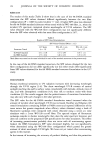
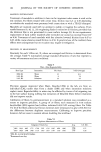
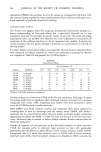
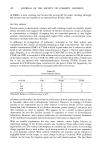
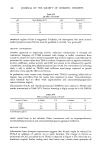
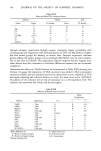
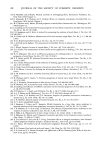
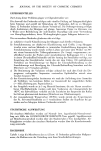
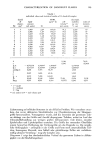
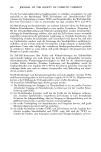
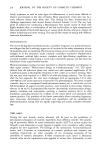
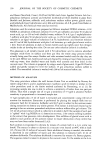
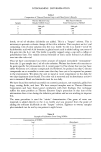
196 JOURNAL OF THE SOCIETY OF COSMETIC CHEMISTS Table XVII Metal and Metal-TEA Complex Cations Additive TEALS SLS Cation Equiv. H. Rubber Wool H. Rubber -- 0 .34 .3O .38 Mg 1.0 .26 .25 -- Cu 1.0 .42 .41 .34 Cu 2.0 .40 -- .29 Cu/TEA 2.0/1.0 -- -- .38 A1 0.1 .27 -- -- A1 1.0 .19 .24 .31 AI/TEA 1.0/1.0 -- -- .21 through nitrogen, magnesium through oxygen. Assuming copper coordinates with amino groups and magnesium with hydroxyl groups of TEA, the Mg:TEALS complex has free amino groups for binding to keratin sites. Sorption experience indicates greater affinity for amino groups and accordingly Mg:TEALS may be more substan- tive to hair than Cu:TEALS. This explanation requires sorption data for support since other factors may also contribute to frictional differences between the two surfactant complexes. Aluminum ion effects on TEALS friction are summarized in Table XVII showing low friction. To gauge the importance of TEA, aluminum was added to SLS as potassium aluminum sulfate, pH was adjusted and friction determined as 0.31. Addition of TEA and again adjusting pH reduced friction to about the same level as for AI:TEALS. Cloudiness of the solution led to trial of aluminum at a 1/10 equivalent level. The solution was somewhat less cloudy and friction higher. Table XVIII Influence of Metallic Ions on TEALS Metal Classification Additive Appearance F.C. 1 2 CuSO4 Clear .42 B A-B CdSO 4 Clear .37 B B Hg(Ac)• Clear .36 B B Pb(Ac)2 Cldy, ppt. .34 -- A-B None Clear .33 (avg.) -- -- Zn(Ac)2 Cldy .31 -- A-B Zr(Ac)4 Cldy, ppt. .31 A A SnCl4 Cldy .29 A A CaCl= Cldy .29 A A SrCI= Cldy, ppt. .28 A A MgCI• Clear .24 A A K A1 (SO4)• Cldy, ppt. .19 -- A •Bailar, Reference 39 A--Bond to oxygen stronger. B--Bond to nitrogen stronger. •Pearson, Reference 40 A--Hard Lewis Acid. B--Soft Lewis Acid. A-B--Intermediate.

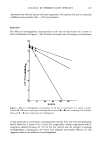
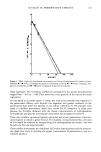
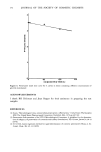
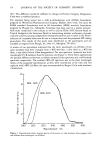
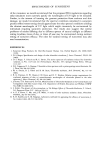
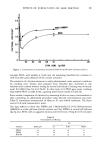
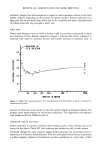
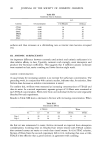
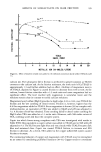
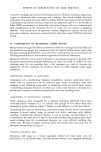
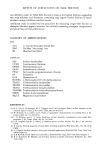
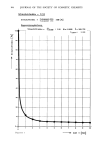
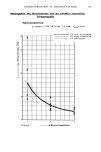
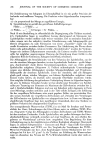
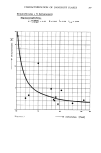
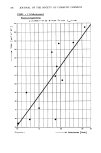
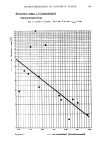
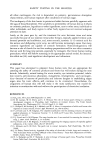
EFFECTS OF SURFACTANTS ON HAIR FRICTION 197 A test for combing ease involved immersing tresses in TEALS containing magnesium, copper or aluminum salts, removing and combing. The scores confirm frictional predictions. In a search for more effective metals, friction was measured for 1% TEALS containing an equivalent of various metal ions and adjusted to pH 7-7.5. As the data in Table XVIII accumulated, we found that directional change in friction correlated well with classifications in the literature (39-41) of metal ions for relative complexing behavior. Two metals seem of particular interest. Magnesium reduces friction and gives clear solutions. Aluminum reduces friction more but causes TEALS to become cloudy. IV. COMPARISON OF SHAMPOOS, CREME RINSES Measurement of single hair fibers is obviously useful for studying frictional effects of hair products but proper test conditions must be selected before results agree with practical combing performance. As an aid, tress combing tests are recommended for checking direction and to some extent magnitude of frictional differences. Distinction between creme rinses or between conventional shampoos is possible with frictional measurements although differences are often too small to confirm by tress combing tests. For our purposes here, a few examples are cited to illustrate the importance of test conditions for products which do differ tangibly under usage conditions. CONDITIONING SHAMPOO VS. CREME RINSE Comparison of a conditioning shampoo (amphoteric, cationic surfactants) with a creme rinse by measuring 0.1% AI solutions gave results inconsistent with tress combing scores. Retesting using water as measuring media for treated fibers caused 'conditioning shampoo' friction to increase and 'creme rinse' friction to decrease for a pronounced crossover of values and agreement with tress combing results. CONDITIONING VS. CONVENTIONAL SHAMPOO These shampoos were compared by a dilution technique. Bleached fibers were immersed several minutes in a 1:4 dilution and groups of five fibers were then measured in greater dilutions. Figure 5 displays a wide difference in shampoo effects. Considering the curves as representing controlled rinsing, friction of the conventional shampoo is much higher, rising to exceed 0.40 which associates with difficult combing. Conditioning shampoo friction is low at rinsings corresponding to 1% concentration but then starts to rise. In tress tests, conditioning shampoo gave much easier combing than the conventional shampoo but more difficult combing than creme rinse. Rinsing of tresses evidently leaves less residue than that from the 1% shampoo concentration in Figure 5. SHAMPOO CONTAINING SOAP Shampoos with soap as a minor ingredient depend on hard water ions for performance. In deionized water dilutions, friction showed only marginal advantage
Purchased for the exclusive use of nofirst nolast (unknown)
From: SCC Media Library & Resource Center (library.scconline.org)