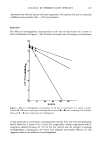
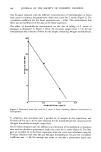
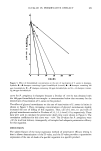
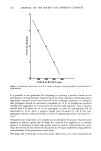
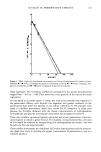
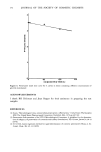
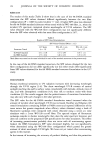
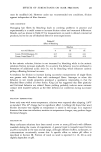
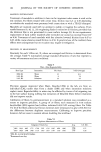
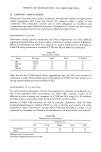
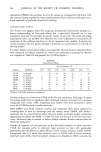
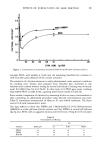
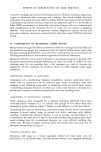
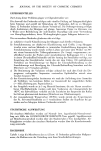
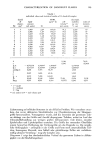
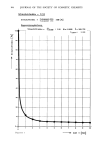
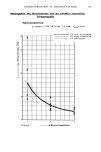
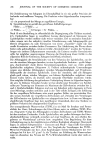
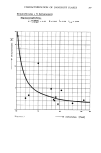
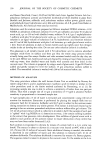
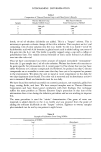
198 JOURNAL OF THE SOCIETY OF COSMETIC CHEMISTS .40 o o R TEALS SHAMPOO .30 .20 CONDITIONING SHAMPOO .10 • • • I I 5 I0 20 SHAMPOO CONC. (•J/100) Figure 5. Measurements in 1:4 dilutions of a conventional and a "conditioning" shampoo followed by measurements at greater dilutions. over a conventional shampoo in contrast to easily detected combing differences for tresses prepared with tap water. Measuring fibers from these tresses in water significantly increased the frictional difference between shampoos. The shampoos are compared in Table XIX using deionized and hard water for dilutions. Results indicate a critical ratio of shampoo to hardness, beyond which friction is reduced. Data for dilutions of a coco-oleic soap solution likewise displayed a critical ratio for obtaining low friction. Tresses treated with 0.1% soap solution combed easier than tresses treated with 0.5%, agreeing with friction results. Improvement at 0.1% was however not as great as friction values suggest since combing of creme rinsed tresses Table XlX Shampoo Containing Soap Shampoo Shampoo w/Soap g Shampoo/100 D.W. 150 ppm D.W. 150 ppm 5.00 .34 .38 .33 .33 1.00 .40 .37 .39 .37 0.10 .48 .43 -- .15 0.01 -- -- -- .21

EFFECTS OF SURFACTANTS ON HAIR FRICTION 199 was definitely easier. In Table XIX, friction is rising at the highest dilution, suggesting that soap solutions and shampoos containing soap require further dilution to better simulate rinsing conditions used for tresses. Additional study is needed but the procedure for measuring single fiber friction at shampoo dilutions appears attractive for critically examining shampoo compositions and predicting wet hair performance. GLOSSARY OF ABBREVIATIONS HAIR: LAL DM BL 12 year old Caucasian female hair De Meo "blue string" hair Bleached hair fibers CHEMICALS: SLS CTAB DMSA SAAC FPAC SA Q-18 HADEA TEALS TEADS TEACS TEADBS SDDS Mg LS Sodium laurylsulfate Centrimonium Bromide Dimethylstearamine Stearalkonium chloride Fatty amido-propylammonium chloride Stearamine Quaternium-18 2-Hydroxyalkyl (C15-18) diethanolamine Triethanolamine laurylsulfate Triethanolamine decylsulfate Triethanolamine hexadecylsulfate Triethanolamine dodecylbenzenesulfonate Sodium dodecanesulfonate Magnesium laurylsulfate REFERENCES (1) N. E. Yin, R. H. Kissinger, W. S. Tolgyesi, and E. M. Cottington, Effect of fiber diameter on the cosmetic aspects of hair,J. Soc. Cosmet. Chem., 28, 139-50 (1977). (2) W. Newman, G. L. Cohen, and C. Hayes, A quantitative characterization of combing force, J. Soc. Cosmet. Chem., 24, 773-782 (1973). (3) C. R. Robbins and G. V. Scott, Prediction of hair assembly characteristics from single fiber properties,J. Soc. Cosmet. Chem., 29, 783-792 (1978). (4) J. H. Langston and W. T. Rainey, A literature survey on fiber friction, Tex. Res. J., 23, 643-653 (1954). (5) B. Lincoln, Physical properties of wool fibers, frictional properties, IVool Science Rev., No. 18, 38-50 (1960). (6) L. i. Osipow, Surface chemistry, theory and industrial applications, Reinhold Publ. Corp., New York (1962) Chapter 15. (7) E. R. Kaswell, Textile fibers yarns and fabrics, Reinhold PuN. Corp., New York (1953) Chapter 4. (8) H. G. Howell, K. W. Mieszkis, and D. Tabor, Friction in textiles, Interscience Publishers, Inc., New York (1959).
Purchased for the exclusive use of nofirst nolast (unknown)
From: SCC Media Library & Resource Center (library.scconline.org)