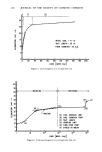
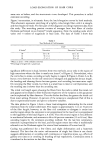
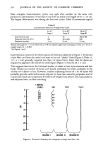
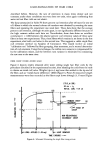
j. Soc. Cosmet. Chem., 34, 227-239 (August 1983) Load-elongation of single hair fiber coils C. R. ROBBINS, Colgate-Palmolive Research Center, 909 River Road, Piscataway, NJ 08854. Received December 9, 1982. Synopsis The objective of this project was to study the load-elongation and creep behavior of water set single hair fiber coils at constant RH to provide some insights into their physical behavior. Single fibers were used instead of tresses to avoid complications from interfiber interactions and to simplify data interpretation. The first portion of this paper is concerned with measuring forces involved in stretching and recovery of single hair fibers water set as helical spirals. For initial uncoiling, the load is approximately proportional to the extension. With further extension a region is found in which load is proportional to the logarithm of the extension. However, as the fiber approaches straightness, once against the load is proportional to the extension. A large proportion of the extension is recoverable even after multiple extension-recovery cycles however, some coil loss occurs, confirming a lack of true elasticity. The existence of creep confirms the absence of a true Hookean region for stretching water set single fiber coils. With no external load, most of the fiber creep (84%) or uncoiling can be explained by fiber diameter, with thicker fibers resisting coil deformation better than thinner ones. With small added loads no meaningful relationship between creep and fiber diameter was found. However, the initial coil deflection with added load is significantly related to fiber diameter. Spiral spring theory predicts a power dependence of coil deflection on fiber diameter, and is useful for predicting the initial deflection but not the creep of water set hair curls with load. INTRODUCTION Although several single fiber methods are available to evaluate the mechanical properties of human hair (1-6), no methods or data could be found which describe the physical behavior of single hair fibers in coil or curl form. Since single fiber testing eliminates complications from interfiber interactions involved in the behavior of hair tresses or hair on the head, we elected to explore the simpler coil-extension behavior of single hair coils. Initially, we evaluated methodology then to develop some under- standing of the load-elongation behavior of water set curls, we examined the extent of coil loss from single fiber water set coils, under the influence of stress and time, at a constant relative humidity of 40%. The first part of this discussion is concerned with the stress-strain behavior of single fiber water set coils, set as helical spirals, and their extension under load until approximately straight. Then single fiber water set coils are released, hung vertically, and their elongation (uncoiling) observed over time with and without added weight. 227

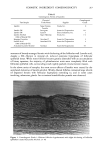
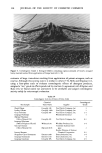
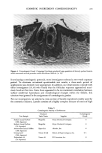
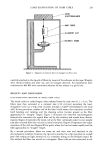
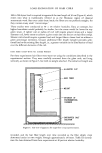
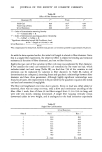
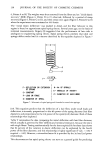
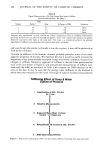
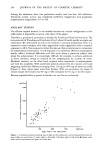
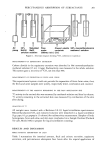
228 JOURNAL OF THE SOCIETY OF COSMETIC CHEMISTS EXPERIMENTAL Dark brown hair fibers* from DeMeo "blue string" hair were used in this investigation. The fibers were washed with one percent sodium laureth sulfate (3EO) [Conoco Inc.] at pH 7 and dried in air before use. For all fibers, diameter was estimated by the linear density method (7), weighing the fibers on a 3 mg capacity Precision Balance.•' WATER SETTING SINGLE FIBERS Single hair fibers (30 cm _+ 0.2 cm with 1 gram weight) were taped by their root end with Scotch Brand © electrical tape to a 7.98 mm diameter glass rod (tape covering about 0.5 cm of fiber), and a one gram weight (alligator clip) was attached to the tip end. The glass rod was placed in a wooden support with the rod at an angle of approximately 10 degrees from horizontal and the rod slowly turned, to produce a spiral coil about the rod with approximately 11 turns, the tip end taped to the rod. The rod was then placed in water (deionized) at room temperature for 30 minutes, then removed and allowed to dry at 40 percent RH overnight in a glove box containing a saturated solution of zinc nitrate. Data from these experiments represent means of 8 or more replicas unless otherwise noted. LOAD-ELONGATION MEASUREMENTS For load-elongation measurements electrical tape was placed over the root end of a single fiber, and the tape doubled over on itself, glued to a small cellulose-acetate tab, and a small hole punched through this fiber support. It was then secured to a 7.98 mm glass rod by applying a rubber band over the tape-fiber holder, and the fiber coiled and water set as above. Fibers coiled in this manner were carefully released from the rods and the root end hung on a hook attached to the probe of a Cahn -+ electrobalance, Model RM-2 (Figure 1). The tip end of the fiber was placed in an alligator clip attached to a Brookfield* Hellpath © stand Model D (a platform programmed to descend and/or rise at a constant speed), and then stretched to approach its taut length (29.7 cm), and reversed, at a rate of 2.18 cm/min, recording the load-elongation data on a strip chart recorder attached to the Cahn © balance. With this procedure the fiber did not actually uncoil during extension however, fibers were also tested by attaching the tip end to a clip glued to a 3 cm diameter petri dish (total wt. 3.1 g) resting on light mineral oil in a small dish on the Helipath © stand. By this method (extension) coil stretching and fiber uncoiling were achieved simultaneously. ELASTIC AND CREEP BEHAVIOR MEASUREMENTS Water set single hair coils were removed from the rods, hung vertically from alligator clips, and the length of the coiled hair measured with a cathetometer calibrated in tenths of a millimeter. For physical measurements, weights were made by cutting small pieces of masking tape, which were weighed on the 3 mg Precision balance, and *DeMeo Brothers, 39 West 28th St., New York, N.Y. •'Federal Pacific Electric Company, Newark, N.J. + Ventron Instruments Corp., Paramount, California. *Brookfield Engineering Labs, Stoughton, Mass.
Purchased for the exclusive use of nofirst nolast (unknown)
From: SCC Media Library & Resource Center (library.scconline.org)