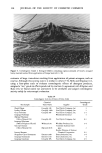
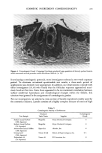
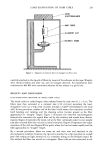
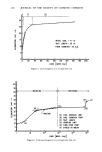
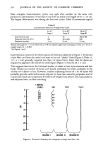
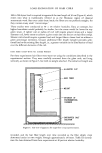
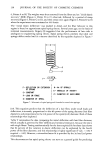
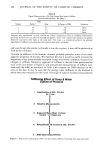
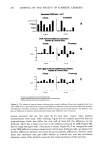
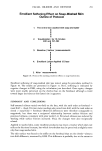
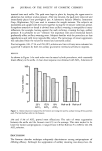
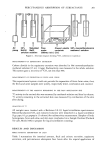
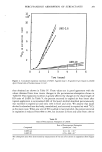
LOAD-ELONGATION OF HAIR COILS 233 200 to 500 dynes load is required to approach the taut length of 30 cm (Figure 4), which enters into what is traditionally referred to as the Hookean region of classical stress-strain work. But even under these loads, the fibers are not perfectly straight, for they contain many small "microcrimps." These studies were conducted at 40 + 2% relative humidity. Data at constant, but higher humidities would probably be similar, but the stress would be lower for any given strain. A tighter coil or radius of curl will require greater stress and a larger diameter coil, lower stress to achieve a given strain (see the section on hair fiber creep). Shorter coils should require a greater load and longer fibers a lower load to achieve a given percentage extension, because additional fiber length (weight) provides addi- tional load to the existing fiber length, i.e., a greater variation in the distribution of load over the different elements of the coil. HAIR FIBER CREEP WITH NO ADDED WEIGHT For these experiments hair fibers were water set using the conditions described in the experimental section. They were carefully removed from the glass rods, and hung vertically, as shown in Figure 5, but with no weight attached. The initial curl length was . • ALLIGATOR CLIP -- HAIR FIBER --WEIGHT • INTERIOR OF ENVIRONMENTAL CHAMBER r SATURATED SALT SOLUTION Figure 5. Side view of apparatus for single fiber creep experimentation. recorded, and the hair fiber length over time recorded as the fiber slowly crept downward under its own weight, through approximately 24 hours. Table III summa- rizes the data obtained from these experiments at 40 percent relative humidity.

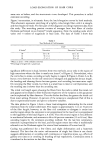
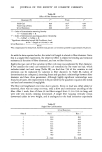
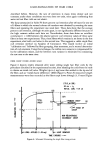
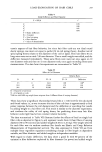
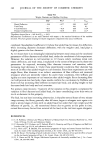
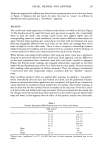
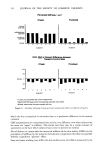
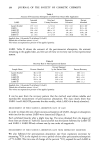
234 JOURNAL OF THE SOCIETY OF COSMETIC CHEMISTS Table III Effect of Fiber Diameter on Curl Parameter (Y) r 2+ F Calc. r 2ñ Initial Curl 0.59 16.95 0.64 Total Creep (24 hrs.) 0.83 39.7 • 0.84 % Curl Retention 0.68 22.0 • 0.73 +r 2 = Index of determination assuming linearity Y = Constant (Dia) + K -+r 2 = Index of determination assuming quadratic relationship Y = C•(Dia) 2 + C2(Dia) + K • Significant relationship beyond 99% Confidence Level 30 cm - (length at 1345 min) x 100 % Curl Retention = 30 cm *No compensation for Initial Curl, therefore max percent curl retention possible is approximately 80 percent. As with the data reported earlier, the initial coil length is related to fiber diameter. Since this is a single fiber experiment, the observed effect is related to bending and torsional resistance (a function of fiber diameter), and not to fiber friction. Eighty-four per cent of the variation in fiber coil creep was explained by fiber diameter. If we consider the total curl retained (% curl retention) by the water set hair, which includes initial curl and creep (Table III), we find that 73% of the variation in curl retention can be explained by variation in fiber diameter. In Table III, indices of determination are compared, assuming linear and quadratic relationships between fiber diameter and these three parameters. Although highly significant relationships were found in all cases, the improvement in fit provided by the quadratic equation (for initial curl and curl retention) is negligible. The fiber coil lengthened over time due to gravity. Since no load was either added or removed, there was no creep recovery, only a slow and continuous uncoiling of the fiber. After 1 week, four of these 30 cm fibers ranged from 11.3 to 19.6 cm long, and were still very slowly creeping downward. A single fiber hanging vertically creeps downward under its own weight, and is analogous to the load extension experiment Table IV Single Fiber Curl Retention % Curl Retention Fiber # Run 1 Run 2 1 43.4 3O.6 2 55.6 44.8 3 32.3 23.3 4 52.3 40.4 5 53.3 43.8 6 58.6 52.5 7 64.1 53.4 8 74.7 69.1 9 70.0 63.8 -- -- A • 56.0 B = 46.86
Purchased for the exclusive use of nofirst nolast (unknown)
From: SCC Media Library & Resource Center (library.scconline.org)