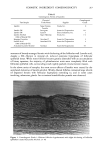
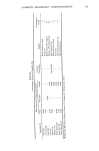
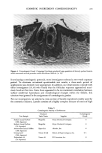
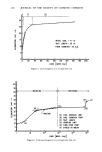
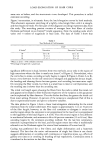
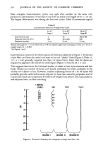
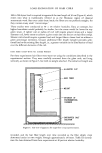
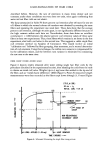
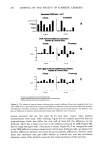
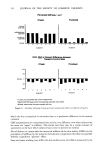
LOAD-ELONGATION OF HAIR COILS 235 described before. However, the rate of extension is many times slower and not constant under these conditions recovery does not exist, once again confirming that water set hair fiber coils are not elastic. The data summarized in Table IV show percent curl retention after 24 hours for one set of 9 fibers in which the second column of numbers was obtained by resetting the same fibers and repeating the experiment one week later. These data show that the average percent curl retention, although 10 units apart, is not significantly different because of the high variance within each data set. Nevertheless, these data show an excellent correlation (r --- 0.99) between the. relative percent curl retention values of these same fibers in these two experiments. Thus, those fibers.which retained a set better in the first experiment, also held a set better in the second one. This suggests a viable single fiber curl retention method via Analysis of Covariance. This would involve an initial "calibration run" followed by fiber grouping, then treatment, and a second determina- tion of curl retention. Using this technique, the Within runs variance is compensated for by the calibration values, and the between runs variance is minimized by conducting the test runs at the same time. FIBER CREEP UNDER ADDED LOAD Figure 6 depicts results obtained after water setting single hair fiber coils by the procedure described in the experimental section, then releasing the coils from the rods to obtain an initial curl value. Weights (up to 3 mg) were then added to the tip end of the fiber, and an "initial elastic deflection" (IED) (Figure 6, Point A) measured. Length measurements were then recorded as the fibers crept down through •21.5 hours (Figure 10 m (78.3 F DiK) 30 ½• = L T INITIAL cU•L = 9.9 cm TOTAL _ilL_ fPRIMARY CREEP (El CREEP (C) 'l•-'-` RECOVERY II (D} ! - - :lED IO ,,,•'.•LOAD APPLIED (I.45 rag} •"2 nd STAGE OF CREEP NON-I•ECOVERABLE SECONDARY CREEP I ' i I II• I1• I 20 30 40 LOAIJ: REMOVED TIME (-HOURS) • Figure 6. Schematic illustrating the single fiber creep process.

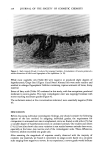
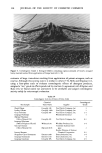
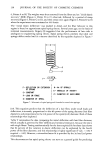
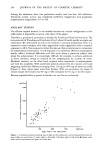
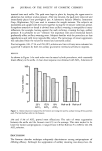
236 JOURNAL OF THE SOCIETY OF COSMETIC CHEMISTS 6, Points A to B). The weights were then removed from the fibers and an "initial elastic recovery" (IER) (Figure 6, Points B to C) observed, followed by a period of creep recovery (Figure 6, Points C to D), and then creep once again (Figure 6, Points D to E) when the experiment was terminated at 44.6 hours. The "initial elastic deflection" was studied in detail, and the fiber behavior in this region is found to approximate spiral spring theory. Several years ago, on the basis of torsional measurements, Bogaty (9) suggested that the performance of hair coils is analogous to engineering spring theory. Spiral spring theory predicts that ideal coil springs deflect under load in a manner described by the equation depicted in Figure 7 CPD3N F= Gd 4 F = DEFLECTION OR EXTENSION OF SPRING I i N: No. OF SPIRALS i G = MODULUS OF RIGIDITY C: CONSTANT I d: DIAMETER OF HAIR (WIRE) P = LOAD OR FORCE I D = DIAMETER OF SPIRAL I Figure 7. Schematic of spiral spring and formula for round wire springs. (10). This equation predicts that the deflection of a hair fiber, under small loads and deflections, is inversely proportional to the 4th power of the spring diameter (hair fiber diameter), and proportional to the 3rd power of the spiral (coil) diameter. Both of these relationships were explored. Table V summarizes the data comparing the initial deflection with hair fiber diameter, which actually is governed by fiber stiffness and torsional resistance, because the test is with single fibers. Testing mathematically for the best empirical fit for these data shows that 84 percent of the variation in elastic deflection can be explained by the fourth power of the fiber diameter, and this relationship is highly significant (F calc. = 109 F required = 4.45). However, a somewhat better fit is provided by the 3rd and 2nd power relationships. This demonstrates that spiral spring theory can serve as a general guide for predicting
Purchased for the exclusive use of nofirst nolast (unknown)
From: SCC Media Library & Resource Center (library.scconline.org)