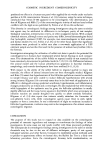
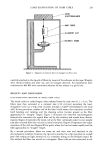
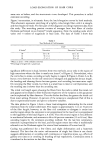
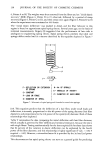
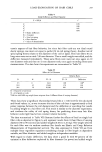
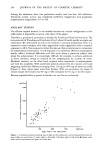
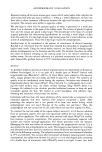
LOAD-ELONGATION OF HAIR COILS 237 Table V Initial Deflection and Fiber Diameter F = KP/d r 2 d d 2 d • d 4 F = Elastic deflection K = Constant P = Load on spring d = fiber diameter r 2 = index of determination 0.78 0.90 0.91 O.84 certain aspects of hair fiber behavior, but since hair fiber curls are not ideal round elastic springs, one must not expect a perfect fit to coil spring theory. Another test of spiral spring theory relates to the diameter of the coil or spiral. Here hair fibers 30 cm long were water set on rods 7.98 mm diameter. Then a small weight was added, and the deflection measured immediately. These same fibers were water set once again on 19 mm diameter rods and then on 32 mm diameter rods, once again recording these same measurements. The data from this experiment are summarized in Table VI. Table VI Effect of Coil Diameter Relative Ratio D N D 3- N D 3 ß N Deflection 9.5 11 9,431 1.00 1.00' 19.9 4.5 35,463 3.76 3.34 30.6 2.9 83,093 8.81 6.68 D = Diameter of coil (ram) N = # of spirals or coils *0.88 cm with 0.802 mg weight (mean response from 5 different fibers of varying diameter). These data show a significant relationship beyond the ce = 0.01 level for the calculated and found values, i.e., as one increases the size of the coil there is approximately a third power response between the coil diameter and the deflection or uncoiling that results by adding weight to a hair fiber coil. This result is similar to the diameter experiment, and confirms the utility of coil spring theory for predicting short term hair fiber behavior under light load at low constant relative humidity. The data summarized in Table VII illustrate further the effects of load on single hair fiber coils as depicted in Figure 6, and represent results from 19 hair fibers of varying diameter (50 to 99 microns) and added weights (0.182 to 2.26 rag). The weight selected for each fiber was via random numbers (for details see Elastic and Creep Behavior Measurements of Experimental section). The data expressed in Table VII are from multiple linear regression equations considering change in fiber length as dependent variable, and fiber diameter and added weight as independent variables. With regard to elastic deflection, the data show a good fit with 89 percent of the variation in fiber deflection explained by fiber diameter (lst power) and added weight

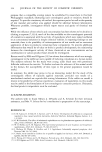
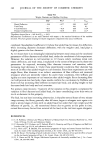
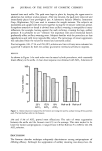
238 JOURNAL OF THE SOCIETY OF COSMETIC CHEMISTS Table VII Weight, Diameter, and Hairfiber Uncoiling Dia# Wt.# r 2 F(calc) Elastic Deflection -0.66 +0.77 0.89 66.4* Total Creep -- -- 0.03 0.3 % Curl Retention + 0.73 -- 0.29 0.60 11.9' Primary Creep Recovery - 0.34 + 0.78 0.74 22.2* *Significant beyond the o• = 0.01 level (F(req.) = 8.02). #Standardized Coefficients (11) are made standard with respect to the standard deviations of the variables involved. They have greater meaning for relative magnitude comparisons than actual coefficients. combined. Standardized coefficients (11) show that added load increases the deflection, while increasing diameter decreases deflection with the weights used, load plays a slightly greater role than diameter. At 21.5 hours there is no meaningful relationship between total creep and the combined parameters of fiber diameter and added load, under the conditions of this experiment. However, the variation in curl retention to 21.5 hours, which combines initial curl, elastic deflection, and total creep, is explained to the extent of 60 percent by these two parameters. As expected, increasing fiber diameter increases curl retention, while increasing load decreases it. Under these experimental conditions fiber diameter has more of an effect than added weight on curl retention. Since these experiments are with single fibers, fiber diameter is an indirect assessment of fiber stiffness and torsional resistance which are inherently related. So under these conditions, fiber stiffness and rigidity are more important to curl retention than added weight. Since decreasing fiber curl will provide less hair body, these results confirm the conclusions by Robbins and Scott (12) that increasing fiber stiffness increases hair body, and adding weight to hair decreases both hair body and curl retention. For primary creep recovery, 74 percent of the variation in this property is explained by variation in fiber diameter and added load, the latter contributing more than twice as much as diameter to this property. The final, but not least interesting observation, is that after several hours of very minute creep recovery, the fibers, generally after 40 hours, began to elongate once again or to enter a second stage of creep with no added load, but under their own weight and the influence of gravity, i.e., the extensional forces due to gravity at this point in time, exceed the recovery forces from removal of the load, so the coil once again elongates. REFERENCES (1) C. R. Robbins, Chemical and Physical Behavior of Human Hair (Van Nostrand Reinhold Co., New York, 1979), pp 153-183, and references therein. (2) P. Alexander, R. F. Hudson, and C. Earland, lVool, Its Chemistry and Physics (Chapman and Hall Ltd., London, 1963), pp 55-128, and references therein. (3) P.J. Huck and C. B. Baddiel, The mechanical properties of virgin and treated human hair fibers: A study by means of the oscillating beam method,J. Soc. Cosmet. Chem., 22,401-410 (1971). (4) M. M. Breuer, The binding of small molecules to hair. I. The hydration of hair and the effect of water on the mechanical properties of hair,J. Soc. Cosmet. Chem., 23,447-470 (1972). (5) D. E. Deem and M. M. Rieger, Mechanical hysteresis of chemically modified hair, J. Soc. Cosmet. Chem., 19, 395-410 (1968).
Purchased for the exclusive use of nofirst nolast (unknown)
From: SCC Media Library & Resource Center (library.scconline.org)