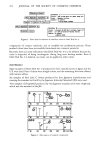
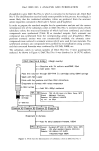
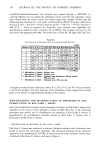
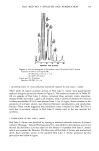
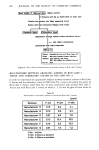
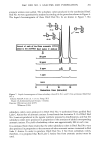
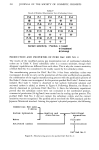
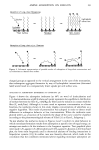
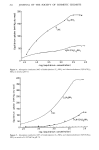
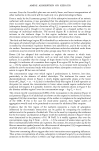
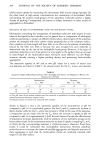
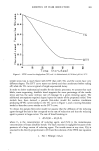
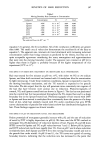
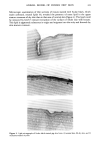
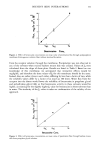
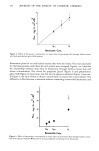
D&C RED NO. 9 ANALYSIS AND PURIFICATION 283 b 20 - 10- oo • Straight color Extended toner • Oo ß o a' 6b 7'0 a c L -50 -40 Figure 9. Result of colorimetric measurements plotted using Hunter Lab co-ordinates. O: Purified article e: Commercial article Pigment 15 parts, Titanium 42 parts, Oil 43 parts I dioxide I Mix I Sample for colorimetric measurement were investigated: 1) color tone 2) specific surface area and oil absorption and 3) electron microscopic appearance. For the purified article, the straight color and the one diluted with barium sulfate (35% pure dye) were comparable with the corresponding commercial articles. 1. Color tone: The color tones were measured by an Hitachi Spectrophotometer 607. Results are shown in Figure 9. Both the straight color and the extended toner have the same color tones as the commercial articles. 2. Specific surface area and oil absorption: The specific surface areas measured by nitrogen absorption using a Shimadzu Table VI Specific Surface Area and Oil Absorption i Oil absorption (ml/g x100) Specific sur- Samples face area(m•/g) Oil A Oil B Straight Commercial 56.10 105 100 color Purified 52.54 115 110 Commercial 19.85 55 50 Extended toner Purified 22.46 55 50

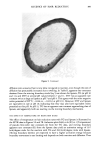
284 JOURNAL OF THE SOCIETY OF COSMETIC CHEMISTS Sorptograph ADS-lB and oil absorption measured according to the JIS standard are shown in Table VI. Both the specific surface area and the oil absorption of the purified articles are on levels comparable with those of the commercial articles. 3. Electron microscopic observation: The purified articles and the commercial article were observed by an electron microscope. Purified articles had the same shapes as corresponding commercial articles. The above results show that the purified pigment's physical properties are comparable with those of the commercial articles. Thus, the manufacturing process was established by combining the regular manufacturing process with a Red Lake C Amine purification process. The cost of the purified article manufactured by this process was fairly close to that of the commercial article, and the pigment can safely be used for cosmetics. Based on the above-mentioned approach, manufacturing processes of other colors such as D&C Red No. 17, D&C Orange No. 4, D&C Yellow No. 10, D&C Green No. 6, etc. have been explored. The colors free from contact sensitizers can be commercially manufactured and appear suitable for cosmetics. REFERENCES (1) S. Fregert and B. Gruvberger, Allergic dermatitis from solvent yellow 14 used in plastic, Contact Dermatitis, 2, 126 (1976). (2) T. Kozuka, M. Tashiro, S. Sano, K. Fujimoto, Y. Nakamura, S. Hashimoto, and G. Nakaminami, Brilliant Lake Red R as a cause of pigmented contact dermatitis, Contact Dermatitis, 5, 297-304 (1979). (3) T. Kozuka, M. Tashiro, S. Sano, K. Fujimoto, Y. Nakamura, S. Hashimoto, and G. Nakaminami, Pigmented contact dermatitis from azo dyes. I. Cross-sensitivity in humans, Contact Dermatitis, 6, 3.30-336 (1980). (4) Y. Sato, Y. Katsumura, H. Ichikawa, T. Kobayashi, T. Kozuka, F. Morikawa, and S. Ohta, A modified technique of guinea pig testing to identify delayed hypersensitivity allergens, Contact Dermatitis, 7, 225 (1981). (5) T. Sugai, Y. Takahashi, and T. Takagi, Pigmented cosmetic dermatitis and coal tar dyes, Contact Dermatitis, 3, 249-256 (1977).
Purchased for the exclusive use of nofirst nolast (unknown)
From: SCC Media Library & Resource Center (library.scconline.org)