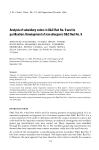
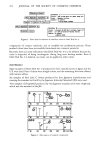
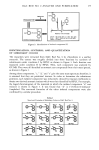
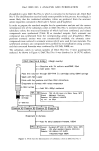
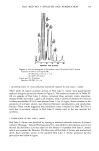
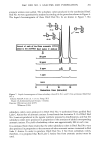
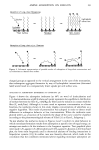
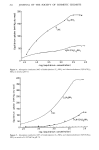
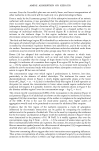
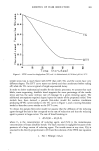
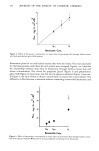
D&C RED NO. 9 ANALYSIS AND PURIFICATION 281 aromatic amines were added. The subsidiary colors produced in the synthesized D&C Red No. 9s were quantitatively analyzed according to the procedure shown in Figure 4. The liquid chromatograms of these D&C Red No. 9s are shown in Figure 7. No I Amount of each of the three aromatic amines' added to the purified Red Lake C Amine 9) ppm & . , 10 ppm I 1 ppm none L, Retention time (minutes) Figure 7. Liquid chromatograms of three subsidiary colors (P-0, P-•[•, and P-15) in synthesized D&C Red No. 9. Column: Partisil*, 6 mm i.d. x 25 cm, Temp.: R.T. Eluent: 4% dichloromethane/n-hexane, 3 ml/min. Detector: VIS (436 nm), 0.02 AUFS *Whatman (USA) subsidiary colors were produced in D&C Red No. 9 synthesized from purified Red Lake C Amine free of aromatic amines. It was found that derivative P-15 of D&C Red No. 9 was not produced in the regular synthetic process by desulfonation, and that the subsidiary colors were produced in proportion to the amounts of added corresponding aromatic amines. The yield of subsidiary colors was approximately 80% in each case. It is estimated from these results that the other subsidiary colors in D&C Red No. 9 are also produced in proportion to the amounts of other aromatic amines contained in Red Lake C Amine. In order to produce D&C Red No. 9 free from subsidiary colors, therefore, it is proposed that Red Lake C Amine free from aromatic amines must be used.

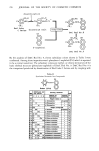
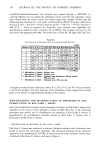
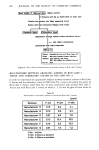
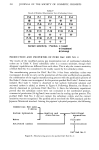
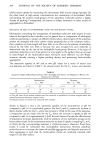
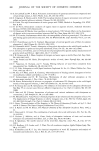
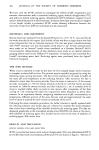
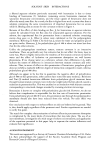
282 JOURNAL OF THE SOCIETY OF COSMETIC CHEMISTS Table V Result of Modified Maximization Test of Subsidiary Colors P-O P-1 P-2 P-3 P-4 P-5 P-6 P-7 P-8 P-9 P-10 P-11 P-12 P-13 P-14 P-15 P-16 P-17 P-18 Contact sensitivity ß Positive, -I- (weak) • (moderate) • (strong) PRODUCTION AND PROPERTIES OF PURE D&C RED NO. 9 The results of the modified guinea pig maximization test of synthesized subsidiary colors are in Table V. Every subsidiary color is a contact sensitizer, though their allergenic capabilities are different from each other. This is why the contact sensitivity of D&C Red No. 9 is considered to be mainly caused by the subsidiary colors. The manufacturing process for D&C Red No. 9 free from subsidiary colors was investigated. In order to carry out the production of this color as effectively as possible, the combination of the regular manufacturing process with the purification process of Red Lake C Amine was investigated. In this process purified Red Lake C Amine is not isolated. Red Lake C Amine is dissolved in hot sodium hydroxide solution and activated carbon is added, as shown in Figure 8. Following filtration, the tiltrate is directly diazotized to synthesize D&C Red No. 9. Since the laboratory experiment proved that the subsidiary colors were not contained in the synthesized product, commercial production (50 kg/batch) was carried out by scaling up that process. The purified D&C Red No. 9 did not contain the subsidiary colors, and the contact sensitivity was not recognized. The purified article met both the FDA standard and the Japanese Ministerial standard. Among the pigment's physical properties, the following Commercial Red Lake C Amine Sodium hydroxide Water Activated carbon Heating and dissolution Centrifugal separation Filtrate Diazotization D&C Red No.9 Figure 8. Manufacturing process for purified D&C Red No. 9.
Purchased for the exclusive use of nofirst nolast (unknown)
From: SCC Media Library & Resource Center (library.scconline.org)