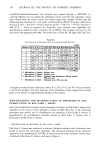
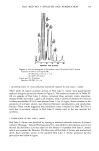
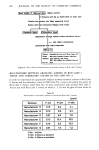
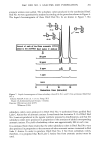
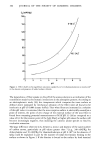
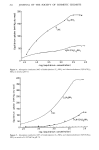
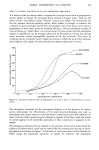
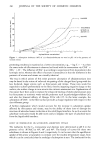
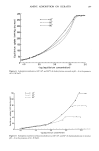
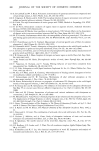
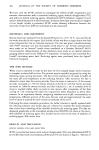
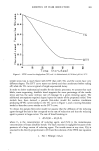
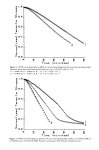
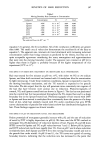
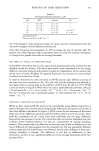
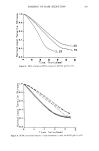
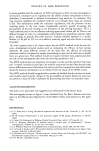
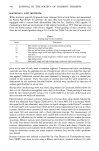
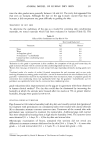
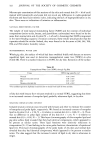
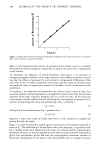
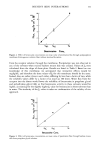
KINETICS OF HAIR REDUCTION 311 Table II Moving Boundary Rate Constants vs. pH pH DTT Lipoate TG 7 5.4 x 10 -7 1.5 x 10 -7 -- 8 7.7 x 10 -7 3.5 x 10 7 _ 9 2.9 x 10 6 2.4 X 10 -6 -- 10 1.1 X 10 5 1.2 X 10 -5 3.9 X 10 -6 11 -- 1.3 X 10 -5 1.1 X 10 -5 0.42 M Thiol, 22øC The units on K are cm M -• sec •/2. the 28 kcal/degree mole activation energy for lipoic acid has contributions from the activation energies of both diffusion and reaction. Note that increasing the temperature to 39øC increases the rate of reaction with TG greatly, but unlike high pH, high temperature does not cause the reaction mechanism to change from pseudo first-order to moving boundary. THE EFFECT OF STRAIN ON REDUCTION RATES In the SFTK method the hair is under strain which produces stress that is relieved as the disulfide bonds are broken. This stress must make some contribution to the energy difference between reactants and products leading to a dependence of the reaction rate on the level of strain. Wolfram (5) reported that strain can increase the rates of both oxidation and reduction of hair. In order to determine the effect of strain on SFTK reaction rate, different sections of the same hair were extended to 1.0%, 1.5%, and 2.0%, and the relaxation was allowed to take place without cycling prior to the addition of DTT (0.21 M, pH 9.0, 22øC). SFTK curves are shown in Figure 8. While there was only a small difference between 1.0% and 1.5% extension (K = 2.2 x 10 cm moles -• sec -3/2 vs. K = 2.6 x 10 cm mole -• sec-3/2), the rate of stress loss was considerably greater at 2.0% extension (K = 4.7 x 10 cm moles -• sec-3/2). INDIVIDUAL VARIATIONS IN REACTIVITY While we have observed SFTK results to be reproducible using different hairs from a given individual, we have also observed significant differences among the reactivities of hair from different individuals. In Figure 9, SFTK curves for the treatment of four hairs from each of two different individuals with 0.6 M TG, pH 9.5, at 21øC are shown. Note both the consistency of the curves from each individual and the large difference between the two groups of curves. The curves from the less reactive individual not only evidence slower reaction kinetics, but also are characteristic of moving boundary kinetics. This indicates that the difference in reactivity may be due to differences in the rate of diffusion of reducing agent into the unreacted hair. For one individual, diffusion is fast and pseudo first-order kinetics are followed for the other, diffusion is slow and a moving boundary is formed. The difference is not due to differences in hair dimensions, as there is not a significant difference in the average dimensions of the two groups of hair.

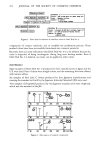
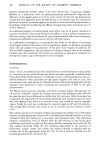
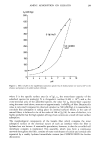
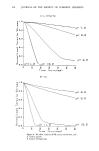
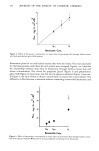
312 JOURNAL OF THE SOCIETY OF COSMETIC CHEMISTS A-TG 25 øC øc I I I I ! I Tim• (m i r•uL•8) oe -o N 0 Z 1. O 0.8 0.6 0.4 0.2 0.0 B-LipooLe lO C o Timm (mi nuLem) Figure 7. Effect of temperature on SFTK curves, 0.42 M thiol, pH 9.0. A. Sodium Thioglycolate B. Sodium Lipoate
Purchased for the exclusive use of nofirst nolast (unknown)
From: SCC Media Library & Resource Center (library.scconline.org)