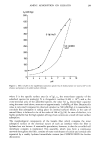
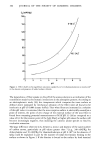
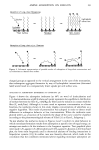
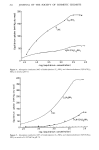
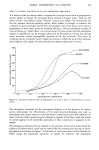
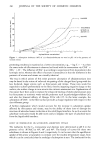
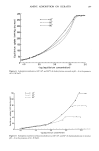
AMINE ADSORPTION ON KERATIN 299 with increasing pH clearly demonstrates that electrostatic interactions play an important role in the adsorption process. The initial binding of the cation to the fiber surface is most likely induced by charge-pairing, while the subsequent cooperative formation of hemi-micellar aggregates would be controlled to some extent by like-charge repulsion between cationic head groups. The non-conformity of the isotherms to Langmuir or Freundlich analysis is clear evidence that the structure of the adsorbed amine at fiber saturation cannot be a monolayer (even though such a structure may be formed at low concentration), while the positive entropy change associated with adsorption indicated the absence of an ordered structure in the surface layer. It is possible, however, that the sign of the entropy change may simply be a consequence of the randomization of adsorbed water molecules following displacement by long-chain ammonium ions. The results of this study nevertheless indicate that aggregation of the amine on the fiber by way of van der Waals' forces is a predominant feature of the adsorption process. Such a two-stage adsorption process in which multilayer formation follows electro- static interactions has been proposed as a likely mechanism for the binding of dodecylammonium chloride on mineral particles with a polar surface (16). As stressed earlier, the nature of the keratin surface upon which cationic species such as amines or indeed all types of ionic substances initially adsorb prior to bulk diffusion has not been clearly defined. Peters and Lister (30) in a fundamental thermodynamic study on the interaction of HC1 and Orange II free acid with wool came to the conclusion that adsorption occurs over a *'vast internal miceIlar surface in a mobile monolayer that inhibits water adsorption," thereby supporting a postulate that was proposed by Speakman (32) over fifty years ago. It has been suggested (33-34) that dyes and other substantive ions may be transported throughout keratin fibers by the cell membrane complex. This structure, which is thought to form a continuous network throughout the fiber, consists of a "sandwich" made up of two membranes (from adjoining cortical cells or cuticle layers) and inter-cellular cement. Such a model may be conceptually similar so that proposed by Speakman who described the internal structure of the fiber in terms of "lameliar micelies" separated by narrow pores which are capable of extensive swelling by water. REFERENCES (1) J. C. Harris, Adsorption of surface-active agents by fibers, Text. Res. J., 18, 669-678 (1948). (2) A. S. Weatherburn and C. H. Bayley, The sorption of synthetic surface-active compounds by textile fibers, Text. Res. J, 22, 797-804 (1952). (3) R. G. Aickin, The adsorption of sodium alkyl sulfates by wool and other fibers, J. Soc. Dyers & Colorists, 60, 60-65 (1944). (4) J. C. Griffith and A. E. Alexander, Equilibrium adsorption isotherms for wool/detergent systems. Parts I and II,J. Coil. Interface Sci., 25, 311-321 (1967). (5) G. Reese, Adsorption processes of amines on hair keratin, Fette, Seifen, Anstrichmittel, 68, 763-765 (1966). (6) G. V. Scott, C. R. Robbins, and J. D. Barnhurst, Sorption of quaternary ammonium surfactants by human hair,.J. Soc. Cosmet. Chem., 20, 135-152 (1969). (7) J. R. Cook and D. E. Rivett, Amine pretreatments for enhancing the polymer shrinkproofing of wool, Text. Res. J, 51,596-600 (1981). (8) I. W. Stapleton, The enhancement of shrinkresist efficiency of two polymers on wool by polyamine pretreatments, Text. Res. J, 53,445-452 (1983).

300 JOURNAL OF THE SOCIETY OF COSMETIC CHEMISTS (9) E. D. Carkhuff and W. F. Boyd, Volumetric determination of quaternary ammonium compounds and certain tertiary amines,J. Amer. Pharm. Assoc., 43,240-241 (1954). (10) S. O.Jansson, R. Modin, and G. Schill, The two-phase titration of organic ammonium ions with lauryl sulfate and methyl yellow as indicator, Talanta, 21,905-918 (1974). (11) R. Fields, The rapid determination of amino groups with TNBS, Methods in Enzymology, Vol. XXV, Part B, 464. (12) D. D. Perfin, Dissociation constants of organic bases in aqueous solution, Analytical Chemistry Division, IUPAC (1965), Butterworths. (13) H. Ohtaki and M. Maeda, Ionic equilibria in mixed solvents. VIII. Solvent effects on the dissociation of diprotic acids in aqueous methanol mixtures, Bull. Soc. Chem. Ja/an, 46, 2052-2056 (1973). (14) W. G. Crewther, Pretreatments which affect the susceptibility of wool to proteolysis. I. The effects of pH, wetting agents and solvent extraction, Proc. Int. 1Vool Textile Res. Con/Australia, Vol. C, 225-256, 1955. (15) B. E. Fleischfresser and G. N. Freeland, Measurement of external specific area of fibers by solution adsorption,J. A/p/. Polymer Sci., 20, 3453-3456 (1976). (16) B. Tamamushi and K. Tamaki, Adsorption of long-chain electrolytes at the solid/liquid interface. II. The adsorption on polar and non-polar adsorbents, Trans. Far. Soc., 5 5, 1007-1012 (1959). (17) C. H. Giles, A. P. D'Silva, and A. S. Trivedi, Use of p-nitrophenol for specific surface measurements of granular solids and fibres,J. Appl. Chem., 20, 37-41 (1970). (18) J. W. Rowen and R. L. Blane, Sorption of nitrogen and water vapor on textile fibers, Ind. Eng. Chem., 39, 1659-1663 (1947). (19) A.M. Sookne and M. Harris, Electrophoretic studies of wool, Amer. Dyestu•5 Rep., 28, 593-5% (1939). (20) Y. Nakamura, K. Kamada, and T. Tanaka, Wetting behavior of wool fibers considered from zeta-potential, Sen-I Gakkaishi, 28, 160-166 (1972). (21) C. H. Giles, Adsorption at solid/liquid interfaces, Surfactant Sci. Set., 11, (Marcel Dekker Inc., New York, 1981), pp 143-171. (22) M. Sen, S. P. Mitra, and D. K. Chattoraj, Thermodynamics of binding cationic detergents to bovine serum albumin, Colloids and Surfaces, 2, 259-275 (1981). (23) P. Somasundaran and D. W. Fuerstenau, Mechanisms of alkyl sulfonate adsorption at the alumina-water interface,J. Phys. Chem., 70, 90-96 (1966). (24) M. Rosen, Relationship of structure to properties of surfactants. III. Adsorption at the solid-liquid interface from aqueous solution,J. Amer. Oil Chemists Soc., 52,431-435 (1975). (25) S. R. Sivaraja Iyer and K. Subramanian, The influence of electrolytes on the adsorption of Chlorazol Sky Blue FF on viscose rayon fibres at different temperatures, J. Soc. Dyers & Colorists, 96, 185-188 (1980). (26) S. Saito and M. Yukawa, Interactions of polymers and cationic surfactants with thiocyanate as counterions,J. Coll. Interface Sci., 30, 211-218 (1969). (27) M. Mitsuishi and G. Aida, Physico-chemical properties of dye solution and the adsorption of dyes. VI. The displacement of Orange II anions on silk by inorganic ions,J. Soc. Fiber Sci. Technol. Japan, 20, 482-484 (1964) throughJ. Soc. Dyers & Colorists, 80, 618 (1964). (28) L. Peters, Thermodynamics of Dye Sorption, in The Theory of Coloration of Textiles, ed. by C. L. Bird and W. S. Boston (The Dyers Company Publications Trust, 1975). (29) I. E. Rattee and M. M. Breuer, The Physical Chemistry of Dye Adsorption (Academic Press, 1974), p 44. (30) L. Peters and G. H. Lister, The combination of acids and color acids with keratin, Disc. Far. Soc., 16, 24-34 (1954). (31) F. Perineau, J. Molinier, and A. Gaset, Study of adsorption isotherms of ionic and non-ionic surfactants on carbonised wool fibers, Can. J. Chem. Eng., 59, 82-88 (1981). (32) J. B. Speakman, The micelle structure of the wool fibre, Royal Soc. Lond. Proc., A, 132, 167-191 (1931). (33) J. H. Bradbury, J. D. Leeder, and I. C. Watt, The cell membrane complex, Applied Polymer Symp., No. 18, p. 227 (1971). (34) J. H. Bradbury and K. F. Ley, The chemical composition of wool. XI. Separation and analysis of exocuticle and endocuticle, Aust. J. Biol. Sci., 25, 1235-1247 (1972).
Purchased for the exclusive use of nofirst nolast (unknown)
From: SCC Media Library & Resource Center (library.scconline.org)