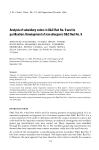
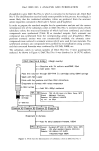
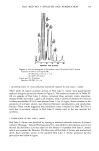
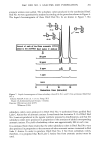
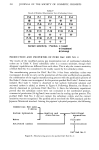
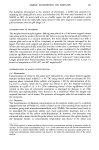
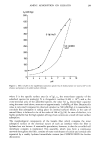
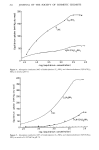
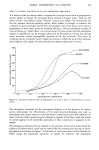
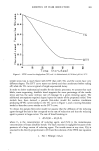
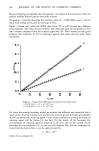
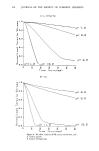
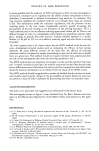
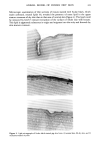
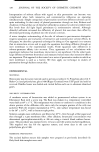
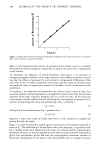
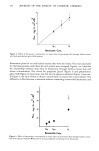
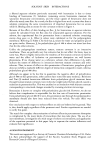
AMINE ADSORPTION ON KERATIN 289 Cf{rnM/Kg} 500 45O 400 350 300 250 200 150 100 50 pH Figure 1. Effect of pH on the equilibrium saturation uptake (Cf) of dodecylamine on wool at 40 ø in the absence and presence of added sodium chloride. where S is the specific surface area (in m2/g), Ym the mono-layer capacity of the adsorbed species (in moles/g), N is Avogadro's number (6.109 x 10²³), and a, the cross-sectional area of the adsorbed species, the value for Ym (mono-layer capacity) using the areas cited above, amounts to approximately 3 mM/Kg of fiber. Because this value is very small compared to observed uptakes (ca. 500 mM/Kg), it is reasonable to conclude that adsorption is taking place on internal surfaces which, in the case of natural fibers, is believed to be of the order of 100 m2/g (18). In view of this fact, it is highly probable that the high uptakes of long-chain cations are a result of inner-surface adsorption. The morphological components of the keratin fiber which comprise the inner adsorptive surface or the chemical nature of such an interface when the fiber is hydrated are not known. A reasonable speculation, however, is that the so-called cell membrane complex is implicated. This assembly, which may form a continuous network throughout the fiber, consists of outer membranes of cuticle and cortical cells separated by a readily hydrated intercellular cement (see CONCLUSION for further discussion).

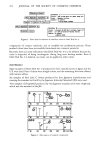
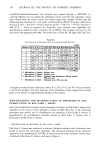
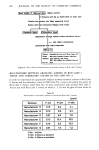
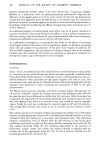
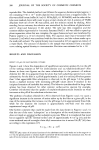
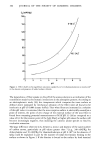
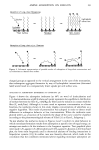
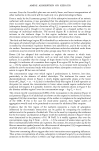
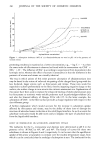
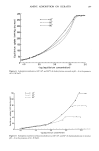
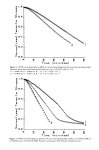
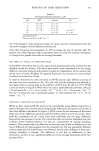
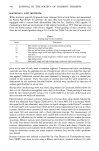
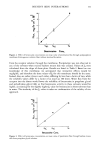
290 JOURNAL OF THE SOCIETY OF COSMETIC CHEMISTS Cf(mMIKg) 160 ¸ 140 _ 120 100 80 /o / SAL 60 z.13 o...._.•o• •'• E] 0•, 3 4 5 6 7 8 9 pH Figure 2. Effect of pH on the equilibrium saturation uptake (Cf) of 1,12-diaminododecane on wool at 40 ø in the absence and presence of added sodium chloride. The dependence of fiber uptake on the pH of the amine solution is an indication of the contribution made by electrostatic interactions in the adsorption process. According to an electrophoretic study (19), the components which comprise the inner surface as defined above (prepared by mechanical abrasion of the fiber) were all found to be isoelectric at pH 4.5 (0.005 acetate buffer). Thus when fibers are immersed in a solution of this pH value it is assumed that the inner sorptive surface is electrically neutral [as a point of interest, the point of zero charge of the external surface of the wool fiber is found from streaming potential measurements to be atpH 3.5 (20) as compared to a value of 6.3 for the isoinoic point of the bulk fiber] at higher pH values the surface will become increasingly negative, thus inducing the cationic amine species to bind by coulombic attraction. The large difference observed in Cf between a mono- and diamine of the same number of carbon atoms, particularly at pH values greater than 7 [e.g., 240 mM/Kg for dodecylamine and 70 mM/Kg for diaminododecane at pH 8 (40 ø) in the absence of salt], could be explained in part by the manner of initial electrostatic binding to the surface as shown in Figure 3. If the diamine is bound to the surface by both terminal
Purchased for the exclusive use of nofirst nolast (unknown)
From: SCC Media Library & Resource Center (library.scconline.org)