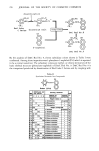
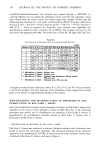
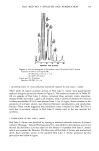
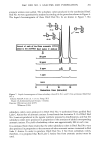
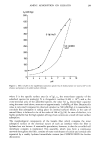
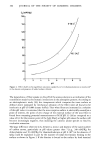
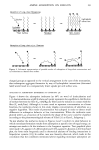
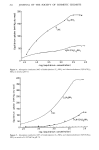
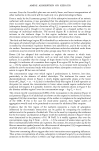
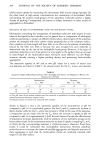
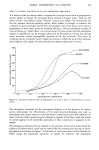
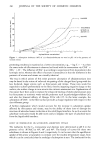
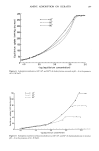
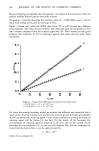
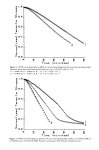
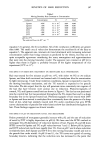
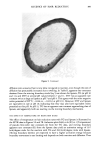
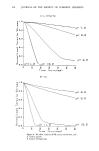
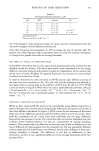
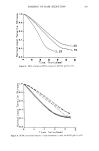
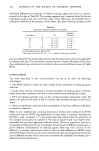
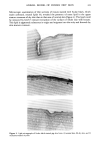
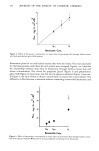
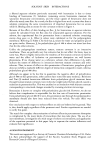
KINETICS OF HAIR REDUCTION 307 Table I Moving Boundary Rate Constants vs. Concentration Compound Concentration K r 2 rmsd Lipoate .07M 4.4 x 10 -6 .9997 0.004 Lipoate .17M 4.3 x 10 -6 .9998 0.003 Lipoate .29M 3.8 x 10 -6 .9999 0.006 DTT .07M 4.6 x 10 -6 .9995 0.008 DTT .14M 3.8 x 10 -6 .9996 0.008 DTT .33M 3.6 X 10 -6 .9971 0.013 pH 9.0, 25øC The units on K are cm M -• sec -3/2. equation 5. In general, the fit is excellent. All of the correlation coefficients are greater than 0.995. The small r.m.s.d values also demonstrate the excellent fit of the data to equation 5. The apparent rate constants do trend downward with increasing reductant concentration rather than being constant as predicted by the theory, but they are in quite acceptable agreement considering the many assumptions and approximations that went into the moving boundary model. The apparent rate constant at pH 9.0 is higher than those in Figure 3, probably because of the higher temperature of this experiment (25øC vs 220). THE EFFECT OF REDUCTIVE TREATMENT ON METHYLENE BLUE PENETRATION Hair was treated for five minutes at pH 9.0, 21øC, with either 5% TG or 2% sodium lipoate, and then thick sectioned and stained with 1% methylene blue for examination by light microscopy. Under these reduction conditions, lipoate is expected to react by the moving boundary mechanism, and the TG reaction is expected to be pseudo first-order. We also expect that the dye will penetrate more extensively into regions of the hair that have become more porous due to reduction. Photomicrographs of control, TG, and lipoate treated hairs are shown in Figure 5. The dye has not penetrated into the control hair but has penetrated throughout the TG-treated hair and to a sharp boundary line in the lipoate-treated hair. Photomicrographs of hair treated with DTT or lipoate and then stained in methylene blue consistently show the presence of a sharp front of dye, while hair similarly treated with TG under conditions that give SFTK curves characteristic of pseudo first-order kinetics show dye distributed throughout the hair. These findings support our kinetic models. THE EFFECT OF pH ON REDUCTION RATES AND MECHANISMS Redox potentials of mercaptans generally increase with pH, and the rate of reduction of wool by DTT is highly dependent on pH (4). We have used the SFTK method to investigate the pH dependence of reduction kinetics of hair. Figures 6A and 6B show SFTK curves for lipoate and TG at pH values between 7 and 11. Below pH 10, lipoate and DTT reduce hair much more rapidly than TG. Even at pH 7 and 8 where reduction is relatively slow, both lipoate and DTT fit to the moving boundary model and not to the pseudo first-order model. At pH 10 and 11, the TG curves are typical of moving boundary kinetics, indicating that the reduction rate has increased to the point that

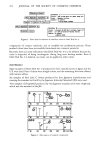
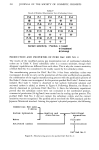
Figure 5. Photomicrographs of A-control, B-TG, and C-lipoate-treated hair stained with methylene blue, Mag 550x.
Purchased for the exclusive use of nofirst nolast (unknown)
From: SCC Media Library & Resource Center (library.scconline.org)