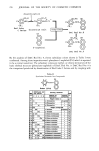
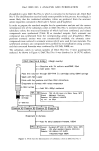
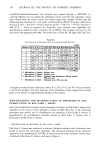
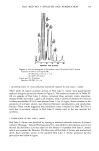
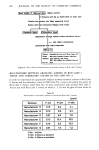
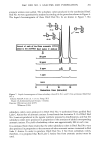
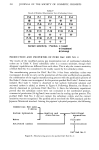
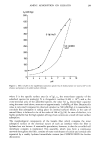
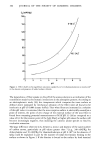
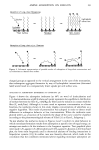
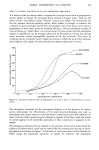
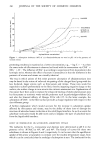
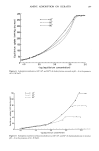
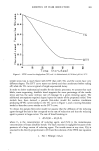
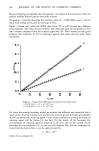
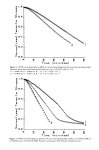
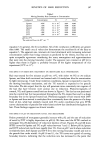
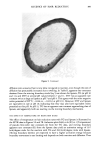
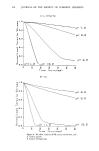
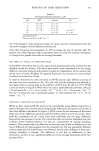
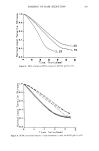
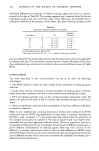
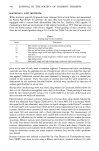
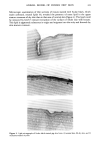
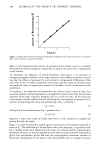
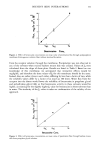
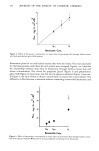
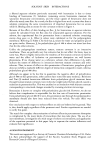
KINETICS OF HAIR REDUCTION 309 Figure 5. Continued diffusion into unreacted hair is now slow compared to reaction, even though the rate of diffusion has presumably increased due to swelling. In Table II, apparent rate constants obtained from the moving boundary model (eq 5) are shown for lipoate, TG (at pH 10 and 11), and DTT at several pH values between 7 and 11. DTT has an apparent rate constant twice as large as lipoate at pH 7 and pH 8. This agrees with the more negative redox potential of DTT (--0.366 vs. --0.322v) at pH 8 (2). However, DTT and lipoate are equivalent in rate at pH 10, indicating that they may also have equivalent redox potentials at this pH. At pH 11, TG has an apparent rate constant approaching that of lipoate, and apparently both are reacting via the moving boundary mechanism. THE EFFECT OF TEMPERATURE ON REDUCTION RATES The effect of temperature on hair reduction rates with TG and lipoate is illustrated by the SFTK data in Figures 7A and 7B. Arrhenius plots (ln(k) or In (K) vs. 1/Temperature) of pseudo first-order rate constants (k) from the TG data, and moving boundary apparent rate constants (K) from the lipoate data yield an activation energy of 19.7 kcal/degree mole for the reaction with TG and 28.0 kcal/degree mole with lipoate. Moving boundary kinetics are expected to have a higher activation energy because boundary movement is rate limiting and depends on both reaction and diffusion. Thus

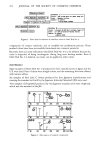
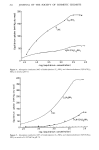
310 JOURNAL OF THE SOCIETY OF COSMETIC CHEMISTS A-LIPOATE pH 7.0 pH 8.0 pH 1•,.0 , , , pH Time (m i nu•r. es) oe -o N ,•,1 E oe 0 Z B-TO pH pH ß • ,pH Time (minu•es) Figure 6. The effect of pH on SFTK curves, 0.42 M thiol, 22øC. A. Sodium Lipoate B. Sodium Thiolglycolate 10.0
Purchased for the exclusive use of nofirst nolast (unknown)
From: SCC Media Library & Resource Center (library.scconline.org)