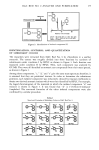
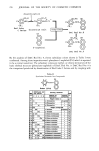
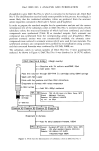
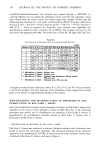
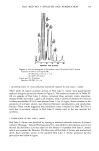
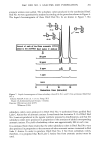
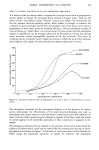
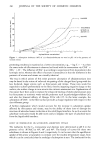
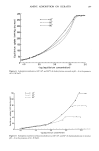
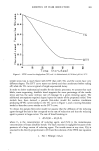
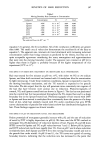
278 .JOURNAL OF THE SOCIETY OF COSMETIC CHEMISTS acid/N,N-dimethylformamide the solution was passed through a SEP-PAK C•8 cartridge (Waters Co.) to adsorb the subsidiary colors, and then the subsidiary colors were eluted with the solvent. First, the eluted matter was roughly divided into the following four fractions (A • D) under condition III by HPLC: (P-0) was collected in fraction A, (P-1 - P-6, P-9 - P-10) in fraction B, (P-7 • P-8, P-11 • P-15) in fraction C, and (P-16 • P-18) in fraction D. Secondly, each fraction was separated and quantitatively analyzed under condition IV by HPLC. The average recovery by this procedure was approximately 80%. The results are in Table III. All eight D&C Red No. Table III Determination of Subsidiary Colors in Commercial D&C Red No. 9 [ppm•] Sample No. P-0 P-6 P-7 P-9 IP-12 P-13 P-14 P-15 P-16 P-17 P-18 Total I m 0.7 m 0.5 • 32. 42. 2.9 1.6 • 13.1 2 1.0 • 0.5 0.7 4.4 0.7 0.8 4.4 1.0 0.7 • 142. 3 • 7.4 m -- 19.0 4.6 !3.6 22.4 1.7 68.7 4 0.5 2.1 • • 3.7 0.9 1• 1.0 • 10.0 . 5 7.5 1.3 27.1 1.7 t0'4 14.8 10.2 6.5 1.8 71.3 6 5.1 • 1.0 1.5 22.1 2.4 -- 12.7 8.2 4.2 1.3 58.5 7 4.7 8.9 1.1 I • 6.1 6.2 1.8 1.3 30.1 8 14.8 m 3.5 • 5.2 3.4 1.3 24.8 20.0 7.0 3.9 83.9 m: not detected 1-3. Manufacturer A (Japan): Straight color 4. Manufacturer B (Japan): Straight color 5-7. Manufacturer C (USA) : Extended toner (Substratum: Barium sulfate) 35% pure dye 8. Manufacturer C (USA) : Extended toner. 87% pure dye 9 samples contained some subsidiary colors.,P-12, P-15, P-16, and P-17 were contained in all of the samples. The total amounts of the subsidiary colors ranged from several ppm, at the lowest, to approximately 80 ppm at the highest. IDENTIFICATION AND QUANTIFICATION OF IMPURITIES IN AND PURIFICATION OF RED LAKE C AMINE Since the unsulfonated aromatic amine impurities contained in Red Lake C Amine were regarded as the source of the subsidiary colors in D&C Red No. 9, the following procedure was carried out: 1) identification of impurities in Red Lake C Amine 2) quantification of unsulfonated aromatic amines in Red Lake C Amine and 3) purification of Red Lake C Amine. 1. IDENTIFICATION OF IMPURITIES IN RED LAKE C AMINE Red Lake C Amine was dissolved in sodium hydroxide solution and chloroform was added to extract the non-acidic impurities. The structural formulae of the extracted impurities were confirmed by GC-MS. It was found that many aromatic amines were contained in Red Lake C Amine, as shown in Figure 5.

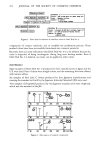
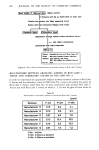
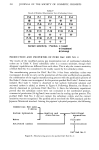
D&C RED NO. 9 ANALYSIS AND PURIFICATION 279 i Fl©t©ntion tim© {minut©$} Figure 5. Gas chromatogram of chloroform extract from Red Lake C Amine. Column: 5% OV-17 on Uniport HP 80-100 mesh, 2 mm i.d. x 1 m 80-180øC (4øC/min.) Carrier gas: N2, 30 ml/min. Detector: NP-FID, 32 x 10 2. QUANTIFICATION OF UNSULFONATED AROMATIC AMINES IN RED LAKE C AMINE Three kinds of typical aromatic amines in Red Lake C Amine were quantitatively analyzed using the procedure shown in Figure 6. The analytical results are in Table IV. All six samples of Red Lake C Amine contained three aromatic amine impurities. Aniline (P-0A) was below 1 ppm in all samples, while 3-chloro-p-toluidine (P-12A) and 4-chloro-m-toluidine (P-15A) were present from 1.2 to 15.4 ppm. Some variation in the amounts of aromatic amines was observed between manufacturers and production batches. These results suggested that subsidiary colors contained in D&C Red No. 9 were due to aromatic amines in Red Lake C Amine used as the raw material for synthesis. 3. PURIFICATION OF RED LAKE C AMINE Red Lake C Amine was dissolved by heating in sodium hydroxide solution. Activated carbon ("Shirasagi," Takeda Pharmaceutical Co.) was added to the solution, and it was filtered. Hydrochloric acid was added to the flitrate to crystallize Red Lake C Amine which was separated by filtration. The filter cake of Red Lake C Amine was washed and dried. Each aromatic amine in the purified Red Lake C Amine produced by this procedure was below 0.5 ppm.
Purchased for the exclusive use of nofirst nolast (unknown)
From: SCC Media Library & Resource Center (library.scconline.org)