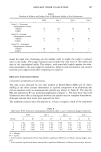
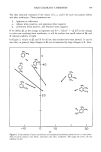
HAIR COLORANT CHEMISTRY 305 To sum up, the reactions involved in color formation in oxidative dyeing are sequential oxidation of the primary intermediates followed, in each case, by competitive reactions of the resulting imine with the various couplers (Figure 4). The final color produced is a function of the amounts and nature of the individual primary intermediates and couplers in the composition and the pH at which the process is performed. Obviously, the individual dyes are not formed synchronously and the shade does not develop monotonally. Thus we would expect, as found in practice, that the tonal quality of the shade produced will be time-dependent. From the above discussion, it is evident that, while it is not possible to define fully the process of oxidation dyeing in quantitative terms, a stage of understanding exists where formulation of products does not have to proceed entirely by trial and error. SEMIPERMANENT COLORANTS The considerations which go into the formulation of semipermanent hair colorants are quite different from those which have been enumerated for the permanent hair colorants. The semipermanent products make use of preformed direct dyes which are neutral, sparingly soluble, and of relatively low molecular weight. Dyes currently used in the United States are listed in Table II. It can be seen that they are nitrophenylene-diamine and nitroaminophenol derivatives, supplemented with some aminoanthraquinones. Table II Dyes Currently Used in Semipermanent Colorants in the United States Dye Color N-(2-Hydroxyethyl)-2-nitroaniline N•-Tris(hydroxymethyl)methyl-4-nitro-0-phenylenediamine N•-(2-Hydroxyethyl)-2-nitro-p-phenylenediamine N s,N4,N4-Tris(2_hydroxyethyl)_2_nitro_p_phenylenediamine O,N-Bis(2-hydroxyethyl)-2-amino-5-nitrophenol 4-Hydroxy-2'-nitrodiphenylamine 4-Amino-4'-bis(2-hydroxyethyl)-aminoazobenzene 1,4,5,8-Tet raminoanthraquinone 1,4-Diaminoanthraquinone Yellow Yellow Red Blue-Violet Yellow Orange Orange Blue Violet The selection of dyes for use in formulating these products involves consideration of color, molecular size, and stability of the components. Research into the relationship between color or stability and molecular structure has given rise to some interesting correlations which will be discussed below. It has been found that most shades needed to make up a line of products can be achieved through the use of appropriate proportions of yellow, orange, red, and blue dyes. However, it must be remembered that human hair has variable porosity from root to tip. Low molecular weight dyes can penetrate into the cortex even near the root and, obviously, even more readily into the more porous ends. However, since the dyes used have no inherent affinity for the hair keratin, they are readily washed out of the ends so much so, that much of the color can be lost during the rinse step at the end of the process. In order to achieve a uniform shade over the full length of the fiber, it is

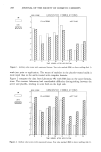
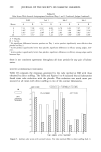
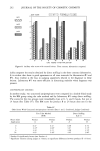
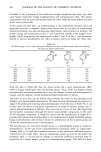
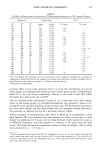
306 JOURNAL OF THE SOCIETY OF COSMETIC CHEMISTS advisable to use a mixture of low molecular weight (single benzene ring) dyes with some higher molecular weight (diphenylamine and anthraquinone) dyes. The former can penetrate and are quite well retained near the roots, while the latter behave similarly at the more porous ends. In the search for new dyes, an understanding of the relationship between color and molecular structure is valuable. Studies have shown that in any series of nitrobenzene derivatives bearing two electron-donating substituents, such as amino or hydroxy, the isomer having the substituents in the 2- and 5-positions absorbs at the longest wave- length, while those having the substituents in the 2- and 4- or the 3- and 4-positions absorb at shorter wavelengths (4). This is shown clearly in Table III. Note also, Table III The Wavelength of the Visible Absorption Maxima for a Series of Nitrobenzene Derivatives Bearing Two Electron Donor Substituents D D' NH 2 NH 2 474 408 389 OH NH 2 446 394 394 NH 2 OH 454 370 394 NH 2 CH• 443 370 395 OH CH 3 393 342 360 OH OH 407 349 368 D from the data in Table III, that the amino group has a more bathochromic effect (shift to longer wavelength) than the hydroxy group. Thus, while the deepest colored unsubstituted nitrophenylenediamine is red, the deepest colored nitroaminophenol is orange, and the deepest colored hydroxymethoxynitrobenzene is yellow. The color of nitro dyes can be shifted more towards the violet by the introduction of N-alkyl or N-hydroxyalkyl substituents. We have recently determined the spectra of a range of N-substituted 2-nitro-p-phenylenediamines. From the data in Table IV, it can be seen that the effect of successive introduction of single N-methyl groups into 2- nitro-p-phenylenediamine is additive. This gives rise to a series of dyes that range from the red parent compound, through the mauve mono-methyl compounds, to the violet N•,N4-dimethyl compound. It should be noted that the introduction of single N-(2- hydroxyethyl) groups has a similar effect to the introduction of single N-methyl groups, being a bathochromic shift of about 26 nm for substitution on the m-amino group and 20 nm for substitution on the 0-amino group. The introduction of a second N-methyl group to a methylamino groups is, however, nonproductive. In the case of the 0-dimethylamino compound, there is a large hypso- chromic shift ( - 50 nm) and a marked reduction in the extinction coefficient which is characteristic of a steric effect. Such an explanation cannot account for the small hyp- sochromic shift (--10 nm) and no change in extinction coefficient resulting from in- troduction of a second methyl group to a m-methylamino group. This lack of a bath-
Purchased for the exclusive use of nofirst nolast (unknown)
From: SCC Media Library & Resource Center (library.scconline.org)