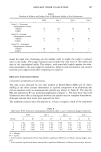
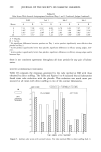
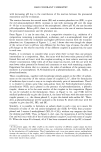
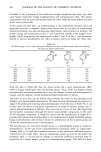
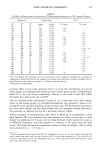
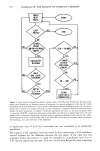
HAIR COLORANT CHEMISTRY 307 Table IV The Effect of Substituents on the Spectra of 2-Nitro-p-phenylenediamines in 95% Aqueous Ethanol Substituent Visible Band A K* N • N 4 N 4 Kmax (log ½) N•-subst. N4-subst. H H H 471 (3.65) - - Me H H 497 (3.67) + 26 - he? H H 495 (3.67) +24 - H Me H 492 (3.56) - + 21 H he H 490 (3.56) - + 19 Me Me H 515 (3.60) + 23 + 18 Me he H 520 (3.66) + 30 +23 he Me H 518 (3.56) + 26 + 23 he he H 513 (3.62) +23 + 18 H Me Me 480 (3.55) - - 12 H Me he 500 (3.47) - + 10 H he he 510 (3.50) - +20 Me Me Me 506 (3.53) + 26 - 9 he Me Me 505 (3.52) +25 - 13 Me Me he 528 (3.50) + 28 + 8 Me he he 536 (3.61) + 26 + 16 he he he 536 (3.59) + 26 + 23 Me Pr H 523 (3.54) - +26 Me Pr Pr 542 (3.52) - + 19 Me Et H 517 (3.61) - + 20 Me Et Et 532 (3.52) - + 15 Me2 H H 442 (2.95) - 55 - +8 +13 * The wavelength shift resulting from the introduction of the indicated N-substituent, obtained by comparison of Kmax with that for the compound not having that substituent. Ordinary numbers relate to alkyl substituents and italicized numbers to 2-hydroxyethyl substituents. ? Represents 2-hydroxyethyl. ochromic effect is even more suprising when it is noted that introduction of a second ethyl, propyl, or 2-hydroxyethyl group onto the m-amino group results in bathochromic shifts of 14, 19, and 20 nm, respectively. Clearly, in the series of dyes (XIV)-(XV) the choice for a blue-violet dye is (XIV). The use of hydroxyethyl substituents in place of, or in conjuction with, alkyl substit- uents on the amino groups of nitrophenylenediamines also provides a means of af- fecting the water and lipid solubility of the resultant dyes. The hydroxyethyl derivatives are more water-soluble and less lipid-soluble than the analogous methyl derivatives, thus assisting in tailoring the dye for a particular delivery system. Another property of semipermanent dyes which is deserving of consideration is their light fastness. We have examined the light fastness of a series of nitro dyes on wool flannel 2 by irradiation for 8 hours with an Atlas Enclosed Violet Carbon Arc lamp in an FDA-RC Fadometer, with the samples at a distance of 10 inches from the light source. This lamp has spec. tral components similar to those of sunlight, with no short wave ultraviolet (i.e., 275 nm.). 2 Pieces of standard worsted wool cloth (S/523), measuring 60 cm by 14 cm, were washed with soap and water, rinsed with water, and dyed for 20 min at 30øC in a dye bath comprised of 0.1 g of the dye, 45 ml water, 5 ml ethanol, and 0.1 g of Standapol 7023 conc. © The cloth was removed from the bath, rinsed with water, and allowed to air dry.

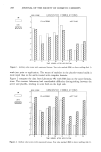
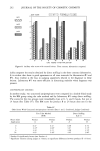
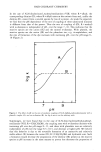
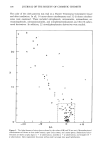
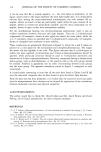
308 JOURNAL OF THE SOCIETY OF COSMETIC CHEMISTS The color of the cloth patterns was read on a Hunter Tristimulus Colorimeter before and after irradiation. In all, 34 mono-donor nitrobenzenes and 32 di-donor nitroben- zenes were examined. These included nitrophenols, nitroanisoles, nitroanilines, ni- troaminophenols, nitroaminoanisoles, and nitrophenylenediamines and their N-substi- tuted derivatives. In addition, 22 nitrodiphenylamine derivatives were studied. 2O x lo 0 x I I I I -2 0 -12 ++.,.+ + ,.14. .+ * ++ .%, I +8 o Figure 5. The light fastness of nitro-dyes as shown by the values of AL and X (see text). Monosubstituted nitrobenzenes are shown as dots (ortho isomer), open circles (meta), and crosses (para) disubstituted nitro- benzenes are shown as plus signs (0 + m substitution), asterisks (0 + p substitution), and triangles (m + p substitution). Dyes represented by points within small rectangle have good lightfastness.
Purchased for the exclusive use of nofirst nolast (unknown)
From: SCC Media Library & Resource Center (library.scconline.org)