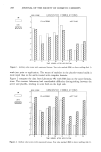
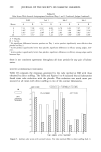
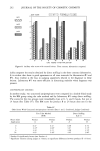
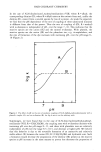
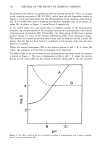
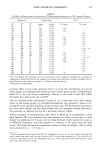
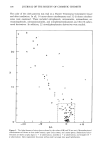
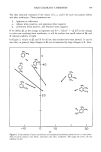
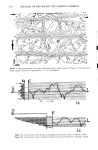
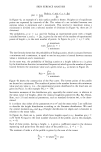
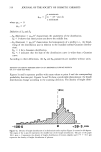
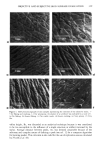
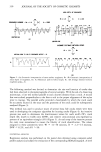
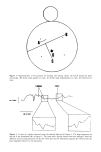
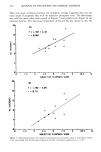
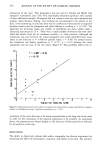
HAIR COLORANT CHEMISTRY 309 The data obtained consisted of the values of L, a, and b for each test pattern before and after irradiation. These parameters are: L, lightness or reflectance a, redness when positive, and greenness when negative b, yellowness when positive, and blueness when negative. If we define AL as the change in lightness and X = ,/{(A a) 2 + (A b) 2} as the change in color tone resulting from irradiation, it will be evident that small values of AL and X indicate stability to light. In Figure 5, values of AL and X for all the dyes studies have been plotted. It can be seen that, in general, large changes in AL are accompanied by large changes in X. Also, •~• b --20 NO:• Figure 6. Tonal stability of some nitroanilines and nitrophenylenediamines plotted on an a, b color plane. Tails of arrows indicate color before, and heads color after, irradiation. The longer the arrow, the less lightfast the dye. I I I I -lO o lO 30

310 JOURNAL OF THE SOCIETY OF COSMETIC CHEMISTS it can be seen that AL is usually negative, i.e., the color fades on irradiation. In the figure, points close to the origin represent the most light-stable dyes. It is immediately obvious that, among the mono-substituted nitrobenzenes, the ortho isomers (30 ex- amples, shown as closed circles) are particularly stable while the para isomers (8 ex- amples, shown as crosses) are particularly unstable, and the meta compounds (12 ex- amples, shown as open circles) have intermediate stability. For the nitrobenzenes bearing two electron-donating substituents, there is also an evident correlation between structure and light fastness. Thus the 2,5-disubstituted compounds (18 examples, shown as plus signs) are clearly the most stable, while the 2,4- (3 examples, shown as asterisks) and 3,4-disubstituted compounds (12 examples, shown as triangles) have moderate-to-poor stability. These correlations are graphically illustrated in Figure 6, where the a and b values are plotted on a color plane for the nitroanilines and nitrophenylenediamines. The longer the arrow, the less lightfast is the color. This figure indicates that if a yellow-green to yellow dye were required, p-nitroanilines and 4-nitro-m-phenylenediamines should be ignored, while particular attention should be paid to 0-nitroaniline derivatives and derivatives of 4-nitro-0-phenylenediamine. However, compounds having a disubstituted amino group, such as dimethylamino, in the position ortho to the nitro group should be avoided. Stability is apparently lost by steric overcrowding between such groups and the nitro group. The apparent anomalous points in Figure 5 correspond to such compounds. It is particularly interesting to note that all the nitro dyes listed in Tables I and II fall into the structural categories that we have found to give the better light fastness. From the data that has been presented, it is evident that the search for novel and useful dyes for semipermanent hair colorants can be focused by application of the correlations between molecular structure and physical properties. ACKNOWLEDGEMENTS The author would like to thank Mr. David Cohen and Drs. Keith Brown and David Palling, all of Clairol Laboratories, for their technical assistance. REFERENCES (1) J. F. Corbett, p-Benzoquinonediimine--A vital intermediate in oxidative hair dyeing,J. Soc. Cosmet. Chem., 20, 253 (1969). (2) J. F. Corbett. The role of meta difunctional benzene derivatives in oxidative hair dyeing. I. Reaction with p-diamines, Ibid., 24, 103 (1973). (3) K. C. Brown and J. F. Corbett. The role of meta difunctional benzene derivatives in oxidative hair dyeing. II. Reactions with p-aminophenols, Ibid., 30, 191 (1979). (4) J. F. Corbett. A relationship between the color and structure of simple nitro dyes, J. Soc. Dyers and Colorists, 83, 273 (1967).
Purchased for the exclusive use of nofirst nolast (unknown)
From: SCC Media Library & Resource Center (library.scconline.org)