j. Soc. Cosmet. Chem., 36, 393-411 (November/December 1985) Physical stability of suspensions JOEL L. ZATZ, Rutgers College of Pharmacy, P.O. Box 789, Piscataway, NJ 08854. Received June 25, 1985. Presented at Scientific Session I, "Suspension Technology," Annual Scientific Seminar, Society of Cosmetic Chemists, May 9, 1985. Synopsis Because of their inherent lack of stability in a thermodynamic sense, the "stability" of suspensions must be described in terms of a time frame and the properties of greatest importance. Thorough wetting and particle dispersion are important first steps in the formation of uniform suspension systems. The critical surface tension of the solid provides guidance in the selection of surfactants used to promote wetting. Contact angles on powders may be measured by several techniques that overcome the problems of surface roughness and particle dissolution. Particle size, density difference between particles and medium, and rheology of the medium are important factors in sedimentation. Viscosity can be adjusted within wide limits so as to modify the sedimentation rate. However, the type of flow behavior is of utmost importance. Materials chosen as suspending agents must provide resistance to sedimentation while still permitting high shear operations such as shaking and pouring. Particle flocculation affects sedimentation rate as well as the degree of compaction that takes place within the sediment. In general, coarse deflocculated systems settle as individual particles to form a "caked" sediment, one which is extremely difficult or impossible to resus- pend. Caking may be prevented by designing suspensions with a structured network that supports the particles and keeps them from entering a close-packed array. The network may consist of suspending agent (structured vehicle), the particles themselves (flocculated), or a combination of the two. INTRODUCTION Most cosmetic suspensions are coarse dispersions with particles in the micrometer range. The existence of an interface between the dispersed and continuous phases raises the free energy relative to that of the separate phases. Since disperse systems in general, and suspensions in particular, are therefore unstable in the thermodynamic sense, we must understand that the word "stability" as used in the title of this paper refers to a situation in which critical suspension properties do not change measurably over some arbitrary period of time. As various products differ in nature, intended application, and use conditions, the properties that are of greatest importance must be identified. Thus we can talk about stability with relation to, as examples, sedimentation or flocculation or caking. It is best to be specific otherwise confusion may result. Because of the complexity of suspensions, many changes can take place during and 393

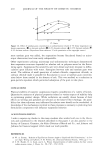
394 JOURNAL OF THE SOCIETY OF COSMETIC CHEMISTS following manufacture. In the discussion which follows, we shall concentrate on three aspects of physical stability. These are: 1) wetting and dispersion. 2) sedimentation and its relation to rheology. 3) prevention of caking. WETTING AND DISPERSION Wetting may be defined as the replacement of a solid-air interface by a solid-liquid interface. In a suspension, solid particles become surrounded by the liquid medium. However, most powders are agglomerated individual (primary) particles are held to- gether by relatively weak bonds. Wetting does not necessarily break up agglomerates although all of the spaces between primary particles will be filled with liquid. FACTORS IN WETTING Wetting depends on the balance of surface forces. If the spreading coefficient, S, de- fined in Eq. 1, is positive, then wetting will occur spontaneously. Other terms used in Eq. 1 are the solid surface energy, 'Ys, liquid surface tension, 'y•., and solid-liquid interfacial energy, 'YL/S- We can see from examination of Eq. 1 that wetting is more likely to occur if 'Ys is large and % and %/s are small. S = Ys - YL -- %/S (Eq. 1) In general, solid surfaces can be divided into those with "high" energy, which wet easily, and those with "low" energy, which may present wetting problems. Most metals and inorganic compounds have high energy surfaces, while organic compounds gener- ally have low energy surfaces. Once a solid material has been chosen, the solid surface energy is fixed so that changes in wetting behavior rely on alteration of % and 'YL/s. Surfactants generally lower both of these. CRITICAL SURFACE TENSION A quantity developed by Zisman (1) called the critical surface tension, 'Yc, gives us a useful way of characterizing solid surfaces. Liquids whose surface tension is equal to or less than the critical surface tension spread spontaneously over that solid surface. Liquids with higher surface tension than 'Yc will form a finite contact angle if a small drop is placed on the solid. 'Yc is determined by measuring the contact angle for a number of liquids on a solid, plotting the cosine of the contact angle against liquid surface tension and extrapolating to the surface tension at which the cosine of the con- tact angle is equal to 1. The value of critical surface tension is dependent to some extent on the characteristics of the liquids used in its determination. CONTACT ANGLES ON POWDERS While contact angles are determined readily on smooth fiat surfaces, powdered mate- rials may present some problems in their measurement. Several methods have been reported. The powder may be compressed into a compact or tablet under high pressure,
Purchased for the exclusive use of nofirst nolast (unknown)
From: SCC Media Library & Resource Center (library.scconline.org)