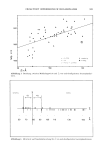
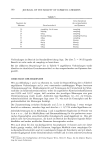
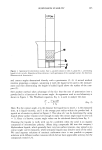
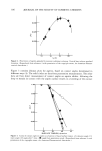
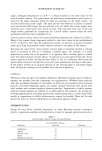
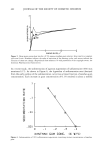
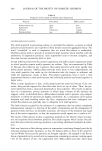
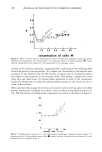
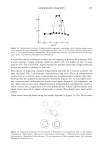
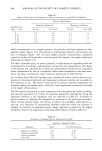
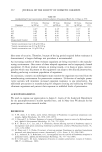
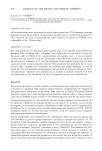
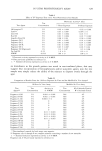
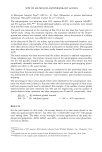
SUSPENSION STABILITY 397 angle, although extrapolation to cos 0 = 1 always resulted in the same value for the critical surface tension. The points from the penetration measurement were closest to those for the angle measured while the drop was growing on the tablet surface, the so-called advancing contact angle. The same pattern was observed in studies on phena- cetin and several sulfa drugs, but not salicylic acid, for which the contact angles mea- sured by direct observation were much too low. This may have been due to the very rough surface generated by compaction (4). Critical surface tension values for other powdered solids have been published (5,6). Critical surface tension values for several powdered substances are collected in Table I. Many of the organic drug compounds studied to date have values in the neighborhood of 30-32 dyn/cm. The value for magnesium stearate, 22 dyn/cm, is typical of surfaces made up of long hydrocarbon chains oriented normal to the plane of the surface. Knowing the value of the critical surface tension helps in deciding whether a wetting agent is necessary as well as in choosing a suitable agent. For example, if a sulfur suspension in water has to be prepared, it is apparent that a wetting agent is needed since the surface tension of water (about 72 dyn/cm) is so much greater than the critical surface tension of sulfur (30 dyn/cm from Table I). Use of a surfactant that lowers the water surface tension to 30 dyn/cm or less will cause spontaneous wetting to take place. If the surface tension of an aqueous solution of the wetting agent is somewhat higher than 30 dyn/cm, wetting is still possible with the aid of agitation. DISPERSION Wetting is only one aspect of complete dispersion. Mechanical energy may be needed to separate the primary particles composing the agglomerates. Whether these particles will then recombine depends on the balance of attractive and repulsive forces between particles. So-called dispersing agents are usually charged molecules that adsorb onto solid surfaces and increase repulsion between particles. Suspensions in which primary particles remain separate are referred to as defiocculated. Flocculation, the process de- scribing agglomeration of primary particles by weak bonding forces, is often used delib- erately in suspensions in which sedimentation cannot be avoided. More will be said about this when we discuss stabilization of suspensions against caking. SEDIMENTATION Except for very dilute colloidal dispersions, in which Brownian motion counteracts gravity, suspensions undergo sedimentation as a result of unequal gravitational pull on Table I Critical Surface Tension Values for Some Powders Critical Surface Tension Substance (dyn/cm) Reference Sulfadiazine 33 4 Aspirin 32 4 Salicylic Acid 31 4 Sulfur 30 6 Magnesium Stearate 22 2

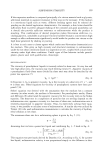
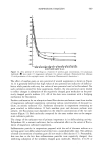
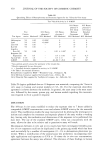
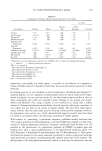
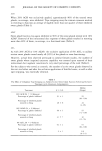
398 JOURNAL OF THE SOCIETY OF COSMETIC CHEMISTS particles and medium. The steady state sedimentation velocity (v) for noninteracting spherical particles is given by Stokes' equation (Eq. 3). 2R2 (P - Po)g v = (Eq. 3) 18 qq In this equation, R is particle radius, p and Po are the particle and medium densities, respectively, and g is the gravitational constant. In most practical coarse dispersions the particles are not spherical and, more importantly, collisions and charge interactions between particles result in interference with free settling. Consequently, Stokes' equa- tion does not usually predict actual sedimentation rates. Nevertheless, the factors men- tioned in Eq. 3, i.e. particle size, difference in density between particle and medium, and viscosity, are relevant. DENSITY MATCHING If the densities of liquid and solid could somehow be made equal, there should be no sedimentation at all since both phases in the suspension would be affected by gravity to the same extent. Once the solid is selected, its density cannot be altered. However, it is possible to increase liquid density by dissolving certain adjuvants in the medium and thereby bringing the liquid density closer to, or perhaps equal to, that of the dispersed solid. Polyols, such as sorbitol, are used for this purpose. While sedimentation rate may be reduced, it is seldom possible to prevent sedimentation altogether, either because too much polyol would be required or because the particle density is too high for density matching to be accomplished. PARTICLE EFFECTS As sedimentation velocity is proportional to particle diameter raised to a power, reduc- tion of particle size may be expected to slow sedimentation considerably. In practice, it is difficult to produce particles much below one micrometer. Typical suspension products may have mean particle sizes of about 1 to 20 micrometers. Stokes' equation applies to a single particle and is thus relevant to very dilute suspen- sions. In suspensions with an internal phase concentration greater than about 1%, sedi- menting particles may be held back by others that are falling at a slower rate. This process, referred to as hindered settling, results in an overall reduction in the rate of sedimentation. Another complication is flocculation of particles within a suspension to form larger clusters which settle much more rapidly than the primary particles of which they are composed. Flocculation as a means of preventing caking is discussed more fully below. RHEOLOGY While density matching and particle size adjustment have their place in suspension design, manipulation of rheological characteristics probably furnishes the formulator with the means of exercising the greatest control over sedimentation. The choice of product rheology and of bodying agent depends to a large extent on the type of medium and its intended application.
Purchased for the exclusive use of nofirst nolast (unknown)
From: SCC Media Library & Resource Center (library.scconline.org)