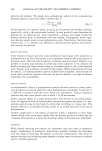
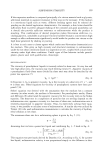
SUSPENSION STABILITY 399 If the suspension medium is composed principally of a viscous material such as glycerin, additional materials to augment resistance to flow may not be necessary. If the medium is a nonviscous liquid such as water, different bodying agents may be selected de- pending on the desired application characteristics. For example, a skin lotion should be sufficiently fluid to permit adequate shaking of the container and good pourability yet it should also provide sufficient resistance to sedimentation while the product is standing. This combination of desired properties makes Newtonian additives, in- cluding glycerin, unsuitable as principal ¾iscosity builders because a concentration high enough to affect sedimentation significantly would make the product too viscous at the high shear generated by shaking or pouring. It is best in such cases to choose agents which confer non-Newtonian characteristics to the medium. This gives us high viscosity and structural resistance to sedimentation under the low shear conditions found in a suspension at rest, coupled with a much lower viscosity under high shear conditions. Useful types of flow behavior include pseudo- plastic, plastic and, with qualification, thixotropic. PSEUDOPLASTICITY The viscosity of pseudoplastic liquids is inversely related to shear rate. At very low and very high shear rates, the viscosity may reach limiting values (7). Apparent viscosity of a pseudoplastic fluid (shear stress divided by shear rate) may often be described by the power law equation (7): 'qA = qqs ø"• • (Eq. 4) In Equation 4, qq^ is apparent viscosity, qqs is the viscosity at a shear rate of 1 s-•, and o' is shear rate. Other equations for viscosity of pseudoplastic systems have been pro- posed (7,8). Stokes' equation was derived with the assumption that the medium has a constant viscosity (in other words, the medium is Newtonian). For pseudoplastic media, Charm and McComis (9) substituted the apparent viscosity for the viscosity term in the Stokes equation. The shear rate in a suspension of particles that are settling depends on the sedimentation rate apparent viscosity is a function of shear rate sedimentation rate is inversely proportional to apparent viscosity. Thus, by repetitively solving three equa- tions, it was possible to calculate a rate of sedimentation. A similar idea was utilized by Torrest (10) who used sedimentation measurements to calculate the viscosity of hydroxy- ethyl cellulose at low shear. The maximum shear rate for a sedimenting sphere is given by Eq. 5 (11): 3v {r -- (Eq. 5) 2R Assuming that we have a power law liquid and combining Eq. 3-5 leads to Eq. 6: 2 R (n+ •) (p - po)gl•/• v = - (Eq. 6) 9 Xls 3 (n- •) This equation was previously derived by Daneshy (12). According to Eq. 6, for a power law liquid, sedimentation velocity is not proportional simply to the difference in den-

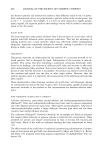
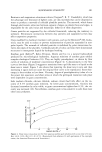
400 JOURNAL OF THE SOCIETY OF COSMETIC CHEMISTS sity between particle and medium but rather to that difference raised to the 1/n power. Also, sedimentation rate is not proportional to particle radius to the second power, but to the 1 + 1/n power. For example, if n is 0.33 (a value typical for a highly pseudo- plastic liquid), the equation predicts that settling velocity will be related to the radius raised to the 4th power. PLASTIC FLOW The most important characteristic of plastic flow is the existence of a yield value, which implies solid-like behavior under quiescent conditions. This has the advantage of locking particles into a rigid network, which may effectively inhibit sedimentation altogether. Agitation temporarily disrupts the network, making it possible to do such things as shake, pour, or spread a preparation onto the skin. THIXOTROPY Thixotropic materials are characterized by the existence of a structural network of col- loidal particles that is disrupted by shear. Reformation of the structure is time-de- pendent. This means that after disturbing a suspension containing thixotropic stabi- lizers (as by shaking), the recovery of sufficient yield value and viscosity to effectively resist sedimentation takes anywhere from several minutes to hours or days. During the period of time that the structure is incomplete, the product can easily be removed from the container and spread over the skin or other target surface. However, after the product has been used, it is important that restructuring of the stabilizing network take place rapidly. These characteristics, shear thinning, existence of a yield value, and thixotropy, depend on concentration as well as the type of agent used. Certain agents capable of producing structural networks in the medium at low concentrations are therefore efficient stabi- lizers. SOME THICKENING AGENTS USED IN COSMETICS Cellulose derivatives, particularly methylcellulose and hydroxypropylmethylcellulose (Methocel ©, Dow) and carboxymethylcellulose have been used in aqueous suspensions and other disperse systems for many years. These agents are pseudoplastic. Solutions of carboxymethylcellulose exhibit a larger difference between high shear and low shear viscosity than methylcellulose solutions. The carbomers (Carbopol ©, Goodrich Chemical) are an example of a family of polymers that impart plastic behavior to aqueous systems at relatively low concentration. These polymers are anionic and require neutralization by base to develop full viscosity and yield value. Much of the work on carbomer theology has been summarized by Barry (13). The effectiveness of the yield value of carbomers in preventing sedimentation of suspen- sions of sand grains and golf balls was demonstrated by Meyer and Cohen (14). Berney and Deasy (15) prepared nonsettling aqueous suspensions of sulphadimidine with car- bomer 934.
Purchased for the exclusive use of nofirst nolast (unknown)
From: SCC Media Library & Resource Center (library.scconline.org)