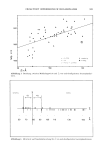
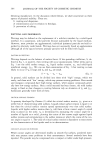
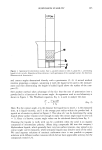
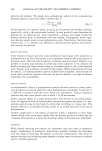
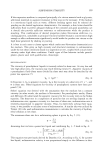
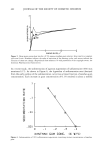
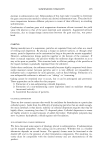
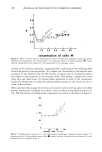
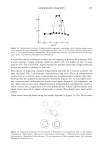
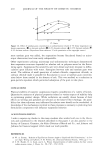
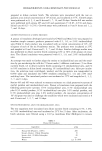
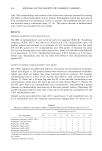
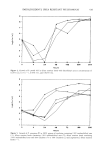
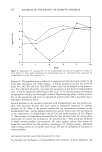
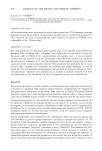
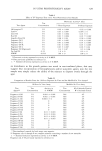
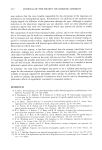
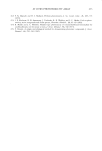
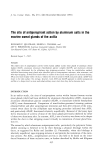
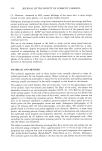
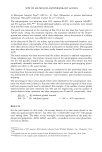
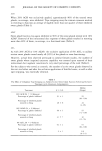
SUSPENSION STABILITY 401 Bentonite and magnesium aluminum silicate (Veegum ©, R. T. Vanderbilt), which has the advantage over bentonire of lighter color, are clay materials that can be dispersed in water to produce a network of colloidal platelike particles. The network, which forms through electrostatic attraction between opposite charges on platelet faces and edges, is responsible for the yield value and thixotropic behavior of these dispersions. Coarse particles are supported by the colloidal framework, reducing the tendency to sediment. Electrostatic interactions between clay particles and suspended actives may affect suspension properties. Clays modified by chemical treatment with amines, such as the Bentones © (NL Indus- tries), may be used to reduce or prevent sedimentation of particles suspended in non- polar liquids. The network of colloidal particles is stabilized by polar interactions be- tween the edges of the platelets. Colloidal particles of silica can form three-dimensional structures in nonaqueous liquids by hydrogen bonding. Xanthan gum (Keltrol ©, Kelco Division, Merck and Co.) is a natural hydrocolloid produced by microbiological husbandry. Aqueous solutions of xanthan gum exhibit complex rheological behavior (16). They are highly pseudoplastic, as shown by flow curves of solutions of moderate concentration (Figure 4). A discontinuity in the flow curve at low shear (Figure 5) suggests a transition from a gel-like state to a liquid as the shear rate is raised. Figure 5 also shows that lowering the shear rate to zero and then increasing it again does not cause the original flow curve to be reproduced. Some thix- otropy is thus evident at low shear. Viscosity, degree of pseudoplasticity (value of n in the power law equation), and shear stress at which the gel-liquid transition took place were dependent on gum concentration. Salts (sodium chloride, calcium chloride, sodium citrate) had little effect on the vis- cosity of 0.3% xanthan gum solutions. At lower gum concentrations, viscosity was decreased somewhat by salts while, at gum concentrations higher than 0.3%, the vis- cosity was increased (16). Nevertheless, xanthan gum is less sensitive to salts than most other ionic polymers. __ I i I I 6 12 18 24 SHEAR RATE, s -• Figure 4. Shear stress versus shear rate for three aqueous xanthan gum solutions with a scan time of 4 min. Key: (A) 0. 133% (B) 0.3% (C) 0.5%. (Reproduced from reference 16 with permission of the copyright owner, the American Pharmaceutical Association.)

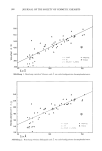
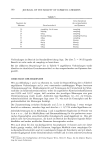
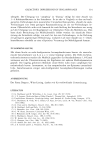
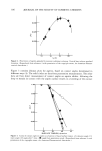
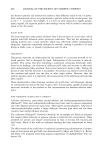
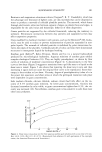
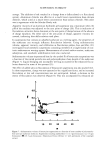
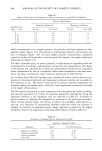
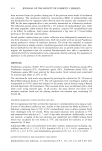
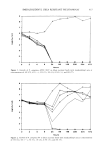
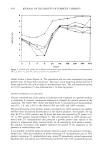
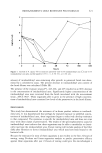
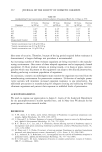
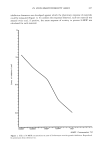
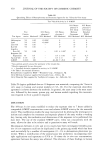
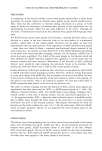
402 JOURNAL OF THE SOCIETY OF COSMETIC CHEMISTS •3 3: 1,2 o i I I I 2 3 SHEAR RATE, s -= Figure 5. Shear stress versus shear rate for a 0.5% aqueous xanthan gum solution. Scan time for a complete cycle was 8 min. Numbers indicate the order of execution of the shearing cycles, and arrows indicate the direction of shear rate change. (Reproduced from reference 16 with permission of the copyright owner, the American Pharmaceutical Association.) In a recent study, the sedimentation of aqueous suspensions of sulfamerazine (10%) was monitored (17). As shown in Figure 6, the logarithm of sedimentation rate (obtained from the early portion of the sedimentation curve) was a linear function of xanthan gum concentration. Each increase in gum concentration of 0.1% resulted in about a tenfold Z .1 .01 ß DO1 ' O .1 .2 .3 .4 XANTHAN GUM CONC. (% W/V) Figure 6. Sedimentation of 10% sulfamerazine suspensions containing various concentrations of xanthan gum.
Purchased for the exclusive use of nofirst nolast (unknown)
From: SCC Media Library & Resource Center (library.scconline.org)