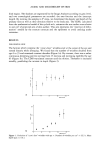
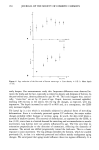
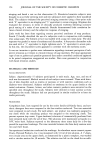
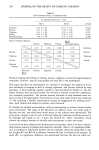
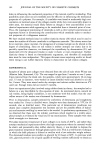
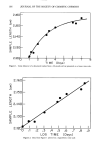
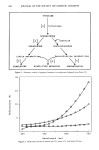
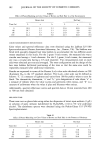
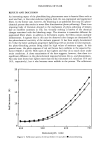
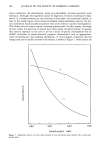
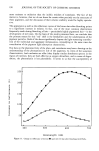
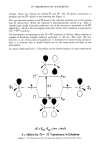
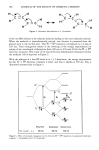
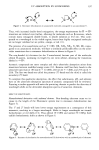
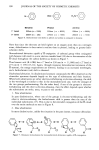
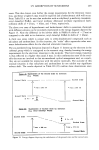
186 JOURNAL OF THE SOCIETY OF COSMETIC CHEMISTS Upon irradiation, the pheomelanin, being less photolabile, becomes spectrally more dominant. Although this hypothesis cannot be disproved, we favor an alternative expla- nation. It is worth pointing out that solutions of both pheo- and eumelanin exhibit, at least in the visible region, structureless and highly similar absorbance spectra. No dis- tinct absorbtion bands or peaks are present that can be linked to specific chromophores. This clearly does not restrict nature's coloring opportunities. On the contrary, the range of hues within the spectrum of natural hair colors seems virtually limitless. It appears that nature's approach to hair color is not by a choice of specific chromophores but by skillful utilization of physicochemical pigment characteristics such as aggregation, mode of distribution, and solubility (hydration). A vivid example of dramatic spectral change that can be readily attained with melanin is shown in Figure 7. Both spectra are ½) .Q o ii I I I I I I • 400 500 600 700 Wavelength (run) Figure 7. Absorbance spectra of intact sepia melanin (l) and solubilized sepia melanin (ll) in polyvinyl alcohol films.

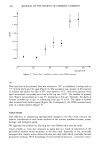
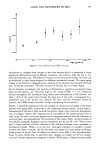
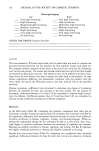
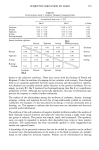
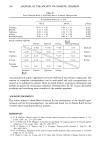
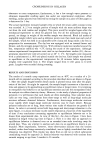
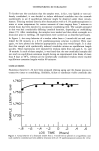
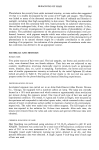
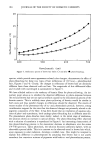
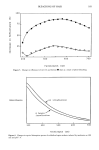
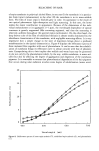
BLEACHING OF HAIR 187 of sepia eumelanin in polyvinyl alcohol films in one case (I) the eumelanin is in particu- late form (intact melanosomes) in the other (II) the eumelanin is in its water-soluble form. The film of intact sepia is blackish grey in color. Its appearance is the result of two optical phenomena: light absorption and light scattering. In this case, the latter makes the major contribution to appearance. Because of the dimensions of the indi- vidual melanosomes or its aggregates ( 1 I•m), the wavelength dependence of optical constants is greatly suppressed (Mie scattering regimen), and thus the scattering is relatively uniform throughout the spectral region (achromatic). On the other hand, the deep brown color of the film of solubilized melanin is almost totally dominated by the absorbance characteristics of the eumelanin, with negligible scattering effects. It is very impressive how a simple change in the state of dispersion brings about a profound transformation in the optical characteristics. Figure 8 displays the reflectance spectra of these melanin films together with one of pheomelanin. It can be seen that the solubili- zation of eumelanin brings its reflectance curve to almost coincide with that of pheomel- anin. Extrapolating this to hair implies that reddish and warm hues may be generated in situ not only by the pheomelanin (which, by the way, unlike eumelanin, is water-sol- uble) but also by affecting the degree of aggregation and dispersion of the eumelanin pigment. It is reasonable to assume that photochemical degradation of the hair pigment that occurs during solar radiation involves some degree of solubilization (water accel- 2O 4• 15 10 I i i I i 400 500 600 700 Wavelength (nm) Figure 8. Reflectance spectra of intact sepia melanin ([•), solubilized sepia melanin (A), and pheomelanin (0).
Purchased for the exclusive use of nofirst nolast (unknown)
From: SCC Media Library & Resource Center (library.scconline.org)