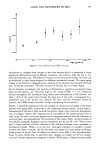
152 JOURNAL OF THE SOCIETY OF COSMETIC CHEMISTS and less stretchable, exactly opposite to the observed alterations of the surface patterns. However, these dimensional SEM views of the collagen network show that the bundles become thicker, straighter, and more random (9). Moreover, probably owing to the diminution of the ground substance, the spaces between the bundles are narrower, resulting in tighter packing. We suggest that these changes probably determine the shift in the orientation of primary lines. In this regard, it has to be admitted that there is no good understanding of the dermal forces which determine the complex pattern of the microrelief. Langer's lines would reflect preferential orientation of the collagen bundles, but this has never been demonstrated convincingly. Langer found that round holes punched in ca- daver skin become elliptical, a phenomenon well known to surgeons. Old subjects were not included in his studies. We found (unpublished observations) that round holes in abdominal and buttock skin gaped and remained round, attributed mainly to deteriora- tion of the elastic fiber network. Our general thesis then is based on the understanding that the skin microrelief is quite susceptible to the effects of time (intrinsic aging). Changes in the microrelief can be enormously accelerated by actinic radiation (extrinsic photo-aging) which accelerates degradation of its elastic fibers (10). As a result, mechanical stresses can easily reorient the original patterns. REFERENCES (1) (2) (3) (4) (5) (6) (7) (8) (9) (10) P. Corneille, Stances. (XVIIth century). K. Hashimoto, New methods for surface ultrastructure, Internat. J. Dermatol., 13, 357-381 (1974). J. Wolf and S. Hanusova, Influence of age on skin relief in man. Folia Morphologica, 18, 262-280 (1970). R. M. Lavker, F. Kwong, and A.M. Kligman, Changes in skin surface patterns with age, J. Ger- ontol., 35(3), 348-354 (1986). P. Corcuff, J. de Rigal, J. L. Leveque, S. Makki, and P. Agache, Skin relief and aging, J. Soc. Cosmet. Chem., 34, 177-190 (1983). S. Makki, J. C. Barbenel, and P. Agache, A quantitative method for the assessment of the microtop- ography of human skin, Acta Dermatovener, 59, 285-291 (1979). P. Corcuff, F. Chatenay, and J. L. Leveque, A fully automated system to study skin surface patterns, Int. J. Cosmet. Sci., 6, 167-176 (1984). I. M. Braverman and E. Fonferko, Studies in cutaneous aging: I. The elastic fiber network, J. Invest. Dermatol., 78(5), 434-443 (1982). J. C. Smith and G. R. Finlayson, Dermal connective tissue alterations with age and chronic sun damage, J. Soc. Cosmet. Chem., 16, 525-535 (1965). A.M. Kligman, P. Zheng, and R. M. Lavker, The anatomy and pathogenesis of wrinkles, British J. Dermatol., 113, 37-42 (1985).

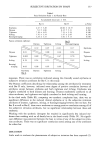
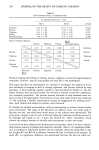
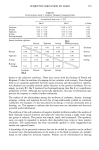
j. Soc. Cosmet. Chem., 82, 153-161 (May/June 1987) Evaluation of subjective irritation induced by soap materials M. B. FINKEY, The Dial Technical Center, Scottsdale, AZ 85254. Received January 21, 1986. Synopsis A sensory questionnaire was employed to determine the subjective irritation perceived by subjects partici- pating in clinical irritancy studies comparing pairs of bar soaps. The questionnaire consisted of a seven- point category scale for the attributes of dryness, tightness, itching, and burning/stinging. The question- naire allowed for detection of significant differences between soaps as described by these attributes. There was no strict relationship between erythema and self-perceived irritancy when any pair of treatments was compared, nor was there a consistent correlation among any of the attributes evaluated for any single soap bar. The questionnaire provided a simple, economical method for assessing subjective irritancy in conjunc- tion with a clinical evaluation. INTRODUCTION Characterization of the irritation potential of personal care products generally includes a series of animal tests followed by human tests. Animal testing may include primary skin and primary eye irritation studies. Human testing may include 21-day cumulative irritation, various patch tests, or exaggerated use and normal use studies (1). There has been increasing awareness and concern among manufacturers of cosmetics and personal care products over what is termed subjective irritation. This is a perceived burning, stinging, itching, drying, or tight feeling or other discomfort in the absence of any visible irritation, i.e., erythema and/or edema. In the past, this type of response was generally ignored or only detected through consumer irritation complaints. How- ever, consumers usually do not take the time to correspond with manufacturers and instead will stop using a product if not satisfied. Most work with sensory perceived attributes of personal care products is based on adap- tation of the food texture profile method (3). The texture profile method gives the sensory description and a quantitation of various textural qualities of food products during the successive stages of initial feel, biting, and swallowing by using a highly trained panel. Schwartz (4) applied this technique to train a panel to evaluate and quantify product attributes of female facial cosmetics. The majority of published work has been done with products that are not rinsed off, such as lotions and cremes (4-6). Usually positive attributes such as smoothness, softness, and suppleness are evaluated. Subjective irritation can be induced in sensitive individuals with certain chemicals such as DMSO, lactic acid, urea, and alcohol. Kligman investigated the phenomenon of 153
Purchased for the exclusive use of nofirst nolast (unknown)
From: SCC Media Library & Resource Center (library.scconline.org)