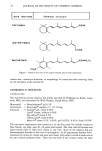
j. Soc. Cosmet. Chem., 39, 1-13 (January/February 1988) Detection and identification of volatile compounds evolved from human hair and scalp using headspace gas chromatography NOEL GOETZ, GENEVIEVE KABA, DANIEL GOOD, GEORGES HUSSLER, and PIERRE BORE, Research Laboratories, Socigtg L'Orgal, 1 Avenue Euggne Schueller, 93601 Aulnay sous Bols, France. Received June 7, 1987. Synopsis Headspace sampling methods, both static and dynamic in conjunction with gas chromatography or GC/MS, were developed to collect volatile species from human hair and scalp. A number of compounds were detected and almost all subsequently identified. The latter belong to various chemical classes such as alkanes, alkenes, alcohols, aldehydes, ketones, acids, and 3'-lactones. A chiral chromatographic system was developed, capable of resolving the enantiomeric pairs of 3'-lactones. The samples collected from human hair and scalp were found to contain racemic mixtures of 3'-lactones. Basically, the same volatile species were encountered in all subjects over an experimental population, but large differences were observed in their amount and distribution from one subject to another. These species are believed to derive from skin surface lipids through oxidative processes which may be purely physico- chemical in nature but could also involve some microbiological activity of the resident flora. INTRODUCTION In a series of previous publications we reported that the skin surface lipids (SSL) un- dergo an evolution as they accumulate on the scalp and the hair. This was first demon- strated by comparing the compositions of samples collected after different accumulation times (1,2). In a later study, a similar evolt•tion was observed by examining micro- samples collected more or less distant from their site of biosynthesis (3). However, the complete evolution of SSL cannot be considered finished once they spread and age on the scalp or along the hair shaft. It is well known that the human scalp has a characteristic odor which may vary in intensity from one subject to another. This means that volatile species are evolved from the human hair and scalp which may represent the ultimate stage in the evolution of the skin surface lipids. In this paper we describe an analytical approach for the separation, detection, and identification of such volatile compounds. Of course, odorless compounds may also be present in the mixture together with those that are olfactorily perceived. Sampling was

2 JOURNAL OF THE SOCIETY OF COSMETIC CHEMISTS achieved using headspace techniques which are of particular interest when volatile con- stituents are to be detected and identified in a non-volatile or less-volatile matrix. For static sampling, the sample is enclosed in a closed system at a constant temperature (4). The volatile compounds present in the matrix undergo a partition between the condensed phase and the gaseous phase ("headspace") and can be detected by injecting an aliquot of the latter. If the equilibrium between the two phases is reached (thus the term "static headspace"), the composition of the vapor phase is representative of the initial composition of the sample. For dynamic headspace sampling, the volatile compounds of interest are continuously stripped from their matrix by a purge gas (4) and subsequently trapped on an adequate adsorbant. After completion of the stripping procedure, the adsorbant is heated and the evolved volatile species are directed toward the chromatographic column. In this study, both the static and the dynamic methods of headspace sampling were adapted for the analysis of the volatile compounds from SSL. EXPERIMENTAL EXPERIMENTAL POPULATION The samples were obtained from an experimental population of 20 adults (male and female) aged 25-45 and one child (male) aged three years. All of these subjects had hair of mid-length and natural (non-colored and non-permanent waved). The sampling pro- cedure was performed four days after the last washing with a shampoo. STATIC HEADSPACE PROCEDURE The skin surface lipids were collected from the scalp and hair using a piece of surgical cotton (about 200 mg) held with a pair of tweezers. The cotton was passed on the scalp and hair of the subject by taking one lock of hair at a time and scrubbing it from root to tip with the cotton. This procedure collected about 3 mg of material for each half of the scalp, with the volatile portion constituting, of course, only a fraction of that amount. The piece of cotton was then enclosed in a 6-ml septum capped vial which was inserted into a commercial headspace sampler (HS6 Headspace Sampler © from Perkin Elmer, Norwalk, CT). The sample was conditioned at 120øC for two hours before injecting. DYNAMIC HEADSPACE PROCEDURE A commercially available instrument was used (Girdel DCI System © from Delsi, Su- resne, France) (5,6). About 100 mg of hair were cut from the subject's head and en- closed in the sample oven of the instrument. The latter was maintained at 50øC and purged by a flow of nitrogen (20 ml ß min-•). The volatile compounds which evolved from the hair were swept up by the purge gas and directed toward an adsorbant trap packed with Tenax and maintained at -50øC. The purge and trap procedure was carried out for 35 minutes. The trap was then back flushed by the carrier gas of the chromatograph and quickly heated to 240øC (the heating rate was about 2000øC ß min-•, which means that the plateau value was reached within 6-8 seconds).
Purchased for the exclusive use of nofirst nolast (unknown)
From: SCC Media Library & Resource Center (library.scconline.org)