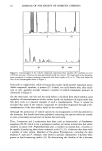
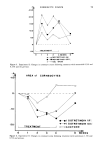
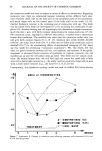
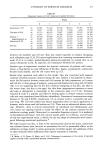
VOLATILE COMPOUNDS FROM HAIR AND SCALP 3 CONDITIONS FOR GC: FIRST SYSTEM A borosilicate glass capillary (length = 40 m internal diameter = 0.25 mm) was preconditioned using the BaCO 3 procedure of Grob (7-9). The tube was then dynami- cally wall-coated with FFAP stationary phase. The operating conditions were the fol- lowing: Injector temperature: 250øC (for static headspace only no injector is used on the dy- namic headspace instrument) Flame ionization detector temperature: 230øC Column temperatures: initial temperature: 30øC for 1 minute programmed to 70øC at 25øC ß min- 1 isothermal at 70øC for 6 minutes programmed from 70øC to 215øC at 4øC ß min- 1 final hold at 215øC for 5 minutes Carrier gas: helium, inlet pressure 0.9 bar Splitless injection according to Grob (10,11) CONDITIONS FOR GC: SECOND SYSTEM A borosilicate glass capillary (length = 30 m internal diameter = 0.25 mm) was preconditioned using the persilylation procedure of Grob (12). The tube was then dy- namically coated with OV 1701 stationary phase. The operating conditions were the following: Injector temperature: 250øC (for static headspace only no injector is used on the dy- namic headspace instrument) Flame ionization detector temperature: 230øC Column temperatures: initial temperature: 30øC for 1 minute programmed to 80øC at 25øC ß min- • isothermal at 80øC for 6 minutes programmed from 80øC to 210øC at 5øC ß min- • final hold at 210øC for 5 minutes Carrier gas: helium, inlet pressure 0.7 bar Splitless injection according to Grob (10,11) CONDITIONS FOR GC/MS For the GC/MS experiments, the static headspace procedure was used in conjunction with the two chromatographic systems (FFAP and OV 1701). The commercial instru- ment (Finnigan 4000 GC/MS system, from Finnigan MAT, San Jose, CA) was operated under electron impact conditions at 70 eV. CONDITIONS FOR GC/MS: SYSTEM FOR CHIRAL RECOGNITION A borosilicate glass capillary (length = 17 m internal diameter = 0.25 mm) was preconditioned according to the persilylation procedure of Grob (13, 14). The tube was then statically wall-coated from a dichloromethane solution containing OV 1701 sta- tionary phase (5 mg/ml) and Nickel (II)-bis (3-heptafluorobutyryl-(1R)-camphorate) (0.3 mg/ml). The latter compound was synthetized according to Schurig (15-17). Due to the presence of this chiral complex dissolved in the stationary phase, the column was

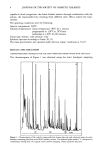
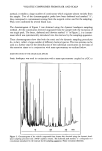
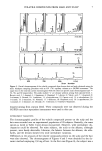
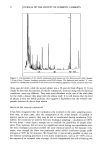
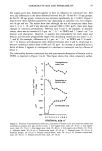
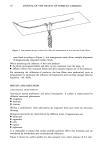
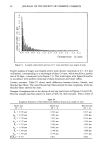
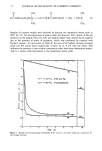
4 JOURNAL OF THE SOCIETY OF COSMETIC CHEMISTS capable of chiral recognition: the chiral chelates interact through coordination with the solutes, the enantioselectivity resulting from different steric effects toward the enan- tiomers. The operating conditions were the following: Injector temperature: 240øC Column temperatures: initial temperature: 40øC for 1 minute programmed to 120øC at 20øC/min isothermal at 120øC for 80 minutes Carrier gas: helium, inlet pressure 1 bar Splitless injection according to Grob (10,11) The mass spectrometer was operated under electron impact conditions at 70 eV. RESULTS AND DISCUSSION CHROMATOGRAPHIC PROFILES OF THE VOLATILE COMPOUNDS FROM HUMAN HAIR AND SCALP The chromatogram of Figure 1 was obtained using the static headspace sampling 110 2,O 3p min. Figure 1. Chromatogram of the volatile compounds from human hair and scalp obtained using the static headspace sampling procedure and a FFAP capillary column. The darkened peaks marked "a" correspond to contaminants arising from the surgical cotton used for sampling. Flame ionization detection.
Purchased for the exclusive use of nofirst nolast (unknown)
From: SCC Media Library & Resource Center (library.scconline.org)