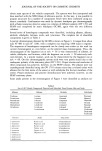
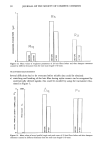
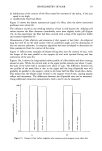
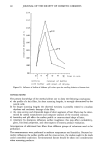
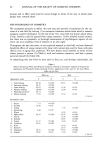
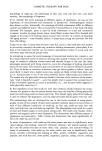
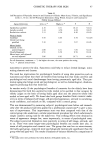
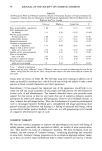
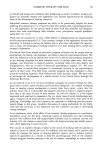
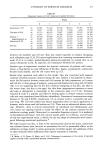
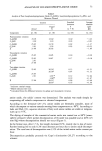
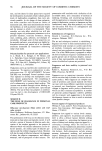
44 JOURNAL OF THE SOCIETY OF COSMETIC CHEMISTS persons and to effect some positive social change in terms of the way in which other people react towards them. THE PSYCHOLOGY OF COSMETICS We attempted seriously to define this new area and provide a foundation for the cre- ation of a new field by writing (1) an extensive literature review from which a research program could be developed. At the end of the 70's, very little was known about what, if any, benefits could be gained from using cosmetics. A few isolated studies existed, but there was no systematic or thorough examination of psychological aspects of cos- metic use as an academic field of research in its own right. Throughout the last nine years, in our empirical research in this field, we have observed beneficial effects of using cosmetics for those with normal skin and for those with skin defects such as aging skin problems. We have shown social benefits in terms of how others perceive a person (3) (Table I) with and without cosmetics, and how a person perceives herself (4) (Table III). In researching this new field we have tried to focus on, and develop individually, the Table I Others' Perceptions With and Without Cosmetics: Results of Univariate Analyses of Variance for Appearance and Personality Scales (showing F ratios, significance levels, and d.f. for main effects: make-up and hair) Make-up Hair Appearance scales F P F P 1. Tidy-looking 89.30 CO. 001 56.67 CO. 001 2. Feminine-looking 48.47 C0.001 3. Clean-looking 69.62 C0.001 11.36 C0.01 4. Pleasant4ooking 38.095 C0.001 12.90 C0.01 5. Physically attractive 58.31 C0.001 6. Mature-looking 17.83 C0.001 13.31 C0.01 Personality scales 1, 24 d.f. 1. Secure 7.31 c0.025 2. Sociable 10.50 c0.01 3. Caring 7.70 c0.025 4. Interesting 4.96 0.05 5. Warm 8.76 c0.01 6. Makes effort 20.55 C0.001 42.56 0.001 7. Sincere 17.26 C0.001 8. Reliable 32.83 C0.001 9. Poised 27.67 C0.001 9.92 C0.01 10. Confident 20.35 c0.001 11. Kind 11.18 C0.01 12. Sensitive 23.14 C0.001 13. Organized 28.43 C0.001 35.53 C0.001 14. Popular 10.87 C0.01 5.24 0.05 1, 24 d.f.

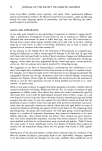
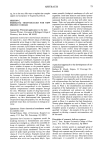
COSMETIC THERAPY FOR SKIN 45 psychology of make-up, the psychology of skin care, hair and hair care, and more recently, the psychology of fragrance. If we consider the social meaning of different aspects of appearance, we can see the importance of attractiveness and adornment in perspective. Anthropological studies have shown us that, historically, the meanings of bodily adornments differ in different cultures and different times. This is reviewed by Victoria Ebin (5) in her book The Body Decorated. For example, paint is used for facial adornment in ritual and ceremonial occasions: wooden lip plugs denote status. Some Maori women from New Zealand still engage in the practice of wearing tattoos around their mouths "as a means of retarding the aging process"-- they honestly believe it keeps them young and prevents the skin from shrivelling. Today we see that in many ways we have come full circle in that both men and women in our society currently use some very primitive-looking adornments, particularly if we look at the somewhat extreme use of cosmetic adornments evident in punk rock and new-wave type subcultural groups today. In attempting to assess the social meanings of conventional modern day cosmetics, our first major empirical study (3) aimed at showing that normal everyday use of a standard range of cosmetics enhances attractiveness and thereby brings to the user the many advantages associated with being attractive, since the advantages of looking physically attractive are many. The attractive gain social benefits in all kinds of different situations (6). They do better in interview situations, they get better grades in school, they are more likely to marry into a higher social class, people are likely to help them more, and so on. Attractiveness is one of the most powerful factors influencing social behavior. The reason why the physically attractive benefit is because of the existence of the stereo- type "what is beautiful is good"-- such that people tend to assume that a person has all kinds of favorable qualities in terms of personality, etc., just because he/she happens to look physically attractive (7). So the hypotheses of our first study (3) were that cosmetics should enhance the attrac- tiveness of a person so that the person should then enjoy the benefits of being physically attractive and being perceived more positively. This should apply when facial make-up is used to enhance the appearance, and the same principle should apply with hair care. The methodology that we developed for use in this study consisted of using photo- graphs of each of four people of (previously assessed) medium physical attractiveness in each of four different conditions: no make-up, no hair care make-up only hair care only and both hair care and make-up together. The photographs were rated by a panel of male and female judges on seven-point rating scales. The scales were bipolar, with a positive and negative pole to each dimension. The dimensions were different aspects of appearance and personality. Table I shows the dimensions that were significantly af- fected by make-up and by hair. In terms of appearance, with make-up the same person was seen as significantly more clean-looking, tidy-looking, attractive, feminine, pleasant, and mature-looking with hair care the person was seen as more clean, tidy, pleasant, and mature-looking. In terms of personality, with make-up the same person was seen as significantly more secure, sociable, interesting and making an effort, poised, confident, organized, and popular and with hair care, more poised, organized, popular, caring, sincere, making
Purchased for the exclusive use of nofirst nolast (unknown)
From: SCC Media Library & Resource Center (library.scconline.org)