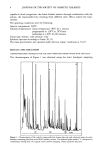
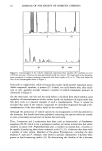
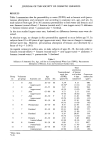
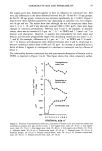
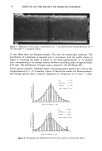
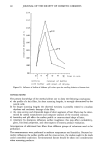
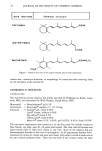
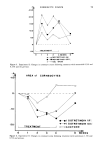
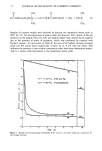
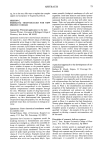
40 JOURNAL OF THE SOCIETY OF COSMETIC CHEMISTS 114 112 11o ß • 108 184 -H 102 100 98 •1 • •1 • m • time in min wetting removal of buffer with buffer and onset of drying F•ure 16. InfluenceofbuffersofdifferentpH values upontheswelling behaviorofhuman hair. CONCLUSIONS The present knowledge of the method allows one to draw the following conclusions: a) the profile of a hair fiber, for short scanning lengths, is strongly determined by the cuticle cells b) for longer scanning lengths the observed waviness is possibly related to circadian rhythms and stochastic damage of the fiber c) the cross section and ellipsoidal shape of short segments of hair fibers may be deter- mined by careful measurement and computer analysis of the recorded contours d) humidity and pH affect the surface profile or cross-sectional shape of hairs e) treatment by shampoos influences surface roughness this may affect combability, gloss, frictional properties, and other aspects of sensory product evaluation. Investigations of additional hair fibers from different groups of volunteers need to be performed. The measurements were performed at ambient temperature and humidity. Because hu- midity influences the surface profile and the cross section, the studies ought to be made under controlled conditions. Environmental factors should be taken into consideration when screening products.

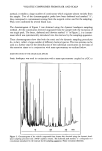
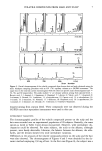
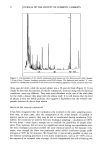
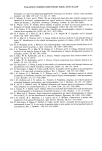
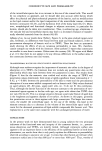
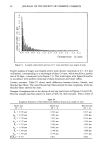
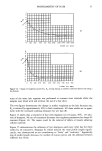
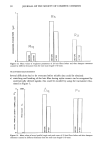
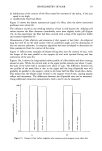
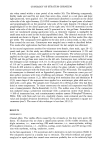
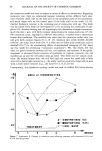
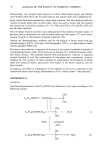
PROFILOMETRY OF HAIR 41 I !• 0 15 30 45 60 75 90 105 120 135 150 [ 0 1 0 45 6 50 direction of scan in pm direction of sca•ln •m 15304• 6• 7• 961651•O li5 lgO [ •O' 1'53' 400'560 .7'• 901_O51•O 13.51•O direction of scan in •m [ direction of scan in •m Figure 17. Examples of cross-sectional contours of hair fibers without (a) and with (b) free rotation of the axes. o o o o o o o o o o o o direction of scan in mm Figure 18a. Surface profile of a hair fiber (scan length 40 mm, axe-shaped stylus) before twisting.
Purchased for the exclusive use of nofirst nolast (unknown)
From: SCC Media Library & Resource Center (library.scconline.org)