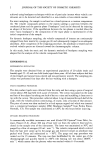
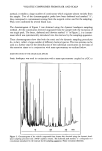
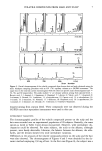
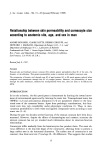
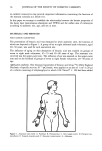
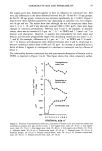
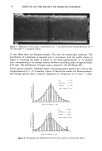
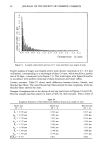
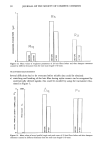
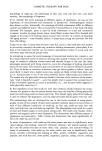
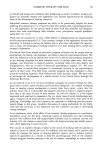
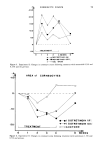
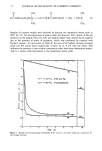
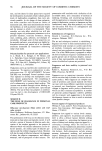
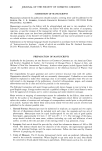
VOLATILE COMPOUNDS FROM HAIR AND SCALP 7 b 23 8 1/. 1 2 7 o 2021 I I i I I I ,. 5 m/e= 56 10 17 9 11 13n•• 1416 L 19 20,•_• I I I I I I mle:58 21 mle = 60 6 12 18 _ I I I I l 500 700 900 11 • 0 Sc(]n Number Figure 3. Partial chromatograms of the volatile compounds from human hair and scalp obtained using the static headspace sampling procedure with an OV 1701 capillary column on a GC/MS instrument. The upper trace is the total ion current chromatogram while the others are specific mass chromatograms (m/e = 56, 58, and 60 respectively). The peaks marked "a" are siloxane artifacts arising from septum bleed. 1: Butyric acid 2: 1-hexanol 3: 2-heptanone 4: Heptanal 5: 1-decene 6: Valetic acid 7: 1-heptanol 8: 2-octanone 9: Octanal 10: 1-undecene 11: •/-butyrolactone 12: Caproic acid 13: •/-valerolactone 14: 1-octanol 15: 2-nonanone 16: Nonanal 17: 1-dodecene 18: Heptanoic acid 19: •/-caprolactone 20: 1-nonanol 21: 2-decanone 22: Decanal 23: 1-tridecene b: 6-methyl-2-heptanone. loxanes) arising from septum bleed. These compounds were not observed during the GC/FID runs since septumless instruments were used in this case. INTERSUBJECT VARIATIONS The chromatographic profiles of the volatile compounds present on the scalp and the hair were recorded over an experimental population of 20 subjects. Basically, the same species as listed in Table I were always encountered. However, wide intersubject dis- crepancies could be observed. For some subjects, the acids or the alkanes, although present, were barely detectable. Likewise, the balance between the alkenes, the alde- hydes, and the ketones showed very wide intersubject variations. Differences in the amounts of the volatile compounds present on the scalp and the hair were also observed. The chromatograms of Figures 4 and 5 were obtained by the dy- namic method employing 130 mg of hair. In the first case (Figure 4), the subject was a

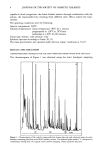
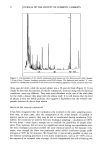
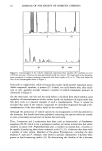
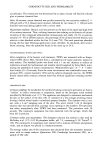
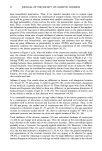
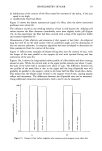
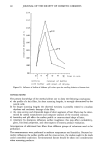
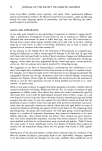
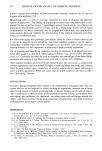
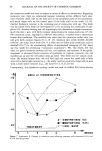
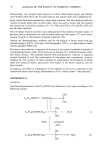
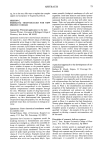
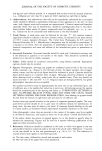
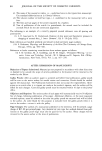
8 JOURNAL OF THE SOCIETY OF COSMETIC CHEMISTS 1,0 2p 3•0 min. Figure 4. Chromatogram of the volatile compounds from human hair of a three-year-old child. Sample: 130 mg of hair. Dynamic headspace procedure with FFAP column. The darkened peak marked "a" corre- sponds to a contaminant introduced in the mixture by the sampling apparatus. Flame ionization detection. three-year-old child, while the second subject was a 30-year-old male (Figure 5). It can clearly be seen that the amounts of volatile compounds, detected using strictly identical conditions, were very different. They were more abundant in the case of the adult than for the child, a feature they share with the sebum itself. It is well known that the level of sebum is very low before puberty this suggests a hypothesis that the volatile com- pounds detected do derive from sebum. ORIGIN OF THE VOLATILE COMPOUNDS It has been recognized that the incubation step involved in the static sampling proce- dure may, in some cases, alter the composition of the initial sample: if unstable or reactive species are present, they may be lost or transformed during incubation (5,6). Indeed, the conditions we used for the static headspace sampling--incubation at 120øC for two hours--seem drastic enough not to overlook the possibility of sample alter- ation. This, however, did not occur to a significant extent during our experiments since the static headspace procedure yielded the same chemical species as the dynamic tech- nique, even though the latter was performed under milder conditions (purge under nitrogen at 50øC for 30 minutes). We found that it was actually possible to carry out the dynamic sampling procedure at even lower temperatures, such as 25-30øC, but at the expense of an increased time of purge. At such temperatures the risk of altering the
Purchased for the exclusive use of nofirst nolast (unknown)
From: SCC Media Library & Resource Center (library.scconline.org)