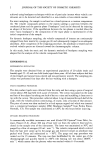
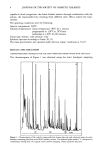
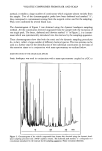
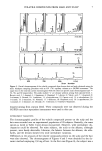
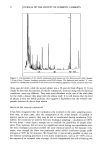
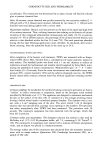
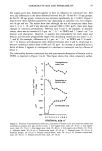
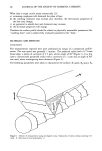
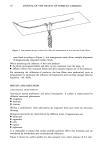
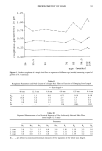
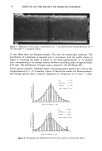
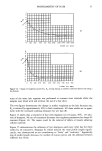
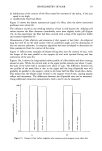
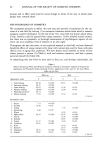
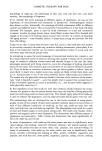
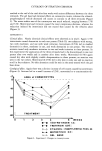
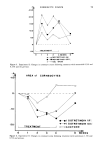
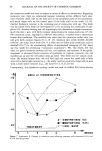
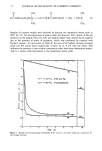
VOLATILE COMPOUNDS FROM HAIR AND SCALP 5 method it exhibits a large number of constituents which originate almost entirely from the sample. Two of the chromatographic peaks have been darkened and marked "a" they correspond to contaminants arising from the surgical cotton used for the sampling. They were confirmed by several blank runs. The chromatogram of Figure 2 was obtained using the dynamic headspace sampling method. All the constituents detected originated from the sample with the exception of one single peak. The latter, darkened and likewise marked "a" in Figure 2, is a contam- inant which was systematically introduced into the mixture by the sampling apparatus. These chromatograms show that both the static and the dynamic sampling procedures do, in fact, collect a large number of different chemical species. The two systems can be used in a further step for the identification of the individual constituents on the basis of the retention times or in conjunction with mass spectrometry as outlined below. IDENTIFICATION OF THE MOLECULAR SPECIES Static headspace was used in conjunction with a mass spectrometer coupled to a GC to 10 20 30 min. I I I Figure 2. Chromatogram of the volatile compounds from human hair obtained using the dynamic head- space sampling procedure and a FFAP capillary column. The darkened peak marked "a" corresponds to a contaminant introduced in the mixture,by the,sampling,aopazarus. Flame ionization,detect4on.

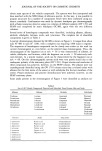
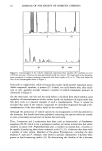
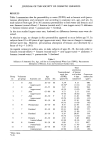
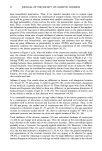
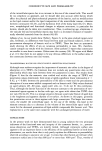
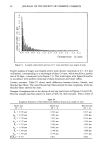
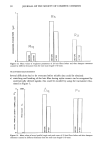
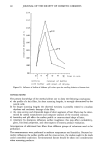
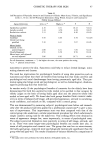
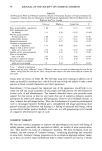
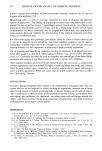
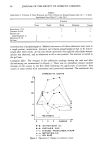
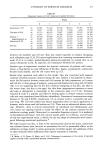
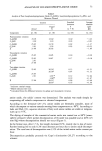
6 JOURNAL OF THE SOCIETY OF COSMETIC CHEMISTS obtain mass spectra of the volatile compounds. The spectra were first interpreted and then matched with the NBS library of reference spectra. In this way, it was possible to propose structures for a number of components which were then confirmed using au- thentic standards. Confirmation was made by dynamic headspace gas chromatography with a flame ionization detector using two columns of different polarity (OV 170 ! and FFAP) and completed by static headspace GC/MS, again with the two different columns. Several series of homologous compounds were identified, including alkanes, alkenes, alcohols, aldehydes, ketones, acids, and •/-lactones. The complete list of identified components is given in Table I. A partial chromatogram obtained by GC/MS is shown in Figure 3. It ranges from about scan N ø 400 to scan N ø 1200, with a complete run requiring 1500 scans to register. The sequences of homologous compounds can be clearly seen either on the total ion current chromatogram or, even better, on the selected mass chromatogram. Thus, the chromatogram of the fragment ion at m/e = 56 is very characteristic of alkenes, al- cohols, aldehydes, and lactones, while the fragment ion at m/e = 58 selectively indi- cates ketones. In a similar manner, acids can be characterized by the fragment ion at m/e = 60. On this chromatographic system acids were very poorly eluted due to the inadequate polarity of the stationary phase (OV 1701). Proper elution and resolution of these compounds was achieved, however, on the FFAP column. The alkanes were not unambiguously identified using the OV 1701 column since they co-eluted either with alkenes (for the first terms of the series) or with aldehydes (for the last members of the series). Proper resolution and positive identifications were achieved, however, on the FFAP stationary phase. Some peaks present in the chromatogram of Figure 3 were identified as artifacts (si- Table I List of All Volatile Compounds Detected and Identified From Human Hair and Scalp Alkanes Alkenes Alcohols Aldehydes Tridecane 1-octene 1-pentanol Pentanal Tetradecane 1-nonene 1-hexanol Hexanal Pentadecane 1-decene 1-heptanol Heptanal Hexadecane 1-undecene 1-octanol Octanal Heptadecane 1-dodecene 1-nonanol Nonanal Octadecane 1-tridecene 1-decanol Decanal 1-tetradecene 1-undecanol Undecanal Dodecanal Tridecanal Ketones Acids •/-Lactones 2-pentanone Acetic acid •/-butyrolactone 2-hexanone Propionic acid •/-valerolactone 2-heptanone Butyric acid •/-caprolactone 2-octanone Valeric acid •/-heptalactone 2-nonanone Caproic acid •/-octalactone 2-decanone Heptanoic acid •/-nonalactone 2-undecanone 2-dodecanone 2-tridecanone
Purchased for the exclusive use of nofirst nolast (unknown)
From: SCC Media Library & Resource Center (library.scconline.org)