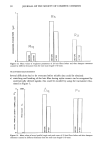
80 JOURNAL OF THE SOCIETY OF COSMETIC CHEMISTS lacking to some extent in esthetic elegance the rate of uptake of ingredients by skin may be limited or, if desired, enhanced and the system maintains con- tact with the skin for a desired time interval and fences the area. By virtue of its design, the system itself can be used to modify stratum corneum hy- dration. The degree of occlusion afforded by a thin film or laminate applied to the skin surface is thus an important characteristic. Skin transport kinetics depend on several factors. By virtue of high solu- bility within the matrix or slow diffusion through it, release to the skin surface may be rate-limiting. On the other hand, diffusion through a skin-con- tacting membrane within the system, or the skin itself, can be the controlling process. SESSION D REGULATORY CONCERNS AND NEW PRO- DUCT DEVELOPMENT Dial soap•Is it or isn't it (a drug)? Helen North-Root, The Dial Corporation, 15101 N. Scottsdale Road, Scottsdale, AZ 85254 The 40-year history of Dial soap emphasizing the procurement and maintenance of a new drug appli- cation (NDA), the subsequent marketing of Dial as an over-the-counter (OTC) drug product, and its present day marketing possibilities will be dis- cussed. The requirements for filing the initial ap- plication for an NDA (necessary forms, labels, studies, samples, and scientific rationale) will be outlined as will the requirements to maintain the NDA (post-market reporting of adverse drug expe- riences, annual reports, submission of advertise- ments and promotional labeling, and changes ne- cessitating filing a supplement). Shifts in regulatory policy enabling Dial soap to be sold as an OTC drug or as a cosmetic will be described.

Journal of the Society of Cosmetic Chemists INFORMATION FOR AUTHORS The JOURNAL OF THE SOCIETY OF COSMETIC CHEMISTS publishes papers concerned with cos- metics or the sciences underlying cosmetics, as well as other papers of interest to SCC members. It is the function of the Editorial Committee to set standards, to judge the scientific merit of a paper, and to help in the editing of the paper and its preparation for press. The Editorial Committee is charged with the responsibility for the maintainance of the JOURN^L'S high standards. It is therefore not the policy of the JOURNAL OF THE SOCIETY OF COSMETIC CHEMISTS tO guarantee publication of all submitted papers. All papers presented before a meeting or seminar of the SOCIETY OF COSMETIC CHEMISTS or before one of its sections, or those papers submitted directly to the Editor will be considered for publication in the Journal. Papers presented before the SOCIETY OF COSMETIC CHEMISTS or one of its sections are the property of the SOCIETY and may not be published in or submitted to other journals. Only if the JOURNAL OF THE SOCIETY OF COSMETIC CHEMISTS is unable to publish a presented paper may it be published in another journal of the author's choice. SUBJECT MATTER The JOURN^L will consider manuscripts for publication in the following categories, provided they are prepared in proper scientific style and adequately referenced: 1. Original Articles. Descriptions of original research work in cosmetics or related areas. 2. General Articles. Articles of a general character may be considered for publication providing they are of a scientific and technical nature. These articles may be concerned with newer analytical techniques, developments in dermatology, toxicology, etc. 3. Review Articles. Intended to present an overview of recent advances in a specific area related to cosmetics. The author of such a review is expected to be actively engaged in the area and capable of presenting a critical evaluation of published reports of a scientific and technical nature. Solicited by special invitation from the Editor and Editorial Committee not subject to review by the Editorial Committee. 4. Preliminary Communications. Intended to provide for rapid dissemination of novel con- cepts and findings, such articles should not exceed four printed pages (approx. 10 double- spaced typed pages). Subject to review, but the time for editorial action will not exceed three weeks and the manuscripts will be published ahead of those submitted for regular processing. 5. Technical Notes. Relatively short manuscripts containing new information obtained by laboratory investigations, these do not contain the depth or extent of research involved in an Original Article. 6. Letters to the Editor. Comments on JOURN^L articles are invited, as well as brief contri- butions on any aspect of cosmetic or related science that does not warrant publication of a full-length paper in one of our other categories. May include figures and/or references, but brevity is necessary. 81
Purchased for the exclusive use of nofirst nolast (unknown)
From: SCC Media Library & Resource Center (library.scconline.org)