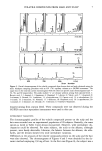
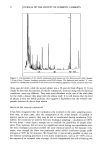
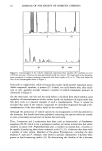
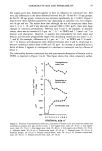
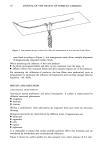
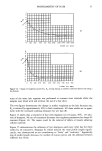
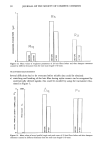
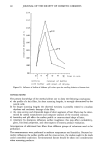
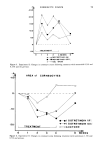
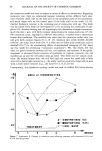
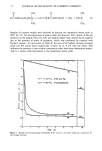
42 JOURNAL OF THE SOCIETY OF COSMETIC CHEMISTS o o o o o o o o o o o o direction of scan in mm Figure 18b. Surface profile of a hair fiber (scan length 40 mm, axe-shaped stylus) after twisting around the fiber axis (-0.5 rotation/cm fiber length). REFERENCES (1) T. Teasdale, G. Blankenburg, and H. Philippen, Querschnittsparameter von Humanhaaren, •rztl. Kasmet. II, 161-170 (1981). (2) C. E. Orfanos, W. Sterry, and T. Leventer, "Haar und haarkosmetische Ma[3nahmen," in Haar und Haarkrankheiten, C. E. Orfanos, Ed. (G. Fischer Verlag, Stuttgart, 1979). (3) H. Dagnall, Exploring Surface Texture, (Rank Taylor Hobsen, Leicester, England, 1980), pp. 50-60. (4) H. Wolff, Die Bedeutung des cut-off bei der Oberfliichen-priifung mit Tastschnittgeriiten, Werkstatt und Betrieb, 92, 817-820 (1959). (5) U. Miiller, Vermessung und Analyse van Haaren mit Hilfe der digitalen Signalverarbeitung, Universitiit der Bundeswehr, Hamburg, January 1986. (6) B. Schubert, Entwicklung einer Methade zur Dickenmessung van Humanhaaren, Diplomarbeit, Fachhoch- schule Hamburg, FB Bioingenieurwesen, Hamburg-Bergedorf, June 1986. (7) J. A. Swift, "The Hair Surface," in Hair Research, C. E. Orfanos, W. Montagna, and G. Stiittgen, Eds. (Springer Verlag, Berlin, 1981). (8) Y. K. Kamath, and H.-D. Weigmann, Measurement of combing forces, J. Sac. Cosmet. Chem. 37 111-124 (1986). (9) C. R. Robbins, Chemical and Physical Behavior of Human Hair (Van Nostrand Reinhold Company, New York).

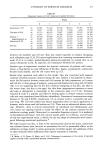
j. Soc. Cosmet. Chem., 39, 43-51 (January/February 1988) Cosmetic therapy for aging skin JEAN ANN GRAHAM, International Consultant.' Psychology of Cosmetics and Appearance By Ways, Llanasa Rd., Gronant, Clwyd., N. Wales, United Kingdom LL19 9SP Received June 16, 1986. Presented at the Scientific Meeting of the Society of Cosmetic Chemists, Boston, May 8-9, 1986. Synopsis Elderly women who had aged well were compared with those who had aged badly in terms of facial cutaneous changes. Elderly women who had aged well perceived themselves more positively mentally, physically, and socially. This work has implications for psychological benefits of using skin protection such as sunscreens and for prevention of the psychological disadvantages of sun-damaged or prematurely aged skin. The concept of cosmetic therapy is presented. Cosmetic therapy for the aged demonstrates the psychological benefits of make-overs for elderly individuals: they benefit in terms of enhanced self image, attitude to socializing, and outlook on life, especially those who aged badly. Cosmetic therapy programs are particularly beneficial for those with depression, skin disorders, and disfig- urements that need camouflaging, and those who simply need a psychological boost. The research described shows that cosmetics can help psychologically, as well as by enhancing the appear- ance, to alleviate some of the problems resulting from aging skin. INTRODUCTION The psychology of cosmetics and cosmetic therapy is a new area of research that we have been developing since the end of the 1970's (1). In researching this new field we have paid particular attention to the effects of cosmetics and cutaneous aging in the elderly because this is a group that has been particularly neglected, partly as a function of ageism--negative attitudes toward the elderly (2). In Western society there is dearly a stigma associated with aging. Since the face is the focal point of human communication, facial cutaneous deterioration is of considerable consequence, such unattractivehess leading to serious social disadvantage. We chose to focus research attention on the elderly because we felt there was room potentially for a great deal of improvement in terms of both their appearance and their psychological and social well being, particularly for the unattractive elderly. Our research has indicated that cosmetic "therapy" programs can be very effective in helping to alleviate some of the problems associated with aging. In the new therapeutic approach to cosmetic use that we have developed, cosmetics are used as a vehicle to improve the psychological state and self image of individual elderly 43
Purchased for the exclusive use of nofirst nolast (unknown)
From: SCC Media Library & Resource Center (library.scconline.org)