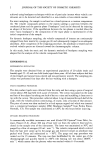
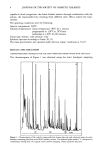
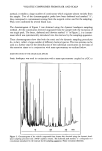
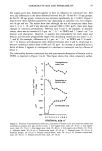
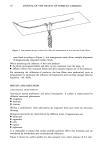
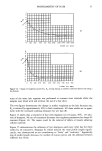
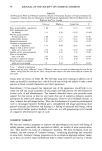
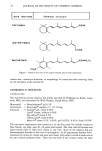
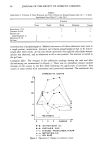
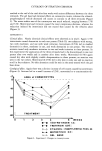
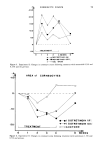
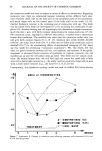
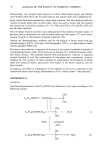
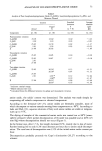
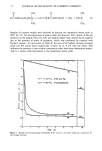
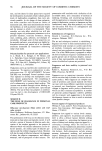
74 JOURNAL OF THE SOCIETY OF COSMETIC CHEMISTS 0 •H3 0 CH 3 II R-C-NHCH2CH2CH2• •O •R-C-NHCH2CH = CH 2 + HO-N CH 3 CH 3 (3) Samples of constant weight were obtained by heating the commercial amine oxide at 40øC for 4 h. No decomposition of amine oxide was detected. The content of the dry substance in the sample tested (33.8%) was slightly higher than claimed by the supplier due to the presence of water of hydration, which was confirmed by titration with Fischer's reagent. As can be seen in Table II, the sum of the highest amounts of amine oxide and free amine found analytically is lower by ca. 4.2% than the solids. This indicates the presence of non-volatile components other than those determined analyti- cally (i.e. amine oxide and amine) in the commercial amine oxide. 100 o• 7o -o--- t=40oc, p=25 men H•I • t=8ooc, p=otmospheric 30 Iv 20 I I I • o 1 2 3 Time Figure 1. Weight loss during heating of Gamidox K-40. Curves I, II: amine oxide loss. Curves III, IV: total weight decrease.

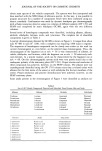
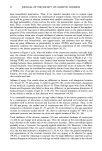
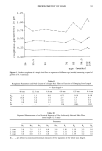
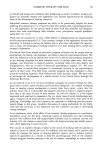
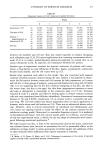
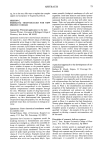
ANALYSIS OF COCAMIDOPROPYLAMINE OXIDE 75 Table II Analysis of Commercial Cocamidopropylamine Oxide (Gamidox K-40) Amine oxide Free amine No. of analyzed X S X S samples wt. (%) wt. (%) wt. (%) wt. (%) Potentiometric titration 5 26.23 0.21 2.10 0.19 Two-phase and titanometric titration 3 27.08 0.10 2.59 l* 0.08 • 1.222* 0.072 Symbols: same as in Table I. CONCLUSIONS The two volumetric methods used for determining the content of amine oxide and free amine both in the samples prepared from pure components and in commercial products provide results of comparable accuracy. They differ in their ability to evaluate indi- vidual components. Thus the amine oxide determination is more accurate when ap- plying the combined two-phase and titanometric titration, whereas potentiometric ti- tration enables accurate determination of free amine content. Potentiometric titration seems to yield more accurate results for determination of amine oxide or free amine in the presence of the second component. The results obtained by Metcalfe confirm this same conclusion (9). The solids determination carried out at 40øC under reduced pressure has an advantage over the method of drying at 80 ø , since the latter procedure produces decomposition of amine oxide. ACKNOWLEDGEMENTS The authors are grateful to Prof. Dr. J. Plucifiski for his stimulating remarks and to G. Z. Ch. G "Pollena" in Gdafisk for providing the samples and financial support. REFERENCES (1) M. Weinstein and L. R. Smith, The use of amine oxides as emulsifiers, Cosmetics and Toiletties, 95, 57-59 (1980). (2) AMINOXID WS 35, Th. Goldschmidt AG, technical information. (3) STANDAMOX © CAW, Henkel Corporation, technical information. (4) F. Devinsky, I. Lacko, D. Mlynar•ik, V. Racansky, and •. Krasnec, Relationship between critical micelle concentrations and minimum inhibitory concentrations for some non-aromatic quaternary ammonium salts and amine oxides, Tenside Deterg., 22, 10-15 (1985). (5) Atomonyx © Amine Oxides, the Utilitarian Surfactants, Onyx Chemical Company, technical information.
Purchased for the exclusive use of nofirst nolast (unknown)
From: SCC Media Library & Resource Center (library.scconline.org)