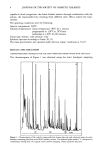
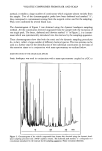
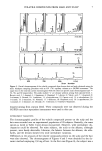
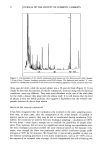
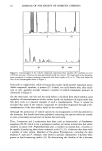
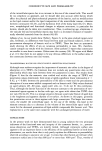
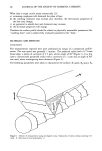
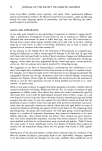
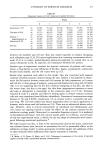
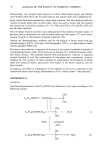
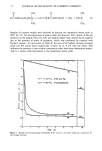
VOLATILE COMPOUNDS FROM HAIR AND SCALP 11 detected in the headspace, it is possible to gain valuable information on their origin, whether chemical or microbiological in nature, since only one of two enantiomers is expected from the activity of Pityrosporum. To assess whether pure enantiomeric lactones or racemic mixtures are present on the hair and the scalp, a chromatographic system capable of chiral recognition was devel- oped accoMing to Schurig (15-17). It was observed that each •/-lactone detected in the headspace samples was, indeed, a racemic mixture (see chromatogram, Figure 7). It appears highly unlikely, therefore, that these lactones arise through microbiological action on the skin surface lipids. CONCLUSION Headspace gas chromatographic investigations revealed that a number of volatile com- pounds are present on human hair and scalp together with the well-known skin surface lipids. The same molecular species were detected in all subjects over an experimental population, but large differences were observed in their distribution from one subject to another. The origin of these volatile compounds, belonging to various chemical classes (alkanes, alkenes, alcohols, aldehydes, ketones, acids and 'y-lactones), has not been • 3 • B 2 3 /" A i i 3 5 7 11 19 21 minu'tes Figure 7. Chromatogram using a column capable of chiral recognition. A: Mixture of synthetic standard compounds. B: Volatile compounds from human hair and scalp obtained using the static headspace sam- pling method. Detection was by mass fragmentometry at m/z = 85. 1: '•-butyrolactone 2: '•-valerolactone (pair of enantiomers) 3: '•-caprolactone (pair of enantiomers) 4: '•-heptalactone (pair of enantiomers) 5: '•-octalactone (pair of enantiomers).

12 JOURNAL OF THE SOCIETY OF COSMETIC CHEMISTS positively elucitated. It is likely, however, that they derive from skin surface lipids through oxidative processes that may either involve the microbiological activity of the resident flora or be of a strictly physicochemical nature. For one particular class of compounds identified--?-lactones--which feature an asym- metric carbon atom in their structure, it was observed that both enantiomers were present as a racemic composition. Thus, for this class of compounds, a microbiological origin seems unlikely. Peroxidized species have been detected in human skin surface lipids by other authors and are suspected to be involved in cutaneous pathogenesis (34). Our results show that other oxidized species which seem to be the breakdown products of the first-formed hydroperoxides are present in the skin surface lipid mixtures and should also be consid- ered in that respect. The methodology which has been developed could be of diagnostic value to assess the state of oxidation of these volatile species prevailing on the human skin. REFERENCES (1) P. Bore, N. Goetz, P. Gataud, and L. Tourenq, Evolution in the composition of human skin surface lipids during their accumulation on scalp and hair, Int. J. Cosmet. Sci., 4, 39-52 (1982). (2) N. Goetz, G. Kaba, and P. Bore, Capillary gas chromatographic analysis of human skin surface lipids after microsampling on ground-glass platelets, J. Chromatogr., 223, 19-28 (1982). (3) N. Goetz, H. Burgaud, C. Berrebi, and P. Bore, Analysis of the lipid content of single hair bulbs. Comparison with the content of the sebaceous gland and with surface lipids,J. Soc. Cosmet. Chem., 35, 411-422 (1984). (4) A.J. Nunez, L. F. Gonzalez, and J. Janak, Pre-concentration of headspace volatiles for trace organic analysis by gas chromatography, J. Chromatogr., 300, 127-162 (1984). (5) J. Gregoire, F. Maillet, R. Gillard, and J. Auger, Improvements of headspace and analysis: Their applications, especially to residual sterilisation gases and by-products in medical and surgical mate- rials, 13th International Symposium on Chromatography, June 30-July, 1980, Cannes, France. (6) A.M. Samoun and J. Gregoire, Dynamic headspace analysis with Girdel D.C.I. gas chromatograph, 3 3rd Pittsburgh Conference on Analytical Chemistry and Applied Spectroscopy, March 8- 13, 1982, Atlantic City, N.J. (7) K. Grob and G. Grob, A new, generally applicable procedure for the preparation of glass capillary columns, J. Chromatogr., 125, 471-485 (1976). (8) K. Grob, G. Grob, and K. Grob, Jr., The barium carbonate procedure for the prepartion of glass capillary columns further informations and developments, Chromatographia, 10, 181-187 (1977). (9) K. Grob, Jr., G. Grob, and K. Grob, Preparation of apolar glass capillary columns by the barium carbonate procedure, J. High Resol. Chromatogr. Chromatogr. Commun., 1, 149-155 (1978). (10) K. Grob and G. Grob, Splitless injection on capillary columns, Part I. The basic technique steroid analysis as an example, J. Chromatogr. Sci., 7, 584-586 (1969). (11) K. Grob and K. Grob, Jr., Splitless injection and the solvent effect, J. High Resol. Chromatogr. Chromatogr. Commun., 1, 57-64 (1978). (12) K. Grob and G. Grob, Deactivation of glass capillaries by persilylation. Part 3: Extending the wetta- bility by bonding phenyl groups to the glass surface, J. High Resol. Chromatogr. Chromatogr. Commun., 3, 197-198 (1980). (13) K. Grob, G. Grob, and K. Grob, Jr., Deactivation of glass capillary columns by silylation. Part 1: Principles and basic techniques,J. High Resol. Chromatogr. Chromatogr. Commun., 2, 31-35 (1979). (14) K. Grob, G. Grob, and K. Grob, Jr., Deactivation of glass capillaries by persilylation. Part 2: Practical recommendations,J. High Resol. Chromatogr. Chromatogr. Commun., 2, 677-678 (1979). (15) V. Schurig and W. Burkle, Extending the scope of enantiomer resolution by complexation gas chro- matography, J. Am. Chem. Sot., 104, 7573-7580 (1982). (16) V. Schurig, Homogene Belegung yon Glas- und Quartzkapillarsiiulen mit Metallkoordinationsver-
Purchased for the exclusive use of nofirst nolast (unknown)
From: SCC Media Library & Resource Center (library.scconline.org)