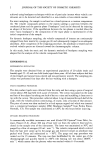
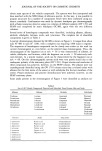
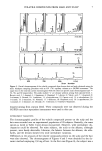
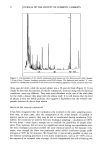
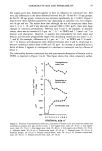
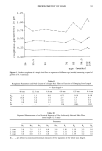
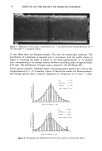
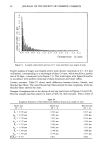
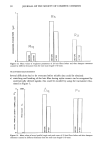
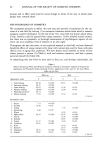
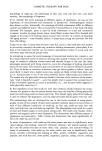
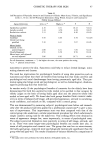
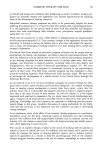
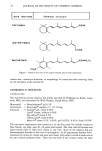
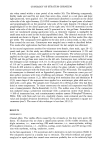
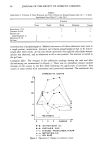
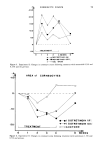
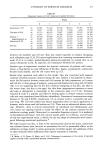
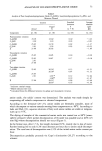
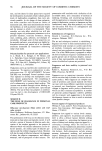
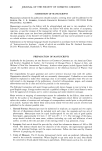
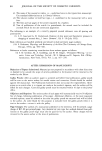
36 JOURNAL OF THE SOCIETY OF COSMETIC CHEMISTS 0.0 0.4 0.8 1.2 1.6 2.0 2.4 2.8 3.2 3.6 frequency 4.0 ( 1/ram) Figure 11. Averaged amplitudinal spectrum of 13 virgin hair fibers (scan length 40 mm). Fourier analysis of longer scan lengths yield a main distinct maximum at 0.1- 0.2 (per millimeter), corresponding to a wavelength of about 10 mm, which would be a growth rate of 28 days, a menstrual cycle (Figure 11). This would agree with Figure 8a and be in accordance with profiles consisting of sharp mountains and broad valleys. Cosmetic treatment. Table IV shows small differences between brown, blonde, and bleached hair fibers. The tested blonde hair fibers showed the least roughness, while the bleached fibers showed the most. Changes of roughness due to the drying of wet hair can be seen in Figures 12a and 12b. The hair samples had been placed in water of 30øC for three minutes. Then a series of Table IV Roughness Parameters of Hair Fibers From Different Strands (scan length 10 mm) Brown hair Blonde hair (N = 5) (N = 4) Bleached hair (N = 4) Rz = 9.970 •m 9.302 (ya z = 2.959 •m 2.083 Rp = 7.759 •m 7.635 (Yap = 2.517 •m 2.183 R s = 2.572 •m 2.264 (Ya• = 1.018 •m 0.603 Rq = 3.250 •xm 2.788 = 1 365 •m 0.750 (YRq ß [R•/Rq] = 0.791 0.812 .tm 11.547 •m .tm 2.940 •m .tm 8.536 •m .tm 3. 544 •m xm 3.026 •m xm 1. 153 •m xm 3.680 •m .tm 1.435 0.822

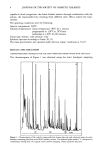
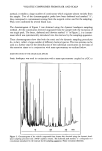
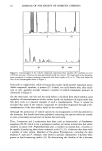
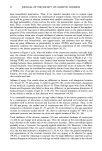
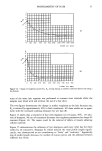
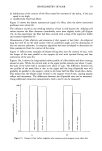
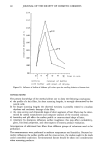
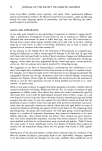
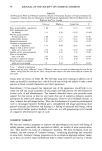
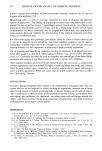
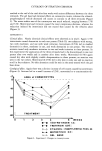
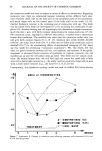
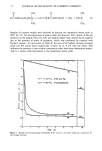
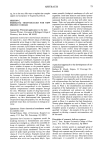
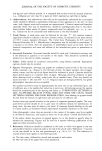
PROFILOMETRY OF HAIR 37 180 360 540 720 900 1080 1260 1440 1620 1800 time in sec a) 0 90 180 270 360 450 540 630 720 810 900 b) time in sec Figure 12. Change of roughness parameters, Rq, during drying at ambient condition (above) and using a fan (below). scans of the same hair segment was performed at constant time intervals while the samples were dried with and without the use of a hair drier. The two figures demonstrate the change in surface roughness as the hair becomes dry Rq is reduced by approximately 10% in both treatments. All these results are in agree- ment with the increased combing resistance for wet hair (8). Figure 13 shows that a treatment of hair with shampoo (in vitro assay, 30øC, 1% solu- tion of shampoo, 90 min of treatment) decreases the roughness parameters but keeps Pc constant (Figure 14). The reason could be the removal of debris or loosely adhering cellular material. Figure 15 demonstrates the influence of two shampoos used every other day for three weeks by 20 volunteers. Shampoo B, which reduced the total profile length signifi- cantly, was characterized as not contributing to "body" and "resilience." Apparently loss of profile length decreases the number of contact points and the adhesion between different hair fibers.
Purchased for the exclusive use of nofirst nolast (unknown)
From: SCC Media Library & Resource Center (library.scconline.org)