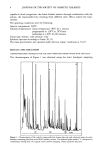
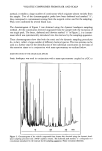
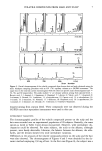
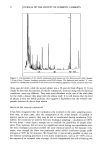
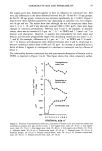
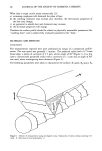
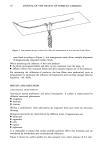
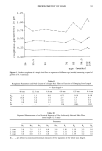
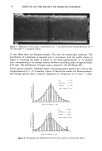
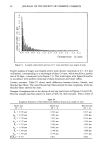
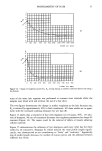
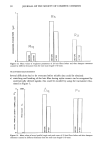
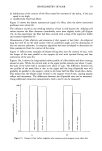
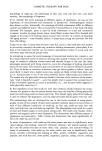
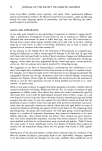
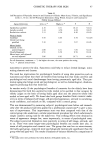
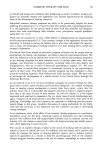
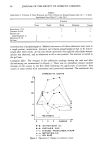
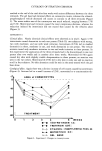
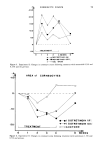
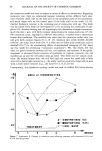
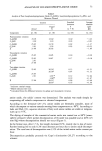
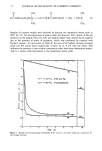
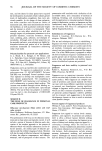
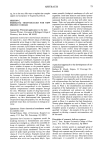
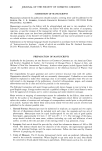
CORNEOCYTE SIZE AND PERMEABILITY 19 Sex (upper-outer arm, forehead) appears to have no influence on corneocyte sizeß Nor were any differences in the latter observed between the 20-30 and 45-55 age groups. In the 65-80 age group, corneocyte size increases significantly (p 0.001). Figure 2 depicts how these different parameters vary depending on anatomic site, but irrespec- tive of age and sex. The results show that although the size of corneocytes taken from sites 4, 5, 2, 1, 10, and 9 was relatively constant (980 to 1007 [•m2), there were large changes in cutaneous permeability. Between sites 9 and 4, for example, in absolute values, there was an increase of 2.6 gm ß m-2. h- • in TEWL and 7.7 nmol ß cm-2 in benzoic acid absorption. However, it appears that permeability for both water and benzoic acid becomes progressively larger with decreasing corneocyte size (sites 11, 6, 7, and 8). For example, differences of 4.3 gm ß m -2 ß h -• in TEWL and 17.8 nmol ß cm-2 in benzoic acid absorption were observed between sites 4 and 8, which had re- spective corneocyte surface areas of 990 and 555 [•m 2. An increase in permeability by a factor of about 2 appears to correspond to a decrease in corneocyte size by a factor of about 2. The relationship between corneocyte size and percutaneous absorption of benzoic acid or TEWL is depicted in Figure 3 (a,b). This figure shows that when corneocyte surface lO o •- 30 •, [ 20 ß •. '• lO E E 0 1000 75O 500 Transep •,•Penetration of ea i i i i , ! i i i i i 8 76114 5 2 I 1093 anatomic site n ø Figure 2. Evolution of transepidermal water loss, penetration of benzoic acid, and corneocyte surface area according to anatomic site, age, and sex in man. 1. Arm (upper-outer, male, 20-30 yr). 2. Arm (upper- outer, male, 45-55 yr). 3. Arm (upper-outer, male, 65-80 yr). 4. Arm (upper-outer, female, 20-30 yr). 5. Abdomen (male, 20-30 yr). 6. Postauricular (male, 20-30 yr). 7. Forehead (male, 20-30 yr). 8. Forehead (female, 20-30 yr). 9. Forearm (ventral-elbow, male, 20-30 yr). 10. Forearm (ventral-mid, male, 20-30 yr). ! 1. Forearm (ventral-wrist, male, 20-30 yr).

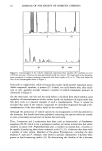
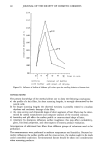
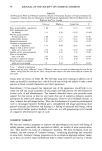
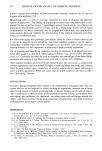
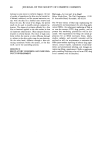
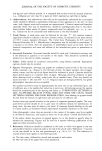
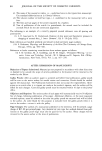
20 JOURNAL OF THE SOCIETY OF COSMETIC CHEMISTS area reaches a certain level (around 1000 Ixm2), it no longer appears to limit percuta- neous absorption and TEWL. On the contrary, when corneocyte surface area decreases, TEWL and percutaneous absorption increase, but only to a limit. Finally, except in the elderly (point no. 3), inward movement of a non-water-soluble compound such as ben- zoic acid and outward movement of water have the same type relationship to corneocyte size. Irrespective of anatomic site and sex, a linear relationship (r = 0.92, p 0.001) exists between total penetration of benzoic acid and TEWL (Figure 4). (Point no. 3 corresponds to subjects aged 65-80 measured on the upper-outer arm. This case is special and will be discussed. It was not taken into account in the calculation of the correlation coefficient). DISCUSSION CORNEOCYTE SIZE-SKIN PERMEABILITY RELATIONSHIP Influence ofanatomic site. The forehead and the postauricular region exhibit greater per- meability than the arm, the forearm, or the abdomen. Since the thickness and number of cell layers of the stratum corneum of all the sites involved in this study are similar (on average 12 Ixm and 18 cell layers) (19,20), the differences in permeability that we have observed have to be explained by additional structural and physicochemical criteria. Thus it is conceivable that the higher penetration through areas such as the forehead might be explained by an increase in transfollicular in preference to transepidermal absorption. However, how can one explain the large difference (a factor of 50 to 100) that exists in the number of sebaceous glands between the arm and the forehead (21,22) 11oo lOOO 900 800 700 600 5OO ,i. 6 10 20 30 5 10 Total penetration of benzoic acid within 4 days (nmol. cm 'z) Transepidermal water loss ( T. (•.W.L.) (gm.m -z.h 'l) Figure 3. Relationship between (A) percutaneous absorption of benzoic acid and (B) transepidermal water loss (TEWL) and corneocyte surface area according to anatomic site, age, and sex in man. 1. Arm (upper- outer, male, 20-30 yr). 2. Arm (upper-outer, male, 45-55 yr). 3. Arm (upper-outer, male, 65-80 yr). 4. Arm (upper-outer, female, 20-30 yr). 5. Abdomen (male, 20-30 yr). 6. Postauricular (male, 20-30 yr). 7. Forehead (male, 20-30 yr). 8. Forehead (female, 20-30 yr). 9. Forearm (ventral-elbow, male, 20-30 yr). 10. Forearm (ventral-mid, male, 20-30 yr). 11. Forearm (ventral-wrist, male, 20-30 yr). (C) according to Marks et al. (11).
Purchased for the exclusive use of nofirst nolast (unknown)
From: SCC Media Library & Resource Center (library.scconline.org)